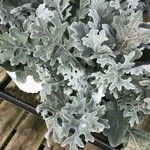
Senecio maritimus
Dusty miller · Silver ragwort
Description
Source: leafsnapJacobaea maritima, commonly known as silver ragwort, is a perennial plant species in the genus Jacobaea in the family Asteraceae, native to the Mediterranean region. It was formerly placed in the genus Senecio, and is still widely referred to as Senecio cineraria; see the list of synonyms (right) for other names. It is widely cultivated as an ornamental plant for its white, felt-like tomentose leaves; in horticultural use, it is also sometimes called dusty miller, a name shared with several other plants that also have silvery tomentose leaves, including Centaurea cineraria and Silene coronaria.
🌳 Although valued for its looks and long-standing medicinal use, dusty miller surprisingly acts as a natural detector. Like the famous coal-mine canaries, it warns of copper in its surroundings by changing the color of its leaves. Unlike other plants that deteriorate under metallic stress, dusty miller resiliently signals soil contamination.
🎭 Yield
Care Guide
💧 Water
☀️ Light Full sun
Dusty miller grows best with abundant sunlight, although reduced light does not always impede its development. It comes from areas known for strong sun, and a lack of light can cause weak growth and faded leaves. Too much sun, however, can lead to leaf scorch.
What are the sunlight requirements for Senecio maritimus?
Senecio maritimus, also known as Senecio maritimus, thrives in different sunlight conditions depending on the type. For full sun exposure, it requires above 6 hours of sunlight a day. For partial sun exposure, about 3-6 hours of sunlight a day is needed. It's important to observe the movement of sunlight through your garden to identify spots that offer a perfect balance of light and shade. This ensures the plants' well-being by meeting their specific sunlight requirements.
🌡️ Temperature 10–35°C
The native habitat of dusty miller is typically in areas where temperatures range from 50 to 95 ℉ (10 to 35 ℃). Its temperature tolerance lies within that range, with a preferred range of 50 to 80 ℉ (10 to 27 ℃). In colder seasons, placing it in a sheltered location can help it adjust to temperature changes and protect it from frost damage. In warmer seasons, offering light shade during the hottest part of the day can help prevent heat stress.
💨 Humidity
🪴 Soil 6-7
🌱 Fertilizer
Usually one fertilizer application in spring is enough for Dusty miller, though repeated feedings can maximize growth. Apply fertilizer every month to a month and a half. Fertilizing improves the leaves’ appearance and function, helping maintain uniform color and a healthy texture. It also promotes root development and nutrient uptake, supporting long-term plant health.
🪴 Pot & Repot 2-3 years
When repotting Dusty miller, choose a pot 1-2 inches (2.5–5.1 cm) larger with ample drainage. Use a well-draining potting mix. Repot in spring or fall, making sure the root ball is slightly below the rim of the flower pot. Water thoroughly after repotting and place it in a warm spot with indirect sunlight.
✂️ Pruning
Senecio maritimus features silvery leaves and vibrant yellow flowers. To keep this plant healthy and attractive, it's important to prune it in early spring. Start by removing any dead stems to stimulate growth and maintain its shape. This will also improve air circulation, reducing the risk of diseases and encouraging more blooms. Regular pruning will help ensure that the plant remains healthy and visually appealing.
🌿 Propagating
🐛 Diseases & pets
☠️ Toxicity
Characteristics
- Plant Type
- Herb
- Life Cycle
- Perennial
- Genus
- Senecio
- Family
- Asteraceae
- Hardiness Zone
- 6-9
- Mature Height
- 15 cm to 46 cm
- Mature Spread
- 15 cm to 46 cm
- Leaf Color
- Green, Silver
- Leaf Type
- Evergreen
- Flower Color
- Yellow, Gold
- Flower Size
- 2.54 cm to 7.62 cm
- Bloom Time
- Late spring, Early summer, Mid summer
- Planting Time
- Spring
- Harvest Time
- Summer
- Native Area
- Italy, Spain, France