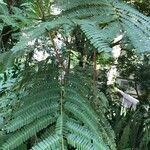
Senegalia caffra
Common hookthorn · Cat Thorn · Common Hook-thorn
Description
Source: leafsnapSenegalia caffra, commonly known as the Common Hook Thorn, is a tree species belonging to the Fabaceae family. Native to southern Africa, this tree thrives in diverse habitats such as savannas, woodlands, and grasslands. It can grow up to 15 meters tall and features a spreading crown with distinctive hooked thorns on its branches. The leaves of Senegalia caffra are bipinnate, with small leaflets arranged in pairs along the stem. The flowers are small and yellowish-white, blooming from August to November. The fruit is a flat pod containing several seeds. The Common Hook Thorn has a variety of uses, including firewood and charcoal production, thanks to its hard wood, which is also suitable for making furniture. Moreover, it possesses medicinal properties and is used to treat coughs, colds, and other respiratory ailments. Ecologically, Senegalia caffra is significant as it provides food for animals like giraffes, which feed on its leaves, and birds, which consume its seeds. Its deep root system helps prevent soil erosion by stabilizing the soil structure. In summary, Senegalia caffra is a vital species in southern Africa, offering ecological benefits and cultural value to local communities who depend on it for their livelihoods.
Care Guide
💧 Water Every 7 days
☀️ Light Full sun
Common hook-thorn comes from open habitats, like sunny meadows and forest edges, where light is plentiful. It does best in Full Sun but can also endure Partial Sun, adapting well to different light conditions.
🌡️ Temperature 20–37.8°C
Common hook-thorn comes from tropical areas, where the climate is generally warm and humid. Therefore, it is well-suited to high heat and moisture. It does not tolerate abrupt temperature shifts and prefers a steady thermal environment, so avoiding temperature swings indoors is important. It typically cannot withstand cold and needs warmer conditions to grow. If the surrounding temperature falls too low, the plant may stop growing or die.
💨 Humidity
🪴 Soil 6-8
🌱 Fertilizer
Providing fertilizer is essential for the care of Common hook-thorn. Consistent feeding throughout the growing season maintains the energy for its showy leaves and supports overall growth. Neglecting fertilization can lead to unhealthy foliage, reduced ornamental value, and stunted or weakened growth that is more likely to break.
🪴 Pot & Repot
✂️ Pruning
🌿 Propagating
🐛 Diseases & pets
☠️ Toxicity
Characteristics
- Plant Type
- Tree
- Life Cycle
- Perennial
- Genus
- Senegalia
- Family
- Leguminosae
- Hardiness Zone
- 9-11
- Mature Height
- 4.88 m to 14.94 m
- Mature Spread
- 3.96 m to 7.92 m
- Leaf Color
- Green, Dark Green
- Leaf Type
- Deciduous
- Flower Color
- White, Cream
- Flower Size
- 0.51 cm to 1.02 cm
- Bloom Time
- Mid fall, Late fall
- Planting Time
- Autumn, Winter
- Harvest Time
- Winter
- Native Area
- South Africa, Eswatini, Mozambique, Botswana