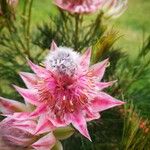
Serruria florida
Blushing bride · Pride of Franschhoek · Pride-of-Franschhoek · Serruria
Description
Source: leafsnapSerruria florida is a species of flowering plant in the family Proteaceae, endemic to South Africa. It is known by the common names of blushing bride or pride of Franschhoek.This species grows to between 0.8 and 1.5 metres in height and 0.5 metres in width. The leaves are fine and dissected and the flowers are white to pink and appear from July to October in its native range.It occurs in the Hottentots Holland Nature Reserve in the Cape ProvinceA well-drained position in full sun is preferred by this species, which tolerates dryness. Propagation is from cuttings or seed, although the latter can prove difficult.The species is cultivated for the cut flower trade and it is also grown as an ornamental plant.
Care Guide
💧 Water
The Blushing Bride plant originates from South Africa's fynbos region, where it thrives in Mediterranean climates characterized by wet winters and dry summers. This drought-tolerant plant requires watering every 2-3 weeks once it is established. As an evergreen, it retains its foliage year-round and benefits from watering patterns that mimic seasonal rainfall.
☀️ Light Full sun
The blushing bride does best in full sun. This need is essential for its healthy growth. Native to areas with abundant sunlight, it can tolerate intense exposure. However, too much sun can scorch the leaves, while too little can cause stunted growth.
What are the sunlight requirements for Blushing Bride?
Blushing Bride requires full sun exposure, which means it needs more than 6 hours of direct sunlight daily to thrive. It's vital to observe the movement of sunlight through your garden to find spots that offer a healthy balance of light and shade, ensuring the plant's well-being. Originating from sunny habitats, Blushing Bride can withstand strong sunlight, but too much or too little exposure may lead to scorched leaves or stunted growth, respectively.
Can artificial lighting be used for Blushing Bride, and how?
Yes, artificial lighting can be used for Blushing Bride, especially when natural sunlight is insufficient, like in winter or less sunny spaces. Adequate artificial lighting is crucial for optimal growth indoors. LED lights are recommended due to their ability to provide specific light wavelengths needed by plants. The intensity of light required varies depending on the plant's natural sunlight needs, with full sun plants needing 30-50W/sq ft, partial sun 20-30W/sq ft, and full shade 10-20W/sq ft. The artificial light should be placed 12-36 inches above the plant and be on for 8-12 hours per day to mimic natural daylight hours.
What symptoms indicate Blushing Bride is receiving insufficient light?
Symptoms of insufficient light in Blushing Bride include smaller new leaves, leggy or sparse growth, premature leaf drop, halted or no new growth, paler new leaves, and symptoms of overexposure like chlorosis, sunscald, leaf curling, wilting, and leaf scorching. These signs suggest that the plant is struggling with the current light conditions, whether due to too little or too much light.
What solutions can help Blushing Bride suffering from light issues?
To address light issues in Blushing Bride, for indoor plants, gradually move them to sunnier locations until they receive at least 6 hours of sunlight daily, use south-facing windows for maximum exposure, and consider artificial lighting for at least 8 hours a day if moving the plant isn't feasible. For outdoor plants, progressively acclimate them to sunnier spots to prevent sunburn. Removing obstructions or transplanting to sunnier locations can improve light exposure for ground plants. Note that parts of the plant affected by past light issues may not recover, but newly emerging growth should be healthy with improved light conditions.
🌡️ Temperature 20–35°C
Blushing bride grows best in environments with temperatures from 68 to 95 °F (20 to 35 ℃). Although it is a temperate woody plant, it favors warmer conditions. Seasonal adjustments to temperature may be needed to replicate its natural habitat.
What is the ideal temperature range for Blushing bride?
Blushing bride, with its scientific name Serruria florida, thrives in environments that maintain a temperature range between 68 to 95 °F (20 to 35 °C). This plant prefers warmer conditions characteristic of its temperate woody plant nature. To replicate its natural habitat, especially during varying seasons, it's crucial to adjust temperatures accordingly. It is particularly tolerant to heat, rather than cold, making it imperative to protect it from cooler temperatures.
How should Blushing bride be cared for in cold weather?
During cold weather, it's essential to take measures to protect Blushing bride from low temperatures. Since this plant flourishes in temperatures above 20°C and requires that it be kept above 5°C during winter, it is at risk when temperatures approach or fall below these thresholds. In the event of cold exposure, the leaves may show discoloration, turning lighter before gradually shifting to brown or black if frost damage occurs, accompanied by wilting and drooping. To manage frost damage, it's recommended to trim off affected parts and move the plant indoors to a warm spot, preferably near a south-facing window that provides ample sunlight while avoiding placement near heaters or air conditioners to prevent air dryness.
What should be done if Blushing bride is exposed to high temperatures?
Blushing bride should ideally be kept under temperatures below 95°F (35°C) during the hotter months. Exposure to temperatures above 105°F (41°C) can lead to the leaves lightening in color and increasing susceptibility to sunburn. If sunburn occurs, it's advisable to trim the sunburned and dried-up parts of the plant. To prevent further damage, relocate the plant to an area where it can receive shade during the peak sun hours of midday and afternoon. Additionally, maintaining soil moisture through watering in the morning and evening is key to helping the plant cope with high temperatures.
💨 Humidity
🪴 Soil 6-6
🌱 Fertilizer
The best time to fertilize a Blushing Bride is in early spring, as it breaks dormancy. This supports overall growth and the development of flowers. Feeding the plant improves foliage, stems, and branches, and encourages flowers that are large, vibrant, and long-lasting. It also helps move nutrients from the roots to the blooms and enhances the plant's health and resistance to disease.
🪴 Pot & Repot
✂️ Pruning
To maintain the shape of your blushing bride plant and encourage healthy growth, prune it in late spring after it has finished flowering. Begin by removing any dead stems. Then, cut back the flowering stems to two leaves to promote bushier growth. Be careful not to prune too heavily, as this plant grows from a central base and could be damaged. Regular pruning not only supports the plant's shape but also improves air circulation, reducing the risk of disease.
🌿 Propagating
🐛 Diseases & pets
☠️ Toxicity
Characteristics
- Plant Type
- Shrub
- Life Cycle
- Perennial
- Genus
- Serruria
- Family
- Proteaceae
- Hardiness Zone
- 10-10
- Mature Height
- 0.76 m to 1.52 m
- Mature Spread
- 49 cm
- Leaf Color
- Dark Green
- Leaf Type
- Evergreen
- Flower Color
- Pink
- Flower Size
- 3.05 cm to 5.08 cm
- Bloom Time
- Fall
- Planting Time
- Summer, Autumn
- Harvest Time
- Winter
- Native Area
- South Africa