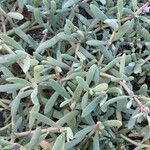
Sesuvium portulacastrum
خرفه ساحلی · Shoreline sea-purslane · Sea-purslane · Shore purslane · Shoreline seapurslane
Description
Source: leafsnapSesuvium portulacastrum, commonly known as sea purslane or shoreline purslane, is a succulent plant in the Aizoaceae family. This small, low-growing plant can reach up to 30 cm in height and features fleshy leaves that are either green or reddish. Native to coastal regions, it thrives on sandy beaches, salt marshes, and mudflats. Sea purslane has evolved to withstand its harsh coastal environment by tolerating high levels of soil salinity. It also has a deep root system, enabling it to endure drought conditions. During the summer months, the plant produces small pink flowers, which are followed by seed capsules containing numerous tiny seeds that are dispersed by wind and water. Historically, sea purslane has been used as a medicinal herb for its anti-inflammatory properties. It is also rich in antioxidants, contributing to overall health benefits. Aside from its medicinal uses, sea purslane is valued as an ornamental plant for its appealing foliage and resilience in challenging environments. Its low-growing nature makes it an excellent ground cover for sandy areas or rock gardens. In summary, Sesuvium portulacastrum is a fascinating succulent with unique adaptations that allow it to thrive in coastal habitats. It offers numerous benefits both medicinally and aesthetically.
🎭 Rest, Affection, Fortune
Care Guide
💧 Water Every 7 days
Shoreline purslane flourishes in well-drained, sandy soils found in saline coastal regions. As a succulent, it is extremely drought-tolerant and needs watering only once every three weeks. Ideal for xeriscaping and seaside gardens, this evergreen plant requires minimal additional watering, thanks to its exceptional ability to retain moisture.
☀️ Light Full sun
Shoreline purslane grows best with plenty of sunlight, reflecting the bright coastal environments it naturally occupies. It prefers full sun but can tolerate shadier sites, though its growth may be reduced. Either too much or too little light can cause discoloration or wilting.
What are the sunlight requirements for Shoreline purslane?
Shoreline purslane requires full sun, which means it needs above 6 hours of sunlight daily, but it can also tolerate partial sun, about 3-6 hours of sunlight. It's important to observe the movement of sunlight through your garden to find spots that provide the right balance of light and shade, ensuring the plant's well-being. In its native sun-drenched coastal habitats, shoreline purslane flourishes under generous sun exposure, although it can withstand less light. However, inadequate light might stunt its growth and lead to discoloration or wilting.
How can artificial lighting be used for indoor Shoreline purslane plants?
Indoor Shoreline purslane plants benefit from adequate artificial lighting, especially when natural sunlight is insufficient. LED lights are recommended for their ability to provide specific wavelengths needed by plants. For full sun plants, 30-50W per square foot is needed; partial sun plants require 20-30W per square foot, and full shade plants need 10-20W per square foot. The light source should be placed 12-36 inches above the plant, mimicking natural sunlight, and typically, plants require 8-12 hours of artificial light per day.
What are the signs of inadequate lighting for Shoreline purslane?
Symptoms of inadequate lighting in Shoreline purslane include smaller new leaves, leggy or sparse growth, faster leaf drop, slower or halted new growth, leaves developing irregular color patterns or appearing pale, chlorosis (leaves turning yellow), sunscald, leaf curling, wilting, and leaf scorching. These signs indicate that the plant isn't receiving the optimal amount of sunlight it needs for healthy growth and photosynthesis.
How do you manage Shoreline purslane if it is not getting enough sunlight?
To manage Shoreline purslane not getting enough sunlight, gradually move the plant to a sunnier location to receive at least 6 hours of direct sunlight daily. For indoor plants that are large or not easily movable, use a desk or ceiling lamp for at least 8 hours daily or invest in professional plant grow lights. Outdoors, gradually adapt your plants to more sunlight without sudden changes to prevent sunburn. If plants are ground-placed and blocked by obstructions, consider pruning or transplanting to sunnier areas. Note that parts of the plant affected by insufficient light may not recover, but new growth will be healthy after increasing light exposure.
🌡️ Temperature 20–37.8°C
Shoreline purslane comes from tropical areas, where the climate is generally warm and humid. As a result, it is adapted to high heat and moisture. It is sensitive to sudden temperature changes and prefers a steady temperature, so avoiding indoor temperature fluctuations is important. It typically does not tolerate cold and needs warmer conditions to grow. If the surrounding temperature drops too low, the plant may stop growing or even die.
What is Shoreline purslane?
Shoreline purslane, known botanically as Sesuvium portulacastrum, is a plant species recognized for its unique characteristics and habitat. However, further details regarding its essentials, symptoms, and additional aspects are not provided.
💨 Humidity high (>60%)
This plant needs special care because it loves high humidity levels of 60-80% or more. The best way to achieve this is by placing a humidifier near the plant. Daily misting is also essential! Make sure the room has good ventilation.
🪴 Soil
🌱 Fertilizer
Most succulents, such as shoreline purslane, flourish in nutrient-poor environments and usually don't need any fertilization. If you do wish to fertilize, you can apply a slow-release fertilizer in early summer. Be sure to avoid fertilizing during dormancy, as too many nutrients can be harmful to the plant's growth.
🪴 Pot & Repot Every 12 months
✂️ Pruning
Shoreline purslane is a hardy ground cover with succulent leaves that thrives in salty environments. Pruning it from early to late spring encourages denser growth, removes damaged parts, and controls its spread, which improves its health and appearance. These qualities make shoreline purslane an excellent choice for coastal landscapes.
🌿 Propagating
🐛 Diseases & pets
☠️ Toxicity
Characteristics
- Plant Type
- Herb
- Life Cycle
- Perennial
- Genus
- Sesuvium
- Family
- Aizoaceae
- Hardiness Zone
- 9
- Mature Height
- 15 cm to 30 cm
- Mature Spread
- 0.3 m to 1.22 m
- Leaf Color
- Green, Yellow, Red
- Leaf Type
- Evergreen
- Flower Color
- Pink
- Flower Size
- 2.03 cm
- Bloom Time
- All year round
- Planting Time
- Spring, Summer
- Harvest Time
- All year round
- Native Area
- Sri Lanka, Somalia, Belize, India, Angola, Mexico, Guatemala, Vanuatu, Namibia, Madagascar, Dominican Republic, Morocco, Kenya, Guinea-Bissau, Tanzania, Jamaica, Fiji, Uruguay, Benin, Cuba, Paraguay, Sierra Leone, Indonesia, Cambodia, Haiti, Cameroon, Mozambique, Venezuela, Argentina, Brazil, Ghana, Suriname, Chile, Tunisia, Honduras, Georgia, Peru, Philippines, Mauritania, Bangladesh, Guinea, China, Colombia, Bahamas, Bolivia, Vietnam, Myanmar, Japan, Guyana, El Salvador, Senegal, Nicaragua, Costa Rica, Ecuador, Côte d'Ivoire, Gambia, Thailand, Gabon