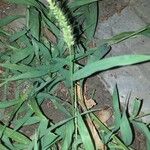
Setaria verticillata
ارزنی چرخه ای · Bristle Pigeon Grass · Bristly Foxtail · Bur Bristle Grass · Bur Grass
Description
Source: leafsnapSetaria verticillata, commonly known as bristly foxtail or green bristlegrass, is a species of grass in the Poaceae family. This annual plant can grow up to 1 meter tall and features a cylindrical stem with alternate leaves. The leaves are narrow with pointed tips and rough edges. During the summer months, the plant produces small, greenish-white flowers in clusters at the ends of its stems. These flowers are distinctive due to their long bristles. Native to North America, bristly foxtail has spread to many parts of the world because of its adaptability to various environments. It can be found in fields, meadows, roadsides, and disturbed areas. This plant serves as an important food source for wildlife such as birds and small mammals. However, it is also often considered a weed because it competes with other plants for resources like water and nutrients. Overall, Setaria verticillata is a notable species of grass that plays a significant role in various ecosystems while also being viewed as problematic by some due to its invasive nature.
🌳 The seeds of hooked bristlegrass have a particular adaptation: tiny hooks that enable them to attach to the fur of passing animals and to human clothing. This feature boosts the plant’s ability to disperse seeds over broad distances, helping it establish in a range of habitats. Although often considered a nuisance, this persistent grip could inspire the development of new adhesives or bioinspired materials for technology and textiles.
Care Guide
💧 Water Every 7 days
Hooked bristlegrass is native to temperate regions and thrives with a moderate water supply. It prefers consistent moisture and needs to be watered weekly to maintain optimal hydration. When grown outdoors, hooked bristlegrass flourishes in full sun and requires well-drained soil to protect its roots from damage due to excess rain.
What should I do if I give my Hooked bristlegrass too much or too little water?
Proper watering is essential for the health of this beautiful ornamental grass. When planted in the ground, watering issues can be resolved. However, in a container, excessive or insufficient water can quickly lead to the demise of Hooked bristlegrass. When Hooked bristlegrass doesn't receive the appropriate amount of water, its growth may be stunted. Overwatering can result in yellow leaves with brown tips, while underwatering can cause drooping leaves, weak seed head production, and browning of the leaves. If you suspect that your Hooked bristlegrass has been watered improperly, the first step is to determine whether it is receiving too much or too little water. If it's receiving too much water, stop watering it immediately. It may take a few weeks for heavy soils to dry out, so patience is necessary. Once you see new growth, check the soil moisture and decide whether it requires more water or not. On the other hand, if the grass is receiving too little water, the solution is simple: provide it with a good, deep drink and observe if it regains its vitality. Remember, it's always better to water Hooked bristlegrass deeply and less frequently. Deep watering encourages the growth of deep roots, enhancing drought resistance and reducing watering-related issues.
How frequently do I need to water my Hooked bristlegrass?
The watering needs of Hooked bristlegrass vary depending on where it is planted. Generally, watering every week is recommended. In hot climates, watering once or twice a week during the summer may be necessary. In moderate climates, watering once every seven days or more may be sufficient. Grass in containers typically need more frequent watering than those in the ground. However, the location also plays a role, as shaded grasses require less frequent watering than grasses in the ground. It's important to water Hooked bristlegrass only when the soil is dry. If you're unsure when to water, there are a few signs to look for. Checking the soil moisture by pressing your finger a couple of inches into the soil is one method. For potted grass, you can also weigh the grass or notice when the pot feels light from lack of water. When the roots lack sufficient water, the grass blades may appear folded and thinner than usual. Despite its drought tolerance, regular and deep waterings will result in a beautiful color. In the wild, Hooked bristlegrass grows in open scrubland, experiencing extreme heat, bright sun, and intermittent rain. Although it is drought-resistant, it still requires care and attention. Consistent watering is recommended for optimal growth. When newly planted, Hooked bristlegrass needs more frequent watering until it establishes deep roots. For potted grass, the soil dries out quickly, especially if exposed to hot, direct sun. Checking the soil every 3 to 4 days and watering when it feels dry is advised. In-ground Hooked bristlegrass generally requires less watering, but this depends on the soil type. Clay soil holds water for a long time and may feel dry at the surface while still retaining moisture below ground. Sandy soils that drain quickly will need more frequent watering.
What do I need to watch out for when I water my Hooked bristlegrass in different seasons, climates, or during different stages of growth?
To determine if you are watering enough for your grasses, observe their growth rate. Hooked bristlegrass is known to double in size within a year, especially during the hottest months. If the weather is hot but the grass is not growing vigorously, you may need to adjust your watering schedule. In winter, you may only need to water once a month, but it’s still important to check the soil for moisture. Keep in mind that during the warmest months when the grass is actively growing, it will require more water than usual. However, during winter and cooler months, the water needs will be significantly reduced. Remember that for Hooked bristlegrass, it is crucial to allow the soil to completely dry out before watering again.
☀️ Light Full sun
Hooked bristlegrass favors a moderate amount of light, similar to its native setting where it gets filtered or dappled light through taller plants. Excessive sunlight can stress the plant, while too little light hampers its growth. Providing an intermediate level of light helps maintain healthy development throughout its life cycle.
What are the sunlight requirements for Hooked Bristlegrass?
Hooked Bristlegrass requires a moderate amount of sunlight, about 3-6 hours of sunlight per day, to mimic its native habitat's conditions of filtered light through taller vegetation. It's important to observe how sunlight moves through your garden to ensure plants get a balance of light and shade. Too much sunlight can stress the plant, and too little can hinder its growth. For indoor plants, artificial lighting is a solution when natural sunlight is insufficient, with recommendations for the type of light, distance, and duration to simulate natural conditions effectively.
What are some common symptoms of light deficiency or excess in Hooked Bristlegrass?
Symptoms of light deficiency in Hooked Bristlegrass include smaller new leaves, leggy or sparse growth, faster leaf drop, slower or no new growth, lighter-colored new leaves, and overall weak appearance. Symptoms of too much light include chlorosis (leaves turning yellow due to loss of chlorophyll), sunscald, leaf curling to minimize sunlight exposure, wilting from too much water loss, and leaf scorching. These symptoms underscore the importance of providing the right amount of light.
How can I manage light conditions for my Hooked Bristlegrass?
To manage light conditions for Hooked Bristlegrass, it's recommended to gradually adapt the plant to changing light conditions by moving it to sunnier spots each week until it receives the optimal 3-6 hours of direct sunlight daily. For indoor plants, consider using desk lamps, ceiling lamps, or professional grow lights for at least 8 hours a day. Outdoors, ensure gradual exposure to sunlight to prevent sunburn. If obstruction is an issue, prune obstructive branches or consider transplanting to a sunnier location, especially during the plant's dormant period for minimal stress.
🌡️ Temperature 5–25°C
Hooked bristlegrass is naturally found in habitats with temperatures ranging from 68 to 95°F (20 to 35°C). It is adaptable but grows best when those conditions are maintained. For optimal seasonal growth, try matching its environment to that temperature range.
What is the ideal temperature range for Hooked bristlegrass?
Hooked bristlegrass naturally thrives in environments where the temperature ranges between 68 to 95°F (20 to 35°C). This adaptable plant grows best when these specific thermal conditions are maintained, which should be considered when aligning its surroundings across different seasons for optimal growth. Despite its adaptability, maintaining this temperature range helps ensure the plant thrives.
How cold-tolerant is Hooked bristlegrass?
Hooked bristlegrass exhibits a high tolerance to cold temperatures and does not require additional frost protection measures during the winter months. It is capable of withstanding winter conditions without additional care. However, to help the plant manage through winter and early spring, it is recommended to water the plant generously before the first freeze of autumn. This ensures the soil around the plant remains moist when it enters a frozen state, thereby preventing drought and water scarcity.
What should be done if the winter temperature falls below -25°C for Hooked bristlegrass?
Although Hooked bristlegrass is extremely cold-tolerant, maintaining winter temperatures above -25°C is crucial. If temperatures drop below this threshold, there may not be any noticeable changes during the winter. However, a decrease in sprouting, or in some cases, no sprouting at all might occur during springtime. In such instances, it is recommended to remove any parts of the plant that have failed to sprout come spring.
How does Hooked bristlegrass react to high temperatures, and what are the recommended solutions?
Hooked bristlegrass does not tolerate high temperatures well. When exposed to temperatures exceeding 35°C, its growth may halt, and the plant becomes more susceptible to rot. To mitigate these effects, it's advisable to trim away any sunburned and dried-up parts. Additionally, moving the plant to a location that offers shade during the midday and afternoon sun, or utilizing a shade cloth, can be beneficial. It's also recommended to water the plant in the morning and evening to keep the soil moist and promote healthier conditions.
💨 Humidity
🪴 Soil 6-7
🌱 Fertilizer
🪴 Pot & Repot
✂️ Pruning
🌿 Propagating
🐛 Diseases & pets
☠️ Toxicity
Characteristics
- Plant Type
- Grass
- Life Cycle
- Annual
- Genus
- Setaria
- Family
- Poaceae
- Hardiness Zone
- 5
- Mature Height
- 10 cm to 91 cm
- Mature Spread
- 20 cm to 49 cm
- Leaf Color
- Light Green
- Leaf Type
- Semi-evergreen
- Flower Color
- Yellow, Green, Brown
- Flower Size
- 0.76 cm
- Bloom Time
- Early summer, Mid summer
- Planting Time
- Spring, Summer, Autumn
- Harvest Time
- Mid summer
- Native Area
- Burkina Faso, Libya, Sri Lanka, India, United Arab Emirates, Slovakia, Madagascar, Montenegro, Pakistan, Nigeria, Morocco, Belarus, Uganda, Tanzania, Benin, Germany, Cameroon, Mozambique, Ethiopia, Romania, Belgium, Netherlands, Portugal, Saudi Arabia, Malawi, Tunisia, Philippines, Bulgaria, Bangladesh, Laos, Cyprus, Ukraine, Chad, China, Lebanon, Afghanistan, Syria, Italy, Kazakhstan, Japan, Togo, Senegal, Eswatini, Iran, Côte d'Ivoire, Ecuador, Azerbaijan, Kuwait, Gambia, Congo (DRC), Djibouti, Somalia, Egypt, Angola, Austria, Lesotho, Namibia, Rwanda, Eritrea, Kenya, Niger, Zimbabwe, Uzbekistan, Russia, Mali, Iraq, Cambodia, Burundi, Oman, Ghana, Qatar, Botswana, France, Nepal, Tajikistan, Czech Republic, South Africa, Sudan, Mauritania, Armenia, Poland, Zambia, Greece, Serbia, Switzerland, Vietnam, Myanmar, Albania, Algeria, Hungary, Turkmenistan