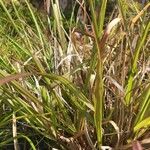
Setaria viridis
Bristlegrass · Foxtail · Green Bristle-grass · Green Bristlegrass · Green Bristol-grass
Description
Source: leafsnapSetaria viridis is a species of grass known by many common names, including green foxtail, green bristlegrass, and wild foxtail millet. It is sometimes considered a subspecies of Setaria italica. It is native to Eurasia, but it is known on most continents as an introduced species and is closely related to Setaria faberi, a noxious weed. It is a hardy grass which grows in many types of urban, cultivated, and disturbed habitat, including vacant lots, sidewalks, railroads, lawns, and at the margins of fields. It is the wild antecedent of the crop foxtail millet. This is an annual grass with decumbent or erect stems growing up to a meter long, and known to reach two meters or more at times. The leaf blades are up to 40 centimeters long and 2.5 wide and glabrous. The inflorescence is a dense, compact, spikelike panicle up to 20 centimeters long, growing erect or sometimes nodding at the tip only. Spikelets are 1.8–2.2 mm long. Each is subtended by up to three stiff bristles. Its fertile lemmas are finely cross-wrinkled. Setaria viridis is often confused with S. faberi, (Chinese or Giant Foxtail), which has sparse, soft hairs on the leaves and a nodding inflorescence. Setaria viridis is closely related to S. italica (Foxtail Millet), which has larger spikelets about 3 mm long and usually smooth, shiny upper lemmas. Foxtail Millet was cultivated in China by 2700 BC and during the Stone Age in Europe. Setaria viridis has been proposed as a model to study C4 photosynthesis and related bioenergy grasses. It has a short life cycle (6–8 weeks), is transformable and is currently being sequenced. Genetic resources are currently being developed by a number of groups. A method to break the prolonged seed dormancy has been discovered recently and all these could contribute towards making S. viridis a choice monocot genetic model system.
🌳 Green foxtail fulfills two roles: it is an important model in experimental biology and a candidate for biofuel. Its well-mapped genes and adaptability make it valuable for plant research. Its high efficiency in converting sunlight into energy makes it a practical, environmentally friendly fuel option. Green foxtail can also reveal copper in soil, serving as a bioindicator of metal contamination.
🎭 Psychic abilities, protection. It represents food, concealment and resilience.
Care Guide
💧 Water Every 7 days
Green foxtail is native to temperate regions and thrives in environments with moderate moisture levels. While it can withstand short periods of dryness, it requires weekly watering. During the growing season, it's important to monitor it closely to avoid water stress. This care routine reflects the balanced rainfall patterns of its natural habitat.
What do I do if I give my Green foxtail too much or too little water?
Proper watering is essential for the optimal growth of this beautiful ornamental grass. When planted in the ground, any watering issues can be resolved. However, in a container, excessive or insufficient water can quickly kill the Green foxtail. Insufficient water can cause it to cease growing, while overwatering can lead to yellow leaves with brown tips. Underwatering can result in drooping leaves, weak seed head production, and browned leaves. To address improper watering, first determine whether the problem is overwatering or underwatering. If overwatering is the issue, immediately cease watering and allow time for the soil to dry. Test the soil for moisture when new growth appears to determine whether additional water is necessary. If underwatering is the problem, simply provide a deep drink to the grass and observe if it rebounds. Keep in mind that watering deeply is always preferable to frequent shallow waterings. This promotes deep root growth, making the grass more resilient to drought and less susceptible to watering-related issues.
How much should I water my Green foxtail?
The watering needs of Green foxtail will vary depending on its location. Generally, watering should occur once a week. In hot climates, watering once or twice a week during the summer may be necessary. In moderate climates, watering every seven days or more may be enough. Grass in containers usually needs more frequent watering than grasses planted in the ground. The location also plays a role, as shaded grasses require less frequent watering than grasses planted in the ground. Water Green foxtail only when the soil is dry. To determine if the soil is dry, press your finger a couple of inches into the soil. For potted grass, you can weigh the grass or feel if the pot is light. Lack of water may cause folded and thin blades. Despite its drought tolerance, regular, deep watering will result in vibrant color. Even though Green foxtail can handle harsh and dry conditions, consistent water is best for its overall health. When first planted, it will need more frequent watering until deep roots have been established. For potted Green foxtail, the soil may dry out quickly, especially if the pot is in direct sun for extended periods. Test the soil every 3 to 4 days and water when it feels dry. Green foxtail planted in the ground generally needs less watering, but this depends on the type of soil. Clay soil holds water longer and may feel dry at the surface while still retaining moisture underneath. Sandy soils that drain quickly will require more frequent watering.
What should I pay attention to when I water my Green foxtail at different times of the year, in different weather conditions, or when it's growing differently?
Determining if you are watering enough can be done by observing the growth rate of your grass. For instance, green foxtail tends to double in size during the hottest months of the year. If the weather is hot but the grass is not growing vigorously, it may be necessary to adjust the watering schedule. In winter, watering once a month might be sufficient, but checking the soil's moisture level is still recommended. During the growth cycle in warmer months, the grass will require increased watering, while the demand for water significantly decreases during winter and cooler months. It is crucial to note that the soil for green foxtail should always dry out completely before providing additional water.
☀️ Light Full sun
Green foxtail generally thrives in the unobstructed sunlight, but it can also sustain in areas with less sunlight. Its evolutionary roots in open, sunlit environments contribute to its critical requirement for intense light to maintain proper growth. Extended periods of shade or long durations without sunlight could obstruct its growth or even damage it.
What are the sunlight requirements for Green Foxtail?
Green Foxtail thrives best in full sun conditions, requiring above 6 hours of sunlight per day. However, it can also tolerate partial sun, needing about 3-6 hours of sunlight daily. Observing how sunlight moves through your garden helps in choosing the right spots that offer a perfect balance of light and shade, ensuring the plants' well-being.
How crucial is sunlight for the growth of Green Foxtail?
Sunlight is essential for the healthy growth of Green Foxtail, a plant that naturally flourishes under the unobscured rays of the sun but can also adapt to lesser light conditions. Originating from open, sunny habitats, Green Foxtail has a strong requirement for light. Insufficient sunlight can lead to hindered growth or potential harm, highlighting the importance of adequate lighting, whether natural or artificial, especially in conditions where sunlight is limited.
How can artificial lighting support indoor Green Foxtail plants?
Indoor plants like Green Foxtail require adequate lighting for optimal growth, especially when natural sunlight is insufficient, such as in winter or less sunny locations. Artificial lights, including LED lights that can be customized to provide specific wavelengths, offer a vital solution. For a healthy growth indoor, full sun plants need 30-50W/sq ft of artificial light, partial sun plants require 20-30W/sq ft, and full shade plants benefit from 10-20W/sq ft. The light source should be placed 12-36 inches above the plant, mimicking natural sunlight's intensity and duration, generally needing 8-12 hours of light per day.
What signs indicate a Green Foxtail is receiving inadequate light?
When grown indoors without sufficient light, Green Foxtail may exhibit symptoms such as smaller new leaves, leggy or sparse growth, premature leaf drop, halted growth, or lighter-colored new leaves. These signs indicate a deficiency in light, affecting the plant's chlorophyll production and overall health. Conditions like chlorosis, sunscald, leaf curling, wilting, and leaf scorching mainly arise from inappropriate light exposure, and are crucial indicators of the need for more light or protection from excessive sunlight for outdoor plants.
What strategies can improve light conditions for Green Foxtail?
To ensure optimal growth for Green Foxtail, gradually adjusting the plant to receive at least 6 hours of direct sunlight daily is key, especially for indoor settings, where moving the plant closer to a south-facing window or using artificial light to supplement natural sunlight can greatly benefit the plant. For outdoor plants, finding the best sunlight spot is crucial, accomplished by gradually relocating plants to sunnier locations, avoiding abrupt changes that could lead to sunburn. Additionally, reducing obstructions like overhanging branches and considering transplantation during dormant periods for small plants can significantly improve sunlight access, contributing to the plant's health and growth.
🌡️ Temperature 5–35°C
The green foxtail thrives best in areas with a moderate temperature range, ideally between 68 and 95°F (20 to 35℃). Ensuring these temperature conditions throughout the year is paramount for its optimum growth. It is a plant native to moderately warm habitats.
What is the ideal temperature range for the growth of Green Foxtail?
Green Foxtail, scientifically known as Setaria viridis, thrives best in environments that offer moderate warmth, ideally between 68 to 95 °F (20 to 35 °C). For optimal growth, it is crucial to maintain these temperature conditions throughout the year. Despite its strong cold resistance, ensuring the plant remains within this temperature bracket enhances its development.
How should Green Foxtail be protected during cold winters?
Green Foxtail is noted for its strong cold resistance, and special frost protection measures are not usually necessary during winter. However, in regions where winter temperatures are expected to plummet below -25°C, it's important to provide extra protection to the plant. Covering Green Foxtail with materials like soil or straw can help. Additionally, an abundant watering before the first autumn freeze, ensuring the soil stays moist and becomes frozen, is advised to prevent drought and water scarcity during winter and early spring.
What symptoms indicate Green Foxtail is experiencing low temperatures and how can it be managed?
Green Foxtail exhibits strong cold tolerance and generally thrives when temperatures are above 20°C. If winter temperatures drop below 0°C, the plant may withstand the cold, but a decrease in sprouting or absence of sprouting might occur if temperatures fall below -25°C. The solution in spring for any potential damage is to remove parts of the plant that have failed to sprout, allowing for rejuvenation and new growth.
How does high temperature affect Green Foxtail and what are the solutions?
During the summer, if temperatures soar above 35°C, Green Foxtail may show signs of stress; its leaves can become lighter, prone to curling, and susceptible to sunburn. In severe cases, the plant might wilt and become dry. To manage these symptoms, trim away the sunburned and dried-up parts of the plant. Relocating the plant to a shaded spot, especially shielding it from the midday and afternoon sun, or using a shade cloth can help. Additionally, watering the plant in the morning and evening to keep the soil moist is beneficial.
💨 Humidity dry (<40%)
This plant prefers dry conditions, so don't mist it. However, watering it less often can also thrive in higher humidity.
🪴 Soil 5-7
🌱 Fertilizer
🪴 Pot & Repot
✂️ Pruning
🌿 Propagating
🐛 Diseases & pets
☠️ Toxicity
Characteristics
- Plant Type
- Grass
- Life Cycle
- Annual
- Genus
- Setaria
- Family
- Poaceae
- Hardiness Zone
- 5-10
- Mature Height
- 10 cm to 91 cm
- Mature Spread
- 30 cm
- Leaf Color
- Green, Blue
- Leaf Type
- Deciduous
- Flower Color
- Green, White, Brown
- Flower Size
- 0.20 cm to 0.25 cm
- Bloom Time
- Late spring, Early summer, Mid summer
- Planting Time
- Spring
- Harvest Time
- Mid summer
- Native Area
- Libya, Egypt, Turkey, Austria, Pakistan, Morocco, Niger, Uzbekistan, Russia, Iraq, Germany, Indonesia, Cambodia, Oman, Romania, Belgium, Portugal, Nepal, Saudi Arabia, Netherlands, France, Tunisia, Philippines, Sudan, Mauritania, Cyprus, Poland, Turkmenistan, Greece, Bulgaria, Bangladesh, Ukraine, Chad, China, Afghanistan, Italy, Kazakhstan, Spain, Switzerland, Vietnam, Myanmar, Mongolia, Israel, Japan, Iran, Albania, Algeria, Hungary, Kuwait, Thailand