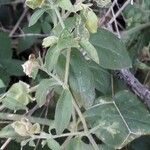
Silene baccifera
Berry catchfly
Description
Source: leafsnapSilene baccifera, commonly known as the Currant Catchfly, is a perennial herbaceous plant belonging to the Caryophyllaceae family. Native to Europe and Asia, it thrives in a variety of habitats including meadows, rocky slopes, and forests. The plant can grow up to 30 cm in height and features a basal rosette of lanceolate or ovate leaves with entire margins. Its erect, branched stem bears small white or pink flowers that bloom from June to August. The fruit of Silene baccifera is a small, berry-like capsule containing numerous seeds. These seeds are dispersed by wind or water. For centuries, Silene baccifera has been used for its anti-inflammatory properties in medicinal applications. Additionally, its attractive flowers have made it a favored ornamental plant in gardens. In summary, Silene baccifera is a fascinating perennial herbaceous plant found in diverse habitats across Europe and Asia. Its medicinal properties and ornamental appeal make it both useful and beautiful in various contexts.
Care Guide
💧 Water Every 7 days
The Berry catchfly thrives in moderate water conditions and benefits from weekly watering to stay healthy. It prefers well-drained soil to prevent waterlogging. This evergreen species is typically grown outdoors and originates from regions with balanced rainfall, which helps it maintain optimal moisture levels.
☀️ Light Full sun
Berry catchfly is a sun-loving perennial herbaceous plant that originates in open habitats, commonly thriving in meadows and grasslands. It prefers full sun but can also tolerate partial sun conditions.
🌡️ Temperature 5–35°C
Berry catchfly can tolerate a wide range of temperatures, but its range may still be restricted by particular combinations of moisture and heat. It does best in warm summer climates with sufficient rainfall or watering. Extended periods of cloudy, rainy weather, as well as extended high temperatures, can raise the chance of Berry catchfly dying. In winter, protecting it from cold can increase the plant's survival rate.
💨 Humidity
🪴 Soil 6-8
🌱 Fertilizer
A single application of fertilizer in spring is generally adequate for Berry catchfly, though multiple feedings can enhance growth. Fertilize every month to month and a half. Fertilization improves the appearance and function of the leaves, helping maintain even color and a healthy texture. It also encourages root development and nutrient uptake, supporting the plant's long-term health.
🪴 Pot & Repot
✂️ Pruning
Berry catchfly produces attractive, berry-like fruits and delicate flowers. For optimal growth, prune in early to late spring to remove dead stems and shape the plant. This encourages healthy growth, abundant flowering, and reduces the risk of disease. Regular maintenance enhances its ornamental appeal and vigor.
🌿 Propagating
🐛 Diseases & pets
☠️ Toxicity
Characteristics
- Plant Type
- Herb
- Life Cycle
- Perennial
- Genus
- Silene
- Family
- Caryophyllaceae
- Hardiness Zone
- 5-9
- Mature Height
- 1.22 m
- Mature Spread
- 61 cm
- Leaf Color
- Green
- Leaf Type
- Deciduous
- Flower Color
- White
- Flower Size
- 1.78 cm
- Bloom Time
- Summer
- Planting Time
- Spring, Summer
- Harvest Time
- Late summer, Early fall, Mid fall
- Native Area
- Turkey, India, Austria, Slovakia, Pakistan, Slovenia, Croatia, Belarus, Russia, Iraq, Germany, Koppen, South Korea, Latvia, Romania, Belgium, Portugal, Netherlands, France, Czech Republic, Bulgaria, Armenia, Poland, Greece, Ukraine, Lebanon, Serbia, Lithuania, China, Afghanistan, Italy, Kazakhstan, Spain, Switzerland, Vietnam, Myanmar, Japan, Bhutan, Azerbaijan, United Kingdom, Hungary, Algeria