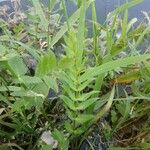
Sium latifolium
Great water-parsnip · Greater water-parsnip · Wideleaf waterparsnip · Broad-leaf water parsnip · Water Parsnip
Description
Source: leafsnapSium latifolium is a species of flowering plant in the family Apiaceae known by the common names great water-parsnip, greater water-parsnip, and wideleaf waterparsnip. It is native to much of Europe, Kazakhstan, and Siberia.This plant grows in wet habitat such as swamps and lakeshores, sometimes in the water. It is a perennial herb with a hollow, grooved stem up to 2 meters tall. The herbage is green and hairless. The leaves are up to 30 centimeters long with blades borne on hollow petioles that clasp the stem at their bases. The inflorescence is an umbel of white flowers.When eaten by dairy cows, the plant tends to imbue their milk with an unpleasant taste.
Care Guide
💧 Water
Greater water parsnip flourishes in damp environments and needs weekly watering because of its high water demands. As a herbaceous perennial native to wetlands, it thrives with plentiful rainfall during the growing season and is sensitive to drought conditions.
How should I water my Greater water parsnip?
To properly water the Greater water parsnip, it is recommended to use filtered water at room temperature. Tap water may contain harmful particles, so filtering it is preferable. The water should be at room temperature or slightly warmer to avoid shocking the plant, as it naturally thrives in warm environments. It's best to avoid overhead watering to prevent foliage issues. Instead, apply the filtered room temperature water directly to the soil until it is completely soaked. This helps moisten the roots and aids in their expansion through the soil to collect necessary nutrients.
What should I do if I give my Greater water parsnip too much or too little water?
Overwatering and underwatering can harm your Greater water parsnip, but overwatering is more common and can cause wilting, yellowing, and diseases like root rot. Underwatering is less common, but can cause brittle, brown leaves. It's important to recognize signs of overwatering early to prevent irreversible damage. Reduce watering and check the soil's drainage if overwatering is detected. To fix underwatering, water more regularly until signs improve.
How frequently should I give water to my Greater water parsnip?
If your Greater water parsnip is in a pot, the most precise way to determine if it needs water is by checking the soil with your finger. If the top two to three inches of soil are dry, then it's time to add water. If you are growing your Greater water parsnip outdoors in the ground, you can use the same method to test the soil. When the top few inches of soil have dried out, it means it's time to water. In the spring and early fall, watering once a week is usually sufficient. However, during extremely hot weather, you may need to water the plant twice or more per week. Nevertheless, mature and well-established Greater water parsnips have an impressive ability to tolerate drought.
How much water does my Greater water parsnip require?
To properly water your Greater water parsnip, don't hold back on the amount of water you provide. To start, make sure the top two to three inches of soil are dry, and then give it a thorough watering. Make sure to water the plant enough to completely saturate the soil, allowing excess water to drain out from the pot's drainage holes. If you can't see any excess water draining, chances are you haven't watered enough. Be careful not to let water accumulate in the soil, as this can harm the plant. In addition, if water doesn't drain well from the pot, it may signify poorly draining soil, which is harmful for the plant's health. Finally, if your plant is outside, 1 inch of rain per week should be adequate.
How do I water my Greater water parsnip as it grows?
The water needs of the Greater water parsnip can vary depending on its growth stages. When the plant is young or has just been transplanted, it requires more water than usual. During these stages, the focus is on developing roots for future growth, so they need extra moisture. However, as the plant matures, it will require less water. Another growth stage that requires more water is during the bloom period, as the development of flowers requires a significant amount of moisture. Therefore, you may need to increase watering during this time.
☀️ Light Full sun
Greater water parsnip is found in well-lit habitats, such as the shallow margins of ponds and lakes. It favors full sun but can also tolerate partial sun.
🌡️ Temperature 5–35°C
Greater water parsnip can adjust to a broad range of temperature conditions, but its distribution may still be limited by various combinations of water and heat. It grows best in warm summer conditions with sufficient rainfall or watering. Extended periods of cloudy, rainy weather or prolonged high temperatures can raise the likelihood of Greater water parsnip dying. In winter, adequate protection from cold can increase the plant's chances of survival.
💨 Humidity
🪴 Soil
🌱 Fertilizer
🪴 Pot & Repot
✂️ Pruning
Greater water parsnip flourishes in wet environments, characterized by its thick, hollow stems and clusters of white flowers. Pruning should be done from early to late spring to remove dead stems, improve air circulation, and encourage healthy growth. Pruning at the right time supports vigorous development and helps maintain an attractive shape.
🌿 Propagating
🐛 Diseases & pets
☠️ Toxicity
Characteristics
- Plant Type
- Herb
- Life Cycle
- Perennial
- Genus
- Sium
- Family
- Apiaceae
- Hardiness Zone
- 4-9
- Mature Height
- 0.91 m to 1.52 m
- Mature Spread
- 30 cm to 61 cm
- Leaf Color
- Green, Dark Green
- Leaf Type
- Deciduous
- Flower Color
- White
- Flower Size
- 0.25 cm to 0.51 cm
- Bloom Time
- Summer
- Planting Time
- Spring, Summer, Autumn
- Harvest Time
- Late summer, Early fall, Mid fall
- Native Area
- Sweden, Austria, Slovakia, Montenegro, Croatia, Slovenia, Belarus, Russia, Germany, Estonia, Romania, Latvia, Belgium, Netherlands, France, Czech Republic, Bulgaria, Poland, Greece, Ukraine, Serbia, Lithuania, Italy, Kazakhstan, Spain, Switzerland, Denmark, Finland, Albania, Ireland, United Kingdom, Hungary