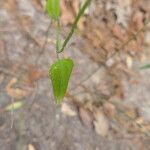
Smilax auriculata
Wild bamboo · Catbrier · Earleaf greenbrier · Greenbrier · Ear-Leaf Greenbrier
Description
Source: leafsnapSmilax auriculata is a North American plant species native to the Bahamas, the Turks & Caicos Islands, and the southeastern United States. Common names include earleaf greenbrier and wild-bamboo, despite the fact that it is not closely related to bamboo. It is reported from Florida, Georgia, North and South Carolina, Alabama, Mississippi, and Louisiana. It grows on coastal sand dunes and in sun-lit locations in sandy woodlands at elevations of less than 100 m (333 feet).Smilax auriculata is a perennial vine-producing underground rhizomes and sometimes tubers. Plants are climbers with zigzag branching, sometimes reaching a height of 9 m (30 feet). Prickles on the stem are flattened and rigid, about 4 mm (0.16 inches) long. Leaves are evergreen, narrowly ovate, not waxy, up to 8.5 cm (3.4 inches) long. Flowers are green, borne in umbels of 3–8 flowers. Berries are dark purple, almost black, about 6 mm (0.24 inches) in diameter.
Care Guide
💧 Water
☀️ Light Full sun
The Earleaf Greenbrier is a resilient plant that does best when it gets direct sunlight for most of the day, though it can tolerate stretches of reduced light. Adequate sun exposure encourages strong growth. Conversely, prolonged periods with insufficient light can cause weak development. In its native range, the plant is generally exposed to a considerable amount of sunlight.
What are the sunlight requirements for Earleaf Greenbrier?
Earleaf Greenbrier requires full sun, defined as over 6 hours of sunlight daily, but it can also tolerate partial sun, which is about 3-6 hours of sunlight per day. It's vital to observe how sunlight moves through your garden to ensure you find the ideal balance of light and shade, promoting the plant's health and vigor.
How essential is sunlight for the Earleaf Greenbrier?
Sunlight is crucial for the Earleaf Greenbrier, enabling it to thrive in its natural habitat. This plant performs best under unobstructed sunlight for most of the day, although it can endure lower light intensities. Adequate sun exposure is critical for robust growth, while insufficient light may result in weaker development.
What artificial lighting requirements do indoor Earleaf Greenbriers have?
Indoor Earleaf Greenbriers need adequate lighting to grow optimally, especially when natural sunlight is lacking. Artificial lights, such as LED lights, are recommended because they can be tailored to provide specific light wavelengths needed by plants. For full sun plants, 30-50W/sq ft of artificial light is needed, partial sun plants require 20-30W/sq ft, and full shade plants need 10-20W/sq ft. The light source should be placed 12-36 inches above the plant to mimic sunlight, and the duration should match the natural daylight hours for the plant species, typically 8-12 hours per day.
What are the signs of insufficient light for Earleaf Greenbrier?
Symptoms of insufficient light in Earleaf Greenbrier include smaller new leaves, leggy or sparse growth, faster leaf drop, halted growth, paler new leaves, chlorosis (yellowing leaves), sunscald, leaf curling, wilting, and leaf scorching. These signs indicate that the plant is not receiving enough sunlight, which is essential for its health and development.
How can I address sunlight deficiency in Earleaf Greenbrier?
To combat sunlight deficiency in Earleaf Greenbrier, gradually move plants to sunnier locations to receive at least 6 hours of direct sunlight daily. For indoor plants, consider using a south-facing window or artificial lighting such as a desk lamp or professional grow lights for at least 8 hours daily. Outdoors, move plants gradually to sunnier spots to avoid sunburn. Pruning or transplanting may be necessary to reduce obstructions and ensure adequate sunlight. Remember, parts of the plant that have suffered due to low light may not recover, but new growth should be healthy with increased light exposure.
🌡️ Temperature 15–35°C
Earleaf Greenbrier naturally occurs in habitats where temperatures typically range from 59 to 95 °F (15 to 35 ℃). When growing this plant, maintaining steady warmth is important. A slight drop in temperature over winter can be tolerated, but it is not required.
What is the native temperature range for Earleaf Greenbrier?
Earleaf Greenbrier (Smilax auriculata) is a plant native to environments where temperatures regularly range from 59 to 95 °F (15 to 35 °C). When cultivating this plant, maintaining a consistent warm environment is crucial. Although a slight reduction in temperature during the winter is tolerable, it is not mandatory for the plant's survival. The key is to ensure the plant experiences consistent warmth, especially within its native temperature range.
How does Earleaf Greenbrier tolerate cold temperatures?
Earleaf Greenbrier has some degree of cold tolerance and generally does not require any special care when temperatures are above -5°C. However, if temperatures are expected to fall below -5°C, temporary cold protection measures should be considered, such as wrapping the plant in plastic film, fabric, or other suitable materials to keep it warm. Once the temperatures rise again, these protective materials should be removed to prevent any potential damage to the plant.
What should be done if Earleaf Greenbrier is exposed to temperatures below -10°C?
When Earleaf Greenbrier is exposed to temperatures below -10°C, the leaves may start to droop; they might recover in mild cases, but in severe cases, the leaves will wilt and eventually fall off. To manage this, the frost-damaged parts of the plant should be trimmed off. Before the arrival of low temperatures again, it's advisable to wrap the plant with non-woven fabric or cloth and construct a wind barrier to protect it from cold winds to prevent further damage.
How should Earleaf Greenbrier be cared for in high temperatures?
During the summer, it is important to keep Earleaf Greenbrier below 35°C to prevent stress and damage to the plant. If temperatures exceed 41°C, the leaves may become discolored, with tips drying and withering, leaves curling, and increased susceptibility to sunburn. The dried-up and sunburned parts should be trimmed away to promote healthy growth. To protect the plant from high temperatures, it should be moved to a shaded location or covered with a shade cloth, especially during the midday and afternoon sun. Ensuring the soil remains moist by watering the plant in the morning and evening can also help mitigate the effects of high temperatures.
💨 Humidity
🪴 Soil 5-7
🌱 Fertilizer
Fertilize your Earleaf Greenbrier in early spring to encourage healthy growth. Regular feeding improves the plant's overall health, leading to strong growth, greater tolerance of harsh conditions, and enhanced resistance to diseases and pests. Follow a consistent fertilization routine for your Earleaf Greenbrier to achieve vibrant, deeply colored, and lush foliage.
🪴 Pot & Repot
✂️ Pruning
Earleaf Greenbrier is a robust, thorny vine with heart-shaped leaves. To control its growth and shape, prune it in early spring. During pruning, remove dead wood and trim back vigorous shoots. This not only enhances the plant's density and aesthetic appeal but also helps manage its spread, keeping it in sync with its natural growth cycle.
🌿 Propagating
🐛 Diseases & pets
☠️ Toxicity
Characteristics
- Plant Type
- Vine, Shrub
- Life Cycle
- Perennial
- Genus
- Smilax
- Family
- Smilacaceae
- Hardiness Zone
- 8-10
- Mature Height
- 1.83 m to 7.62 m
- Mature Spread
- 2.13 m to 3.96 m
- Leaf Color
- Green, Dark Green
- Leaf Type
- Evergreen
- Flower Color
- White, Green
- Flower Size
- 2.54 cm
- Bloom Time
- Mid spring, Late spring, Early summer
- Planting Time
- Spring, Summer, Autumn
- Harvest Time
- Mid summer
- Native Area
- Bahamas