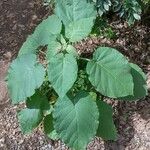
Solanum abutiloides
Description
Source: leafsnapSolanum abutiloides is a species of plant in the family Solanaceae. It is endemic to Argentina and Bolivia, and thrives as a weedy plant in rocky land, on stream banks, and scrub land between 900–3,600 metres (3,000–11,800 ft) in elevation. It is also known as dwarf tamarillo, due to superficial similarities with Solanum betaceum. Both plants are noted for very rapid growth from seed, and very strongly fragrant foliage. Solanum abutiloides is also sometimes known by the archaic Cyphomandra sibundoyensis. Solanum abutiloides quickly matures into a shrub or small tree up to 9 m (30 ft) tall, though usually far smaller. Small flowers form on branches throughout the plant, and individual clusters of flowers can contain as many as 60 blooms. Blooms are followed by fruits - a small oblong berry that ripens to a yellow-orange color. The berries are around 1 cm (0.39 in) (or slightly larger) in diameter. When unripe, the berries are mildly toxic (as are tamarillos), though they are edible upon ripening.
Care Guide
💧 Water
☀️ Light Full sun
The dwarf tamarillo is native to open habitats, such as sunny meadows and forest edges, which provide abundant light. It prefers Full Sun but can also tolerate Partial Sun, adapting well to a range of light conditions.
🌡️ Temperature 0–32.2°C
Dwarf tamarillo comes from tropical areas where the weather is generally warm and humid, so it is well suited to high heat and moisture. It dislikes abrupt temperature shifts and does best with steady temperatures, making it important to prevent indoor temperature swings. It typically cannot withstand cold and needs relatively warm conditions to grow. If temperatures fall too low, the plant may stop growing or even die.
💨 Humidity normal (40-60%)
This plant will thrive in moderate humidity, which is probably the level in your home. However, misting it a few times a week can be very beneficial. Make sure the room has good ventilation.
🪴 Soil 5-7
🌱 Fertilizer
Choose organic fertilizers (e.g., fish emulsion, compost) instead of chemical fertilizers for Dwarf tamarillo. Supply young plants with higher nitrogen and phosphorus during spring. Incorporate compost or fertilizer into the soil before or after planting. For mature plants, supplement in spring with a balanced fertilizer or one targeted to a specific deficiency. Nutrient deficiency results in small leaves, short branches, yellow or bronze foliage, acidic fruits, premature fruit fall, and fruit splitting.
🪴 Pot & Repot
✂️ Pruning
The dwarf tamarillo is a small, tree-like plant that bears edible fruits. To maintain its shape and encourage healthy growth, it is best to prune the plant in early spring. During pruning, remove any dead branches and thin out crowded areas. Using clean, sharp tools helps make precise cuts, which minimizes stress on the plant and enhances fruit production.
🌿 Propagating
🐛 Diseases & pets
☠️ Toxicity
Characteristics
- Plant Type
- Shrub
- Life Cycle
- Perennial
- Genus
- Solanum
- Family
- Solanaceae
- Hardiness Zone
- 3-7
- Mature Height
- 0.91 m to 3.05 m
- Mature Spread
- 0.49 m to 1.52 m
- Leaf Color
- Green, Dark Green
- Leaf Type
- Semi-evergreen
- Flower Color
- White
- Flower Size
- 1.02 cm to 2.03 cm
- Bloom Time
- Late spring, Summer, Early fall
- Planting Time
- Spring, Summer, Autumn
- Harvest Time
- Mid summer, Late summer, Fall
- Native Area
- Bolivia