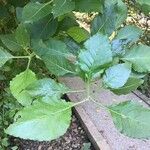
Solanum elaeagnifolium
تاجریزی برگ نقرهای · "ست الحسن الفضي" أو "ست الحسن ذات الأوراق الفضية". · Silverleaf nightshade · Prairie-berry · Silverleaf bitter-apple
Description
Source: leafsnapSolanum elaeagnifolium, commonly known as silverleaf nightshade, is a perennial plant belonging to the Solanaceae family. Native to North and South America, it thrives in various habitats, including deserts, grasslands, and disturbed areas. The plant can grow up to 1 meter tall, featuring a woody stem that branches into multiple stems. Its leaves are silver-gray and have a waxy coating, which helps the plant conserve water in arid environments. The flowers are star-shaped with five petals and can be either white or purple. Silverleaf nightshade is considered an invasive species due to its ability to spread rapidly through underground rhizomes and seed dispersal. It competes with native plants for essential resources like water and nutrients. Despite its invasive nature, Solanum elaeagnifolium has been used for centuries by indigenous people for its medicinal properties. The leaves were applied topically to treat skin conditions such as eczema, while the roots were used internally to address various ailments, including respiratory issues. In summary, Solanum elaeagnifolium is notable for its unique adaptations to survive in harsh environments. However, it also poses a significant threat as an invasive species outside its native range.
🌳 Although often regarded negatively as a weed, silverleaf nightshade has been noted as a bioindicator species. Its presence in particular areas can signal certain soil properties, such as salinity levels, possibly assisting in ecological assessments.
🎭 Truth and silence; your thoughts are dark as well.
Care Guide
💧 Water Every 7 days
Silverleaf nightshade is well-suited to arid environments due to its exceptional drought tolerance. It requires watering just once a week and makes efficient use of limited water resources. Its extensive root system helps it absorb moisture effectively, making it an excellent choice for low-maintenance, drought-resistant gardening in dry landscapes.
How should I water my Silverleaf nightshade plant?
To properly water the Silverleaf nightshade, it is important to use filtered water at room temperature. Tap water should be avoided as it may contain harmful particles. The reason for using room temperature water is that the plant is accustomed to warm conditions and cold water can be distressing. Avoid overhead watering as it can cause problems with the foliage. Instead, thoroughly water the soil with filtered, room temperature water until it is fully saturated. This helps to moisten the roots and support their growth and nutrient absorption.
What should I do if I give too much or too little water to my Silverleaf nightshade?
Overwatering is a common issue for Silverleaf nightshade and can lead to wilting and yellowing of the stems and leaves. It can also cause diseases like root rot, mold, and mildew, which can be fatal to the plant. Underwatering is less common but can still happen, resulting in brittle and brown leaves. It is important to notice the signs of overwatering early and adjust your watering schedule accordingly. If the soil drains poorly, replace it with a well-draining potting mix. If the plant is not receiving enough water, increase watering until the symptoms improve.
How often do I need to water my Silverleaf nightshade plant?
If your Silverleaf nightshade is in a pot, the most precise way to determine if it needs water is to check the soil. Simply stick your finger into the soil and if you find that the top two to three inches are dry, it's time to water it. If you have planted the Silverleaf nightshade outdoors in the ground, you can use the same method to test the soil. Once again, if the top few inches are dry, it's time to water the plant. Usually, during spring and early fall, watering once a week should be sufficient. However, in extremely hot weather, you may need to increase the frequency to twice or even more per week. It's worth noting that mature and well-established Silverleaf nightshade plants have a remarkable ability to tolerate drought.
How often does my Silverleaf nightshade plant need to be watered?
To properly water your Silverleaf nightshade, don't hold back on the amount of water you give. Make sure the top few inches of soil are dry, and then give the plant a thorough watering, ensuring the soil is completely soaked. The water should flow through the drainage holes at the bottom of the pot. If you don't see excess water draining, it means you haven't watered enough. However, be careful not to let water accumulate in the soil, as this can harm the plant. On the other hand, if water doesn't drain through the pot, it may indicate poor soil drainage, which is not good for the plant's health. If the plant is outside, receive 1 inch of rain per week is adequate.
How should I water my Silverleaf nightshade as it grows?
The water requirements of the Silverleaf nightshade can vary depending on its growth stages. To begin with, if your Silverleaf nightshade is in its early years or has just been transplanted, it will require a higher amount of water. During these stages, the plant focuses its energy on developing new roots that will support future growth. To ensure optimal performance, these roots need more moisture compared to more mature stages. As the plant matures over a few seasons, its water needs will decrease. However, during the bloom period, additional water may be necessary due to the high moisture demand for flower development.
☀️ Light Full sun
Silverleaf nightshade thrives optimally when it receives a good deal of sun exposure on a daily basis, even though it can still survive in places with lower light levels or those that are entirely shaded. A setting that mimics its original habitat, which is distinguished by plentiful sunlight, promotes robust growth. Yet, changes in light exposure may have impacts on the health of the plant.
What are the sunlight requirements for Silverleaf nightshade?
Silverleaf nightshade requires full sun, which means it thrives best with above 6 hours of sunlight daily. However, it can also endure partial sun to full shade, with about 3-6 hours of sunlight. It's important to observe how sunlight moves through your garden to find the best spots for your plants, ensuring a balance of light and shade for their optimal growth.
How does the amount of sunlight affect Silverleaf nightshade's growth?
Silverleaf nightshade thrives well in substantial amounts of daily sunlight, resembling its native habitat of abundant sun for healthy growth. However, different variants in light exposure can affect the plant's well-being, suggesting that while it can survive in less light or full shade, the optimal growth and health of the plant are best supported by full sunlight conditions.
Can artificial lighting be used for Silverleaf nightshade, and how?
Yes, artificial lighting can be used for silverleaf nightshade, especially when natural sunlight is insufficient. Utilizing LED lights, which can be customized for plant needs, is beneficial. Full sun plants require 30-50W/sq ft, partial sun plants need 20-30W/sq ft, and full shade plants 10-20W/sq ft of artificial light. The light source should be placed 12-36 inches above the plant, mimicking natural sunlight for 8-12 hours per day to promote healthier growth.
What are the symptoms of inadequate lighting for Silverleaf nightshade?
Symptoms of inadequate lighting in Silverleaf nightshade include smaller new leaves, leggy or sparse growth, faster leaf drop, slower or no new growth, lighter-colored new leaves, chlorosis, sunscald, leaf curling, wilting, and leaf scorching. These symptoms indicate either too little or excessive sunlight, affecting the plant's ability to photosynthesize and maintain health.
How can I improve sunlight exposure for Silverleaf nightshade?
To improve sunlight exposure for Silverleaf nightshade, gradually move plants to sunnier locations or use artificial lighting if they are large or not easily movable. For outdoor plants, avoiding sudden changes in light intensity is crucial. Removing obstructions like tree branches can help, and if possible, smaller plants can be transplanted during their dormant period to areas with better sunlight and drainage.
🌡️ Temperature 15–35°C
The silverleaf nightshade, a plant native to North America, flourishes in a diverse range of climates and temperatures. Its optimal growth occurs in temperatures between 59 and 95 ℉ (15 to 35 ℃), specifically in sunny, arid environments. In periods of harsh summer heat, the plant manages to adapt by slowing its rate of growth and minimizing its water consumption in order to preserve energy.
What are the essential growing conditions for Silverleaf nightshade?
Silverleaf nightshade (Solanum elaeagnifolium) is adaptable to a variety of temperatures and climates, native to North America. It thrives optimally in sunny and dry climates within a temperature range of 59 to 95°F (15 to 35°C). The plant is capable of adjusting to extreme summer heat by reducing its growth rate and water intake as a conservation measure. Moreover, Silverleaf nightshade possesses strong cold resistance, making special frost protection measures generally unnecessary. Nonetheless, if winter temperatures are anticipated to drop significantly, providing cold protection through covering the plant with soil or straw is advisable. It's also recommended to water the plant abundantly before the first freeze in autumn to maintain moist soil, which helps prevent drought and water scarcity during winter and early spring.
How does Silverleaf nightshade respond to low temperature conditions?
Silverleaf nightshade is cold-tolerant but thrives optimally at temperatures above a certain minimum threshold. During winter, keeping it above a tolerable minimum temperature is essential. If temperatures fall below a critical limit, the plant might not exhibit noticeable changes during winter; however, come spring, there may be a decrease in sprouting or in severe cases, no sprouting at all. The solution for this issue is to remove parts of the plant that have failed to sprout in the spring.
How does Silverleaf nightshade respond to high temperature conditions?
During the summer, it is crucial to keep Silverleaf nightshade's exposure to temperatures below a certain maximum suitable for its growth. Exceeding a tolerable high temperature threshold can lead to the leaves becoming lighter in color, prone to curling, susceptible to sunburn, and, in extreme cases, cause the plant to wilt and dry up. To mitigate these issues, sunburned and dried-up parts should be trimmed away. Moving the plant to a shade or using a shade cloth can protect it from the midday and afternoon sun. Additionally, watering the plant in the morning and evening helps keep the soil moist and supports the plant's health during high temperatures.
💨 Humidity dry (<40%)
This plant prefers dry conditions, so don't mist it. However, watering it less often can also thrive in higher humidity.
🪴 Soil 6-7
🌱 Fertilizer
Generally, one fertilizer application in the spring is enough for Silverleaf nightshade. However, to optimize growth, you may consider feeding it multiple times. This should be done roughly once every four to six weeks. Fertilizing improves the aesthetics and functionality of leaves, facilitating uniform coloration and good health. It also encourages the growth of roots and the uptake of nutrients, contributing to the plant's health over the long haul.
🪴 Pot & Repot 2-3 years
When you're ready to repot your Silverleaf nightshade, select a pot that's 1-2 inches (2.5-5 cm) bigger and has sufficient drainage. Fill it with a well-draining potting soil. The ideal time to repot would be during the spring or fall. Make sure the root ball sits a bit lower than the pot's edge. After repotting, water the plant deeply and position it in a warm location where it'll receive indirect sunshine.
✂️ Pruning
🌿 Propagating
🐛 Diseases & pets
☠️ Toxicity
Characteristics
- Plant Type
- Herb
- Life Cycle
- Perennial
- Genus
- Solanum
- Family
- Solanaceae
- Hardiness Zone
- 7-10
- Mature Height
- 30 cm to 91 cm
- Mature Spread
- 30 cm
- Leaf Color
- Green, Silver, Blue, Yellow
- Leaf Type
- Deciduous
- Flower Color
- Lavender
- Flower Size
- 2.03 cm
- Bloom Time
- Late spring, Early summer, Mid summer
- Planting Time
- Spring, Summer
- Harvest Time
- Summer
- Native Area
- Pakistan