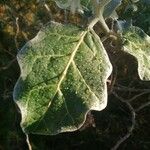
Solanum marginatum
Purple African nightshade · White-edge nightshade · White-margin nightshade · White-edged nightshade · White-margined nightshade
Description
Source: leafsnapSolanum marginatum is a species of plant in the family Solanaceae known by the common names purple African nightshade and white-margined nightshade. It is native to Ethiopia and Eritrea, and it is known on other continents as an introduced species and sometimes a weed. It is a hairy shrub growing up to two meters tall. The large, distinctive, gray-green leaves are wavy along the edges, woolly on the undersides, and measure up to 18 centimeters long. The veins are white and lined with large, widely spaced prickles. The inflorescence contains several white flowers, hanging or nodding bisexual flowers and erect staminate flowers with large yellow anthers. The fruit is a yellow berry up to 5 centimeters wide. This is one of several Solanum species that contain solasodine.
Care Guide
💧 Water
☀️ Light Full sun
Purple african nightshade comes from open habitats, such as sunny meadows and forest edges, which provide abundant light. It thrives in Full Sun but can also tolerate Partial Sun, adapting well to different sunlight conditions.
What are the sun requirements for Purple African Nightshade?
Purple African Nightshade, also known as Solanum marginatum, thrives under specific sunlight conditions. It requires full sun, which means it needs to receive more than 6 hours of sunlight daily. Alternatively, it can grow in partial sun, getting about 3-6 hours of sunlight. It's important to observe how sunlight moves through your garden throughout the day. Choosing spots that provide a perfect balance of light and shade is crucial for the well-being of your plants, ensuring they grow happy and healthy.
🌡️ Temperature 20–37.8°C
Purple African nightshade comes from tropical regions, where the climate is typically warm and humid. Consequently, it is well suited to high temperatures and humidity. It is sensitive to sudden temperature shifts and prefers a stable temperature environment, so avoiding temperature fluctuations indoors is important. It generally does not tolerate cold temperatures and requires higher temperatures for growth. If the surrounding temperature drops too low, the plant may stop growing or even die.
What is Purple African Nightshade?
Purple African Nightshade, known botanically as Solanum marginatum, is a plant species with no further detailed information provided about its essentials or symptoms in the data.
💨 Humidity
🪴 Soil 6-8
🌱 Fertilizer
The best time to fertilize a Purple african nightshade is in early spring, as it breaks dormancy. This encourages overall growth and flower development. Fertilization improves foliage, stems, and branches, and fosters large, vivid, long-lasting flowers. It helps transfer nutrients from the roots to the flowers and enhances the plant's health and resistance to disease.
🪴 Pot & Repot
✂️ Pruning
The purple African nightshade benefits from pruning in early spring. Focus on removing dead branches, thinning out dense areas to improve airflow, and shaping the plant. This practice not only boosts growth and fruit yield but also helps control the plant's size. To minimize stress on the plant, avoid making too many cuts. Additionally, use clean tools to prevent disease and ensure the plant's optimal health.
🌿 Propagating
🐛 Diseases & pets
☠️ Toxicity
Characteristics
- Plant Type
- Shrub
- Life Cycle
- Perennial
- Genus
- Solanum
- Family
- Solanaceae
- Hardiness Zone
- 9-11
- Mature Height
- 0.91 m to 3.05 m
- Mature Spread
- 0.91 m to 2.13 m
- Leaf Color
- Green, Silver
- Leaf Type
- Evergreen
- Flower Size
- 2.03 cm to 3.05 cm
- Bloom Time
- Summer, Early fall, Mid fall
- Planting Time
- Spring, Summer
- Harvest Time
- Late summer, Fall, Early winter
- Native Area
- Djibouti, Eritrea, Ethiopia