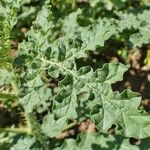
Solanum rostratum
Prickly nightshade · Buffalo-bur · Beaked-sandbur · Horse-nettle · Pincushion nightshade
Description
Source: leafsnapSolanum rostratum is a species of nightshade (genus Solanum) that is native to the United States and northern and central Mexico. Common names include buffalobur nightshade, buffalo-bur, spiny nightshade, Colorado bur, Kansas thistle, bad woman, Mexican thistle, and Texas thistle. It is an annual, self-compatible herb that forms a tumbleweed. Individual plants reach 1–1.5 m (3.3–4.9 ft) tall, have once or twice pinnatified leaves (see image of leaf), and abundant spines on the stems and leaves. It produces yellow flowers with pentagonal corollas 2–3.5 cm (0.79–1.38 in) in diameter and weakly bilaterally symmetric (see flower-closeup image). In its native range S. rostratum is pollinated by medium- to large-sized bees including bumblebees.Solanum rostratum flowers exhibit heteranthery, i.e. they bear two sets of anthers of unequal size, possibly distinct colouration, and divergence in ecological function between pollination and feeding. The fruit, a berry, is enclosed by a prickly calyx. The seeds are released when the berries dry and dehisce (split apart) while still attached to the plant. This species represents one of the later scientific interests of famed biologist Charles Darwin, who just over a week prior to his death had ordered seeds from a colleague in America, so as to investigate their heteranthery, a topic he was interested in.Solanum rostratum is the ancestral host plant of the Colorado potato beetle, Leptinotarsa decemlineata, but this pest adopted the potato, Solanum tuberosum as a new (and more succulent) host, a fact first reported in eastern Nebraska in 1859. It then expanded its range rapidly eastward on potato crops in the next two decades.
Care Guide
💧 Water
☀️ Light Full sun
Buffalo bur grows best with abundant sunlight, though it can also tolerate shaded conditions. Bright surroundings encourage its vigorous growth. Throughout its various growth stages, consistent sunlight is important. Too little or too much light can cause stunted growth. Originally, it occupied sun-drenched landscapes.
🌡️ Temperature 15–35°C
Buffalo bur naturally occurs in habitats with temperatures between 68 and 95°F (20 and 35°C). It prefers warm climates and performs best at the higher end of that range. In cooler seasons, consider using a greenhouse or other heating methods to keep conditions within its preferred temperature range.
💨 Humidity
🪴 Soil 5-7
🌱 Fertilizer
Buffalo bur does well with regular, dilute applications of fertilizer to encourage healthy leaf development. You should apply fertilizer to Buffalo bur about once a month during the summer. Nitrogen is important for foliage, and adding nitrogen-rich sources supports Buffalo bur's growth.
🪴 Pot & Repot
✂️ Pruning
🌿 Propagating
🐛 Diseases & pets
☠️ Toxicity
Characteristics
- Plant Type
- Herb
- Life Cycle
- Annual
- Genus
- Solanum
- Family
- Solanaceae
- Hardiness Zone
- 7-10
- Mature Height
- 30 cm to 91 cm
- Mature Spread
- 15 cm to 46 cm
- Leaf Color
- Green, Blue, Bronze
- Leaf Type
- Deciduous
- Flower Color
- Yellow, Purple
- Flower Size
- 2.54 cm
- Bloom Time
- Early summer, Mid summer
- Planting Time
- Spring
- Harvest Time
- Mid summer
- Native Area
- Honduras, Mexico, Guatemala