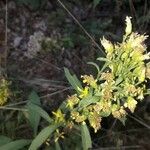
Solidago virgaurea
Goldenrod · European goldenrod · Common goldenrod · Aaron's Rod · Splinuță
Description
Source: leafsnapSolidago virgaurea, the European goldenrod or woundwort, is an herbaceous perennial plant of the family Asteraceae. It is widespread across most of Europe as well as North Africa and northern, central, and southwestern Asia (China, Russia, India, Turkey, Kazakhstan, etc.). It is grown as a garden flower with many different cultivars. It flowers profusely in late summer. Solidago virgaurea is a perennial herb up to 100 cm (40 inches) tall, with a branching underground caudex and a woody rhizome. It produces arrays of numerous small yellow flower heads at the top of the stem. Subspecies and varietiesSolidago virgaurea subsp. alpestris (Waldst. & Kit.) Gremli Solidago virgaurea subsp. armena (Grossh.) Greuter Solidago virgaurea subsp. asiatica Kitam. ex Hara Solidago virgaurea var. calcicola Fernald Solidago virgaurea subsp. caucasica (Kem.-Nath.) Greuter Solidago virgaurea subsp. dahurica (Kitag.) Kitag. Solidago virgaurea subsp. gigantea (Nakai) Kitam. Solidago virgaurea var. insularis (Kitam.) Hara Solidago virgaurea subsp. jailarum (Juz.) Tzvelev Solidago virgaurea subsp. lapponica (With.) Tzvelev Solidago virgaurea subsp. macrorrhiza (Lange) Nyman Solidago virgaurea subsp. minuta (L.) Arcang. Solidago virgaurea subsp. stenophylla (G.E.Schultz) Tzvelev Solidago virgaurea subsp. talyschensis (Tzvelev) Sennikov Solidago virgaurea subsp. taurica (Juz.) Tzvelev Solidago virgaurea subsp. turfosa (Woronow ex Grossh.) Greuter Solidago virgaurea subsp. virgaurea Solidago virgaurea var. virgaurea
🌳 Goldenrod, with its vibrant clusters of bright-yellow flowers, is a valuable addition when planted at the edge of a vegetable garden. This plant not only draws pests away from your crops but also offers a food source for pollinators like butterflies and bees. Additionally, goldenrod can be grown as an ornamental shrub along garden borders or mixed with other shrubs in a shrub garden or naturalized landscape.
Care Guide
💧 Water
Goldenrod thrives with consistent moisture but can also adapt to moderate drought conditions. For optimal health, it is best to water it weekly. As a plant native to meadows and prairies, goldenrod is well-suited for gardens with varying rainfall, demonstrating resilience in diverse water availability.
How should I water my Goldenrod plant?
To properly water the Goldenrod plant, it is recommended to use filtered water at room temperature. Tap water may have harmful particles, so filtered water is preferred. It is important to use water that is at room temperature or slightly warmer because the Goldenrod plant is used to warm climates and cold water can be damaging. Avoid watering the plant from above, as this can cause issues with the leaves. Instead, pour the filtered room temperature water directly onto the soil until it is completely soaked. This helps to keep the roots moist and aids in the spread of roots and nutrient collection.
What should I do if I give my Goldenrod plant too much or too little water?
Goldenrod plants can be negatively affected by both overwatering and underwatering. However, overwatering is a more common issue. When Goldenrod receives too much water, its stems and leaves may wilt and turn yellow. Prolonged overwatering can even lead to diseases such as root rot, mold, and mildew, which can be fatal for the plant. On the other hand, underwatering is less common because Goldenrod has decent drought tolerance. Still, underwatering can happen, resulting in brittle and brown leaves. It is crucial to detect signs of overwatering early to prevent irreversible damage. If you notice these signs, reduce your watering immediately and check the soil's drainage. If it drains poorly, replace it with a loose, well-draining potting mix. Conversely, if your Goldenrod shows signs of not getting enough water, simply increase your watering until the signs disappear.
How often should I give water to my Goldenrod plant?
If your Goldenrod plant is in a pot, you can check if it needs water by sticking your finger into the soil. If the top two to three inches are dry, it's time to water it. If you have your Goldenrod planted outside in the ground, you can use the same method. Once the top few inches of soil are dry, it's time to water. In the spring and early fall, watering once a week usually works. However, during very hot weather, you may need to water twice a week or more. It's important to note that mature Goldenrod plants can handle dry conditions well.
How much water does my Goldenrod plant need?
When watering your Goldenrod, it is important to not hold back on the amount of water you provide. Make sure the first two to three inches of soil are dry before giving it a thorough watering. It is important to water until the soil is completely soaked and excess water is flowing out of the drainage holes at the bottom of the pot. If you don't see excess water draining, it means you haven't watered enough. However, be careful not to let water accumulate in the soil as it can harm the plant. On the other hand, if water is not draining properly, it could be a sign of poorly draining soil, which is not good for the plant's health. If the plant is outdoors, receiving about 1 inch of rain per week should be enough.
How do I water my Goldenrod as it grows?
The water needs of the Goldenrod can vary depending on its growth stages. When your Goldenrod is young or newly transplanted, it requires more water to support root growth and future development. As the roots mature, they need less moisture. Additionally, during the bloom period, the Goldenrod requires extra water due to the significant amount of moisture used for flower development.
☀️ Light Full sun
Goldenrod flourishes with abundant sunlight, yet endures in moderately lit conditions. Native to sun-rich habitats, its healthy growth is strongly linked to light intensity. Too little light can slow its growth, while continuous light exposure may shorten the flowering stage.
What are the sunlight requirements for Goldenrod?
Goldenrod (Solidago virgaurea) requires a specific amount of sunlight to thrive optimally. It prospers in full sun, defined as receiving more than 6 hours of direct sunlight daily. The plant can also grow in partial sun, which means it gets about 3-6 hours of sunlight. It's essential to watch how sunlight moves through your garden, selecting spots that provide the perfect balance of light and shade for your plants, to ensure their happiness and health.
What are the essentials for growing Goldenrod?
Goldenrod thrives best with ample sunlight, being native to environments rich in sun. Its growth and health closely tie to the intensity of light it receives. Insufficient light may slow its growth, while too much direct light could potentially reduce the flowering stage. For indoor plants, where natural sunlight may be lacking, especially during winter or in less sunny spaces, artificial lighting becomes crucial for optimal growth. LED lights are recommended for their ability to offer specific wavelengths needed by plants. Full sun plants require 30-50W/sq ft of artificial light, partial sun plants need 20-30W/sq ft, and full shade plants should have 10-20W/sq ft. The light source should be placed 12-36 inches above the plant, mimicking natural sunlight as closely as possible for 8-12 hours per day.
What are the symptoms of incorrect lighting for Goldenrod?
When Goldenrod does not receive its ideal lighting conditions, several symptoms may appear, indicating light deficiency or overexposure. Symptoms of too little light include new leaves growing smaller, leggy or sparse growth, faster leaf drop, slower or ceased new growth, and lighter-colored new leaves. On the other hand, excessive sunlight can cause chlorosis, sunscald, leaf curling, wilting, and leaf scorching. These conditions represent either a lack of or too much sunlight, affecting the plant's ability to photosynthesize and maintain overall health.
What can I do to ensure my Goldenrod gets adequate light?
To ensure your Goldenrod receives adequate light, gradually move plants to sunnier locations, aiming for at least 6 hours of direct sunlight daily. For indoor plants not easily moved or that are large, consider using artificial lighting, maintaining it for at least 8 hours daily. For outdoor plants, adapt them gradually to more sunlight to avoid sunburn. Also, it's crucial to minimize obstructions that block sunlight, like pruning trees that overshadow your plants, and consider transplanting smaller plants during their dormant period to locations with ample sunlight and good drainage. Remember, areas of the plant that suffered from insufficient light may not recover, but new growth will be healthy with improved light conditions.
🌡️ Temperature 5–35°C
Goldenrod grows naturally in areas where temperatures range from 41 to 95°F (5 to 35℃). The plant favors moderate temperatures and can adapt to seasonal fluctuations. Adjust your care routine with the seasons to ensure optimal growth.
What is the native environment of Goldenrod?
Goldenrod, also known by its botanical name Solidago virgaurea, thrives in environments where temperatures fluctuate between 41 to 95°F (5 to 35°C). This plant is well-adapted to moderate temperatures and can adjust according to seasonal changes. It's important to modify your care routine with the seasons to promote optimal growth.
Does Goldenrod need special protection during winter?
Goldenrod possesses strong cold resistance, so it typically does not require specialized frost protection measures in winter. Nevertheless, if temperatures are anticipated to fall below -25°C, it's crucial to safeguard the plant from the cold. This protection can be provided by covering the plant with insulating materials like soil or straw. To prepare for the first freeze of autumn, it is advisable to water the plant thoroughly to maintain moist soil, which helps prevent drought and water scarcity for the plant during the winter and early spring.
How does Goldenrod react to low temperatures?
Goldenrod is exceptionally cold-tolerant, thriving best in temperatures above 5°C and requiring conditions to remain above -20°C during winter. If temperatures drop below -25°C, there might not be immediate visible damage during the winter, but you may observe a decrease in sprouting or a lack of sprouting come springtime. In such cases, it is recommended to remove any parts of the plant that have failed to sprout in the spring.
What should be done if Goldenrod is exposed to high temperatures?
During the summer, it's important to ensure that Goldenrod's environment stays below 35°C. Exposure to temperatures above 41°C can result in the plant's leaves becoming lighter, curling, and becoming susceptible to sunburn. In extreme cases, the plant may completely wilt and dry out. To mitigate these issues, you should trim away any sunburned or dried parts of the plant. Moving the plant to a shaded location or using a shade cloth can protect it from direct midday and afternoon sun. Additionally, watering the plant in the morning and evening can help keep the soil moist and reduce stress on the plant.
💨 Humidity
🪴 Soil 5-7
🌱 Fertilizer
The best time to fertilize Goldenrod is in early spring, as it comes out of dormancy and begins active growth. Fertilization supplies essential nutrients needed for healthy growth. While Goldenrod has fairly low fertilizer requirements, applying fertilizer annually can improve its survival and encourage better, longer-lasting flowers.
Why do I have to put fertilizers on my goldenrod plant?
The leaves of the Goldenrod form its main structure, and fertilization is essential for both appearance and function. This includes maintaining consistent leaf color and texture. Fertilization also benefits the plant's root system, promoting new root growth and supporting existing roots. By fertilizing, you not only keep the plant healthy in the present but also improve its ability to absorb nutrients from the soil in the future.
When should I put fertilizer on my Goldenrod plant?
If you grow Goldenrod outdoors, it will send out new growth in spring. When the leaves emerge, it's time to fertilize. One application is usually sufficient, but for maximum growth, you can fertilize multiple times during spring and early summer. Feed the Goldenrod about once every month to a month and a half if you choose this option.
When is it not a good idea to put fertilizer on my Goldenrod plant?
During late fall and winter, your Goldenrod goes into a dormant phase and stops producing new growth. This is not the time to fertilize it. When spring and summer come, if you decide to fertilize your Goldenrod multiple times, start reducing the amount of fertilizer as summer approaches because the growth rate of your Goldenrod will also slow down. It is never a good idea to fertilize your Goldenrod when the weather is unusually hot or the soil is extremely dry. Fertilizing in such conditions can stress your Goldenrod and make it die prematurely.
What kind of fertilizer does my Goldenrod plant need?
Choosing the best fertilizer for a Goldenrod is actually quite simple. These plants do well with a general-purpose garden fertilizer that contains equal amounts of nitrogen, phosphorus, and potassium. A fertilizer with a 10-10-10 or similar ratio will be effective. To be safe, avoid fertilizers with high nitrogen levels. The majority of suitable fertilizers for Goldenrods come in a granular form. These fertilizers should be slow-release and easy to apply to the soil. Additionally, using organic soil amendments like compost can be beneficial for feeding your Goldenrod.
How can I give nutrients to my Goldenrod plant?
To ensure healthy growth of your Goldenrod, wait until spring when the first leaves appear. Apply a granular slow-release fertilizer with a balanced formula to the soil surrounding the base of your Goldenrod. If desired, you can repeat this process later in the season. Remember to apply the fertilizer to the soil at the base of the plant, not directly on the plant itself. This may involve moving some leaves to access the soil above the roots. Additionally, it is recommended to water your Goldenrod before and after fertilizing.
🪴 Pot & Repot
Goldenrod needs pots with excellent drainage to grow well and stay healthy.
✂️ Pruning
To enhance the bushiness and blooms of your goldenrod, prune it in early to late spring by cutting back up to one-third of the stems. Use clean, sharp tools to ensure precise cuts, which helps maintain the plant's shape and prevent disease. Pruning at the right time maximizes the ornamental appeal and vitality of your goldenrod.
🌿 Propagating
🐛 Diseases & pets
☠️ Toxicity
Solidago virgaurea has no toxic effects reported.
Characteristics
- Plant Type
- Herb
- Life Cycle
- Perennial
- Genus
- Solidago
- Family
- Asteraceae
- Hardiness Zone
- 5-10
- Mature Height
- 30 cm to 91 cm
- Mature Spread
- 76 cm
- Leaf Color
- Green
- Leaf Type
- Deciduous
- Flower Color
- Yellow
- Flower Size
- 1.02 cm
- Bloom Time
- Mid summer
- Planting Time
- Spring, Summer
- Harvest Time
- Mid summer