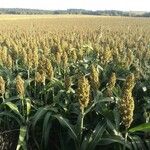
Sorghum bicolor
سورگوم · Sorghum · Great millet · Rhodesian Sudan grass · Giant-millet
Description
Source: leafsnapSorghum bicolor, commonly known as sorghum, is a cereal grain plant belonging to the grass family Poaceae. Native to Africa, it has been widely cultivated across the globe for its edible seeds and use as a forage crop. Sorghum is especially significant in many developing countries due to its drought tolerance and ability to thrive in poor soil conditions. Sorghum plants can grow up to 5 meters tall, featuring long, narrow leaves arranged alternately along the stem. The flowers, which appear on long panicles at the top of the plant, can vary in color from white or yellowish-green to deep red or purple. The seeds of sorghum are small and round with a hard outer layer that provides protection against pests and diseases. These seeds can be ground into flour or used whole to make porridge, bread, beer, or animal feed. Besides its role as a food crop, sorghum also has several other applications. Its high sugar content in the stalks makes it an attractive option for biofuel production. Overall, Sorghum bicolor is a versatile cereal grain plant with numerous uses, making it valuable both economically and nutritionally worldwide.
🌳 Sorghum is notable for its many uses. Its grains are used as livestock feed and are processed into ethanol for fuel. In addition, sorghum is employed to make gluten-free beer — an unexpected but welcome application. Moreover, bioengineered sorghum varieties can grow in soils with high aluminium, offering hope for farming on less fertile land.
🎭 Revival of kin relations, ancestors and deities, staple cereal crop
Care Guide
💧 Water Every 7 days
Grain sorghum, native to arid regions, is known for its high drought tolerance. It requires watering once a week, but the soil should not become saturated. With a deep root system, grain sorghum thrives in areas with fluctuating rainfall, efficiently using available water to produce grain even in challenging conditions.
What do I need to do if I give my Grain sorghum too much or too little water?
If you don't water this beautiful ornamental grass correctly, it won't perform well. When it's planted in the ground, any watering issues can be fixed. However, if it's in a container, too much or too little water can quickly kill the Grain sorghum. When the Grain sorghum isn't getting the right amount of water, it may stop growing. If it's overwatered, it will have yellow leaves with brown tips. Underwatering can cause drooping leaves, weak seed head production, and browned leaves. If you suspect your Grain sorghum has been watered improperly, first determine whether there's too much or too little water. If there's too much water, stop watering it immediately. It may take a few weeks for heavy soils to dry out, so be patient. Once you see new growth, check the soil for moisture and decide if it needs more water. If there's too little water, simply give the grass a deep drink and see if it improves. It's important to remember that watering the grass deeply rather than frequently is better. This promotes deep root growth, making the grass more resistant to drought and watering problems.
How often do I need to water my Grain sorghum?
The watering needs of Grain sorghum depend on its location. In general, the grass should be watered every week. In hot climates, watering once or twice a week during the summer may be necessary. In moderate climates, watering once every seven days or more may be enough. When it comes to container-grown grass, it typically requires more frequent watering compared to grass in the ground. However, the amount of shade also plays a role, as shaded grasses require less water than those in the ground. To determine when to water, there are a few cues to look out for. Checking the soil's moisture by pressing your finger a couple of inches into it will indicate if it's dry. For potted grass, you can weigh it with a portable scale or simply feel the pot to determine if it's light due to lack of water. If the roots of the grass are lacking sufficient water, the blades may appear folded along their centers and thinner than usual. Despite its drought tolerance, regular deep waterings will result in beautiful color. In its natural habitat of open scrubland, Grain sorghum encounters extreme heat, strong sunlight, and intermittent rain. Although this grass is drought-resistant, it still requires care and attention. Even in harsh, dry conditions, consistent watering is beneficial for Grain sorghum. When first planted, Grain sorghum needs more frequent watering until it establishes deep roots. Potted Grain sorghum, especially if exposed to hot, direct sunlight, will quickly dry out, so it's important to test the soil every 3 to 4 days and water only when it feels dry. In-ground Grain sorghum generally requires less watering, but it depends on the soil type. Heavy clay soil retains water for longer periods, so it may appear dry on the surface while still being moist below. Sandy soils that drain quickly will need more frequent watering.
What should I watch out for when I water my grain sorghum in different seasons, climates, or during different stages of growth?
Determining if you are watering enough can usually be done by observing the rate of growth of your grasses. For instance, grain sorghum tends to double in size within a year during the hottest months. Therefore, if the weather is hot but the grass is not growing vigorously, it may be necessary to adjust your watering schedule. In winter, you could potentially water just once a month, but it is still important to check the soil for moisture. Ultimately, during the growth cycle (warmest months), the grass will require more water than usual, whereas during winter and cooler months, water needs will be greatly reduced. Remember, the crucial rule for grain sorghum is to always allow the planted soil to completely dry out before adding water.
☀️ Light Full sun
Sorghum grows best with plenty of sunlight, which is essential for its growth and development. Inadequate light can result in delayed maturation and lower yields. Still, it can tolerate moderate sun exposure and adapts well to changing light conditions. Its native habitat had abundant sunlight, which is reflected in its current sunlight preferences.
What are the sunlight requirements for grain sorghum?
Grain sorghum requires abundant sunshine to thrive, ideally in conditions of full sun exposure amounting to more than 6 hours of sunlight a day. However, it can also perform well under partial sun, defined as about 3-6 hours of sunlight daily. This adaptability to fluctuating light conditions is a reflection of its origin in sun-abundant habitats. Inadequate light exposure can lead to prolonged maturation periods and reduced yields. It's crucial to monitor the movement of sunlight through your garden, selecting locations that provide an optimal mix of light and shade to ensure your plants' growth and happiness.
How can artificial lighting support grain sorghum's growth indoors?
Indoor grain sorghum plants require adequate lighting to compensate for the lack of natural sunlight, especially in winter or less sunny locations. Artificial lighting serves as an effective solution by promoting faster and healthier growth. LED lights are recommended for their customizability to meet the plants' specific light wavelength needs. Full sun plants should receive 30-50W/sq ft, partial sun plants 20-30W/sq ft, and full shade plants 10-20W/sq ft of artificial light. The light source should be placed 12-36 inches above the plant and turned on for 8-12 hours per day to mimic natural daylight hours, ensuring optimal growth.
What are the symptoms of insufficient light exposure in grain sorghum?
Grain sorghum shows several symptoms when it doesn't receive enough light. These include the emergence of smaller than usual leaves, leggy or sparse growth due to elongated spaces between leaves or stems, premature leaf drop to conserve resources, delayed or halted growth, pale or irregularly-colored new leaves indicating a deficiency in chlorophyll and nutrients, chlorosis or the yellowing of leaves due to chlorophyll breakdown, sunscald characterized by pale or necrotic patches on leaves from intense light exposure, leaf curling as a defense against excessive light, wilting from increased water loss through transpiration, and leaf scorching seen as brown, crispy edges on leaves. These symptoms highlight the plant's struggle in inadequate light conditions.
How can I optimize grain sorghum's growth indoors and outdoors?
To optimize grain sorghum's growth, gradually acclimatize it to more sunshine. For indoor plants, move them to sunnier spots each week until they get at least 6 hours of direct sunlight daily, utilizing a south-facing window for maximized light exposure. If moving the plant isn't feasible, consider using artificial grow lights for at least 8 hours a day. For outdoor plants, also transition them progressively to sunnier locations to prevent sunburn. If sunlight is blocked by obstructions like trees, consider pruning to improve sunlight penetration. For smaller plants, transplanting during the dormant period (late winter or early spring) to a location with ample sunlight and good drainage can boost growth. Note, damaged parts from insufficient light may not recover, but new growth will be healthy once lighting conditions improve.
🌡️ Temperature 0–37.8°C
Sorghum is native to warm climates and performs best at temperatures of 68 to 100 °F (20 to 38 ℃). Too much cold can harm it, so practices like planting later in cooler regions or providing shelters are useful.
What is the ideal temperature range for growing grain sorghum?
Grain sorghum thrives optimally in warm climates, with an ideal temperature range between 68 to 100 °F (20 to 38 °C). It is originally adapted to these temperatures, ensuring the best growth and yield under such conditions.
How does grain sorghum react to cold weather conditions?
Grain sorghum possesses strong cold resistance, which allows it to withstand cooler temperatures without needing special frost protection measures. However, in regions where winter temperatures are expected to drop below -40°C, it's important to protect the plant. Before the first freeze of autumn, watering the plant abundantly helps ensure the soil remains moist and enters a frozen state gently, which aids in preventing drought and water scarcity during the colder months.
What should be done if grain sorghum is exposed to temperatures below -40°C?
If winter temperatures are anticipated to fall below -40°C, providing cold protection for grain sorghum is crucial. This can be done by covering the plant with insulating materials like soil or straw, which help maintain a more stable temperature around the plant.
What are the symptoms and solutions for grain sorghum exposed to low temperatures?
Grain sorghum shows remarkable tolerance to cold, thriving best above 20°C and needing to be kept above 0°C during winter. Exposure to temperatures below -40°C might not show immediate adverse effects, but could lead to decreased sprouting or even failure to sprout in spring. The solution for any parts that fail to sprout in spring due to cold exposure is simple removal of these non-viable sections.
What are the symptoms and solutions for grain sorghum exposed to high temperatures?
High temperatures can be challenging for grain sorghum, especially when they exceed 38°C. Symptoms of excessive heat include leaves becoming lighter in color, prone to curling, susceptibility to sunburn, and in severe cases, the entire plant may wilt and dry up. To alleviate heat stress, trim away the sunburned and dried parts of the plant. If possible, move the plant to a shaded location or use a shade cloth to protect it during the hottest parts of the day. Additionally, watering the plant in the morning and evening helps keep the soil moist and reduces temperature-related stress.
💨 Humidity dry (<40%)
This plant prefers dry conditions, so don't mist it. However, watering it less often can also thrive in higher humidity.
🪴 Soil 5-6
🌱 Fertilizer
For optimal growth, Sorghum needs three fertilizer applications: a pre-planting treatment, one applied one month after seedling emergence, and a final treatment 1 to 1.5 months after the second. Some Sorghum types benefit from extra fertilizer at planting to support rapid growth.
Why is it necessary to use fertilizer on my Grain sorghum?
Plants require nutrients to grow, but certain types can acquire what they need without any additional fertilizers. Grain sorghum, for example, benefits from fertilization to boost its harvest yield. Like other plants, grain sorghum uses nutrients for growth and various internal processes that lead to the development of edible seeds or grains. Nutrients facilitate plant growth, photosynthesis, and the production of seeds or fruits. Insufficient nutrients can result in reduced tillering (the formation of additional branches on a single stem), smaller seed size, and lower protein content in the final product.
When should I fertilize my Grain sorghum for the best results?
Spring is the recommended time to fertilize Grain sorghum. To ensure optimal growth, it is suggested to provide three major fertilizer treatments during the growing season. The first treatment should be applied before planting the seeds, followed by the second treatment about a month after seedlings emerge, and the final treatment roughly 1 to 1.5 months after the second one. Additionally, certain types of Grain sorghum may benefit from a fertilizer boost at the time of planting. Nutrients are crucial for all stages of the growth cycle. Some types of Grain sorghum have a short growth period of only one month from seed to harvest, making it essential to supply enough nutrients for them to reach their full size quickly.
When is it best to not put fertilizer on my Grain sorghum?
To keep Grain sorghum healthy and strong, it is important to feed it regularly. However, there is a risk of over-fertilizing or fertilizing at the wrong time. It is best to avoid fertilizing when the soil is very dry or during extreme weather conditions, such as very hot or cold temperatures. It is also important to be cautious about fertilizers coming into indirect contact with seeds, as this can prevent them from germinating. Additionally, it is necessary to check if the fertilizer is safe to directly touch the plant or if it could damage the leaves and fruits. Some fertilizers are only safe to use in the soil near the plants and should not be applied directly on top of actively growing plants.
What kind of fertilizer should I use for my Grain sorghum?
Soil tests are conducted to determine the presence or absence of nutrients in the soil, which is particularly important for commercial or large-scale operations. The success or failure of a harvest can have significant financial implications in such cases. Depending on the soil and the type of Grain sorghum being grown, different nutrients may need to be added. Fertilizers should provide sufficient phosphorus, along with smaller amounts of nitrogen and potassium. Secondary nutrients and micronutrients, such as sulfur, copper, manganese, and zinc, are also necessary for a successful harvest and the development of the plant.
How do I give nutrients to my Grain sorghum plant?
The method of applying fertilizer will depend on the scale of the operation, available tools, and the type of fertilizer. Fertilizers generally come in two formats: liquid (chemical or natural) and dry (including compost, manure, and powdered or granular fertilizers). Some dry fertilizers need to be diluted in water before use. Once you've determined the type of fertilizer and format, the next step is to calculate the right amount for Grain sorghum to get a high yield without over-fertilizing. There are detailed formulas available to help with this. For larger operations, tractor-attached applicators can scatter dry fertilizer or evenly spray liquid fertilizer. Home gardeners can apply fertilizer by hand or with garden tools. After using any dry fertilizer, make sure to water thoroughly to ensure it soaks into the soil.
🪴 Pot & Repot
✂️ Pruning
🌿 Propagating
🐛 Diseases & pets
☠️ Toxicity
Characteristics
- Plant Type
- Grass
- Life Cycle
- Annual, Perennial
- Genus
- Sorghum
- Family
- Poaceae
- Hardiness Zone
- 2-11
- Mature Height
- 3.05 m to 4.88 m
- Mature Spread
- 2 cm to 5 cm
- Leaf Color
- Green
- Leaf Type
- Deciduous
- Flower Color
- Tan
- Flower Size
- 4.06 cm to 10.16 cm
- Bloom Time
- Early summer, Mid summer
- Planting Time
- Spring, Summer
- Harvest Time
- Mid summer
- Native Area
- Burkina Faso, Libya, Egypt, Tunisia, United Arab Emirates, Sudan, Mauritania, Cyprus, Armenia, Morocco, Guinea, Yemen, Niger, Chad, Benin, Mali, Afghanistan, Iraq, Cameroon, Japan, Oman, Ethiopia, Azerbaijan, Algeria, Gambia