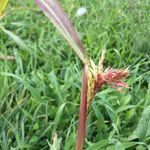
Sorghum halepense
قیاق · چاییز · Johnsongrass · Evergreen millet · Means grass
Description
Source: leafsnapJohnson grass or Johnsongrass, Sorghum halepense, is a plant in the grass family, Poaceae, native to Asia and northern Africa. The plant has been introduced to all continents except Antarctica, and most larger islands and archipelagos. It reproduces by rhizomes and seeds. Johnson grass has been used for forage and to stop erosion, but it is often considered a weed because: Foliage that becomes wilted from frost or hot, dry weather can contain sufficient amounts of hydrogen cyanide to kill cattle and horses if it is eaten in quantity. The foliage can cause 'bloat' in such herbivores from the accumulation of excessive nitrates; otherwise, it is edible. It grows and spreads rapidly, it can 'choke out' other cash crops planted by farmers.This species occurs in crop fields, pastures, abandoned fields, rights-of-way, forest edges, and along streambanks. It thrives in open, disturbed, rich, bottom ground, particularly in cultivated fields. Johnson grass that is resistant to the common herbicide glyphosate has been found in Argentina and the United States. It is considered to be one of the ten worst weeds in the world. In the United States, Johnson grass is listed as either a noxious or quarantined weed in 19 states. With Sorghum bicolor it is a parent of Sorghum × almum, a forage crop also considered a weed in places.It is named after an Alabama plantation owner, Colonel William Johnson, who sowed its seeds on river-bottom farm land circa 1840. The plant was already established in several US states a decade earlier, having been introduced as a prospective forage or accidentally as a seedlot contaminant.In early 20th century Talladega County (Alabama), feelings about Johnson grass were mixed. It was considered a nutritious, palatable and productive forage, but many farmers still found it undesirable. Fields of this grass fell into a "sod bound" state of insufficient new growth unless they were plowed every two or three seasons.A genetic study employing microsatellite markers has investigated Johnsongrass populations across 12 US states and confirmed that the weed was introduced to US from Alabama and North Carolina. Moreover, the study also detected an unreported independent introduction from Arizona. After trans-continental railroad building the two founding populations began to intermix at around Texas shifting diversity from centers of introduction.The 1889 book The Useful Native Plants of Australia records that Sorghum halepense is a "strong, erect-growing species, varying from two to ten feet high, succulent when young, a splendid grass for a cattle run, though not much sought after by sheep. It is a free seeder. The settlers on the banks of the Hawkesbury (New South Wales) look upon it as a recent importation, and seed of it has been distributed under the name of Panicum speciabile. (WooUs) Coast of Queensland, New South Wales, and Western Australia."
🌳 Johnson grass is far more than a common grass. This hardy species is valued as animal feed because it is nutritionally rich. Additionally, it contains a high proportion of cellulose that can be used for biofuel production. Its seeds are edible and protein-rich, making them a valuable survival food, although they are not widely used in cooking. They have potential comparable to other cereal grains.
🎭 Psychic abilities, protection. It represents food, concealment and resilience.
Care Guide
💧 Water Every 7 days
Johnson grass is well adapted to varying moisture conditions and is tolerant of drought. To maintain soil moisture, water it moderately, about twice a week. During its peak growth seasons, it's important to increase the water supply to meet the plant's higher demands.
What should I do if I give my Johnson grass too much water or not enough water?
Proper watering is crucial for this beautiful ornamental grass to thrive. When planted in the ground, watering issues can be resolved, but it's a different story when it's in a container. Too much or too little water can quickly kill Johnson grass in a container. Lack of water can cause it to stop growing, while overwatering can lead to yellow leaves with brown tips. Underwatering can result in drooping leaves, weak seed head production, and browned leaves. If you suspect improper watering, first determine if it's too much or too little water. If it's too much, stop watering immediately and wait for the soil to dry out. Once you see new growth, test the soil for moisture and decide if it needs more water. For insufficient watering, simply give the grass a deep drink and observe if it improves. Remember, it's better to water deeply and less frequently as it encourages deep root growth, making the grass more drought resistant and less susceptible to watering problems.
How many times should I give water to my Johnson grass?
The watering needs of Johnson grass depend on where it is planted. In general, watering once a week is recommended. In hot climates, watering once or twice a week during the summer may be necessary. In moderate climates, watering once every seven days or more may be sufficient. Grass in containers usually needs more frequent watering than grass in the ground. However, the location of the grass also matters, as shaded grass needs less frequent watering than grass in the ground. It is important to only water Johnson grass when the soil is dry. There are a few signs you can look for to determine when to water, such as checking the soil moisture level by pressing your finger into the soil or weighing the potted grass with a portable scale. When the roots lack sufficient water, the grass blades may appear folded and thinner than usual. Despite its drought tolerance, regular, deep waterings will result in a beautiful color. Although Johnson grass is drought resistant, it still needs care and attention, and consistent water is recommended for best results. Newly planted Johnson grass requires more frequent watering until it establishes deep roots. Johnson grass in pots tends to dry out quickly, especially if exposed to hot, direct sun. Sandy soils that drain quickly will need to be watered more often, while heavy clay soils may retain moisture below the ground even if the surface feels dry.
What should I watch out for when watering my Johnson grass in different seasons, climates, or during different stages of growth?
To determine if you are watering enough, pay attention to the rate of growth of your grass. Johnson grass tends to double in size during the hottest months. If your grass is not growing vigorously despite hot weather, you may need to adjust your watering schedule. In the winter, watering once a month may be sufficient, but check the soil for moisture. During the warmest months when the grass is actively growing, it will require more water. However, during winter and cooler months, the water needs of the grass will be significantly reduced. Always allow the soil to completely dry out before watering Johnson grass.
☀️ Light Full sun
Johnson grass requires adequate sunlight for healthy growth. Its light needs stay consistent throughout its various growth stages. Originating from habitats where strong sun exposure is common, it can tolerate somewhat shaded conditions. Too much or too little light can cause deformities and impede development.
What are the sunlight requirements for Johnson Grass?
Johnson grass requires at least 6 hours of direct sunlight daily to thrive, classifying it as a full sun plant. However, it can also tolerate partial sun conditions, receiving about 3-6 hours of sunlight. It's essential to observe the movement of sunlight in your garden to find spots that offer a blend of light and shade suitable for your plants. Insufficient or excessive sunlight can lead to growth issues and deformations in Johnson grass, which originates from environments with significant sun exposure.
How can artificial lighting support Johnson Grass indoors?
When natural sunlight is not sufficient, especially in winter or less sunny spaces, artificial lighting can be a vital solution for Johnson Grass. Indoor plants benefit from proper lighting for optimal growth. LED lights are recommended as they can be customized to provide specific wavelengths needed by plants. Full sun plants, like Johnson Grass, require 30-50W/sq ft of artificial light. The artificial light source should be placed 12-36 inches above the plant to mimic natural sunlight, and plants typically need 8-12 hours of light per day.
What are the signs of inadequate sunlight in Johnson Grass?
Signs of inadequate sunlight in Johnson Grass include smaller new leaves, leggy or sparse growth, faster leaf drop, and halted or no new growth. Additionally, lighter-colored new leaves and symptoms of chlorosis, sunscald, leaf curling, wilting, and leaf scorching indicate poor light conditions. These symptoms reflect the plant’s struggle to adapt to insufficient light, highlighting the importance of providing enough sunlight for healthy growth.
What solutions can address inadequate sunlight for Johnson Grass?
To remedy inadequate sunlight for Johnson Grass, gradually increase sunlight exposure by moving plants to sunnier spots each week until they receive at least 6 hours of direct sunlight daily. For indoor plants, consider using artificial lighting if the plant is large or not easily moved. Outdoor plants should be transitioned to brighter locations gradually to prevent sunburn. Additionally, removing obstructions like branches can improve sunlight access. If necessary, transplant smaller plants during their dormant period to areas with more sunlight. Note that parts of the plant already affected by low light may not recover, but new growth should be healthy with improved light conditions.
🌡️ Temperature 0–37.8°C
Johnson grass typically thrives in hot, dry conditions and prefers temperatures between 32 and 100 ℉ (0 to 38 ℃). To cope with colder temperatures during the winter months, it becomes dormant until temperatures warm again in the spring.
What are the ideal growth conditions for Johnson grass?
Johnson grass thrives in hot and dry environments, preferring a temperature range of 32 to 100°F (0 to 38°C). It adjusts to colder temperatures by going dormant in winter and resumes growth when temperatures warm up in the spring. Despite its strong cold resistance, protection from frost is advised if winter temperatures are expected to drop significantly below the plant's cold tolerance limit. This can involve covering the plant with soil or straw and watering abundantly before the first freeze in autumn to ensure the soil remains moist and enters a frozen state, helping to prevent drought and water scarcity during winter and early spring.
How does low temperature affect Johnson grass, and what are the solutions?
Johnson grass is cold-tolerant and performs best when temperatures are above its minimum growth temperature. It should be kept above its minimum tolerable growing temperature during winter to avoid damage. If temperatures fall below its growth limit, there may not be noticeable changes immediately, but there could be decreased sprouting or no sprouting in the spring. To mitigate this, remove parts that failed to sprout in the spring as a solution to encourage healthy growth.
What should be done if Johnson grass experiences high temperatures?
During summer, it is important to keep Johnson grass below its maximum suitable growth temperature. Exceeding the maximal tolerable growing temperature can cause leaves to lighten in color, become prone to curling, suffer from sunburn, and in severe cases, lead to the wilting and drying of the entire plant. To address this, trim away the sunburned and dried-up parts. Move the plant to a shady location, especially during the midday and afternoon sun, or use a shade cloth. Additionally, water the plant in the morning and evening to maintain soil moisture.
💨 Humidity dry (<40%)
This plant prefers dry conditions, so don't mist it. However, watering it less often can also thrive in higher humidity.
🪴 Soil 5-7
🌱 Fertilizer
Johnson grass needs extra nutrients to encourage healthy new growth. In spring, applying compost around the base of the plant can effectively supply the nutrition it requires. Fertilizing supports vigorous growth and helps the plant resist diseases and pests.
🪴 Pot & Repot
✂️ Pruning
🌿 Propagating
🐛 Diseases & pets
☠️ Toxicity
Characteristics
- Plant Type
- Grass
- Life Cycle
- Perennial
- Genus
- Sorghum
- Family
- Poaceae
- Hardiness Zone
- 2-11
- Mature Height
- 0.49 m to 1.52 m
- Mature Spread
- 1.22 m
- Leaf Color
- Green, White
- Leaf Type
- Deciduous
- Flower Color
- Purple
- Flower Size
- 5.08 cm to 10.16 cm
- Bloom Time
- Late spring, Early summer, Mid summer
- Planting Time
- Spring
- Harvest Time
- Mid summer, Late summer
- Native Area
- Sri Lanka, Libya, Egypt, India, United Arab Emirates, Pakistan, Morocco, Uzbekistan, Russia, Iraq, Jordan, Oman, Nepal, Saudi Arabia, Tajikistan, Tunisia, Cyprus, Bangladesh, Laos, Armenia, Lebanon, Chad, Afghanistan, Syria, Kyrgyzstan, Kazakhstan, Vietnam, Myanmar, Japan, Israel, Iran, Azerbaijan, Algeria, Kuwait, Turkmenistan