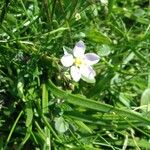
Spergularia media
Greater Sea-spurrey · Coast sand-spurrey · Perennial Sea Spurrey · Intermediate sand-spurrey · Media sand-spurrey
Description
Source: leafsnapSpergularia media (syn. S. maritima) is a species of flowering plant in the family Caryophyllaceae known by the common names media sandspurry and greater sea-spurrey. It is native to Eurasia and the Mediterranean, where it grows in many types of habitat, including disturbed areas, including places with saline substrates, such as salt marshes and beaches. It is known in many other parts of the world as an introduced species and a common roadside weed. In North America it is a "highway halophyte", often springing up at the margins of roads that are heavily salted in the winter.
Care Guide
💧 Water
Greater sea spurrey thrives in coastal environments, as it can tolerate saline soils and withstand dry periods between tides. It requires weekly watering to stay healthy and also benefits from the natural moisture found in coastal areas. This makes it an excellent choice for gardens in similar climates.
☀️ Light Full sun
Greater sea spurrey comes from open, well-lit habitats and performs best in full sun. It can tolerate some partial shade but prefers direct sunlight for optimal growth. This plant, which may be annual or biennial, is noted for its preference for sunny conditions.
🌡️ Temperature 5–25°C
Greater sea spurrey is native to temperate regions and prefers a moderate climate. It does best at temperatures of about 68 to 95 °F (20 to 35 ℃), so keep it in similar conditions for optimal growth.
💨 Humidity
🪴 Soil 6-7
🌱 Fertilizer
Greater sea spurrey does well with regular, low-strength fertilizer applications to encourage healthy leaf development. Fertilize Greater sea spurrey about once a month throughout the summer. Nitrogen is important for foliage, so supplying nitrogen-rich sources helps Greater sea spurrey thrive.
🪴 Pot & Repot
✂️ Pruning
To maintain the health and appearance of greater sea spurrey, prune the plant from early to late spring. Remove any dead or damaged stems to improve airflow and reduce the risk of disease. Light shaping encourages natural growth and avoids the need for heavy pruning. Consistent maintenance not only enhances the plant's appearance but also boosts its bloom production, ensuring that greater sea spurrey adds a vibrant presence to your garden.
🌿 Propagating
🐛 Diseases & pets
☠️ Toxicity
Characteristics
- Plant Type
- Herb
- Life Cycle
- Annual, Perennial
- Genus
- Spergularia
- Family
- Caryophyllaceae
- Hardiness Zone
- 4
- Mature Height
- 15 cm to 30 cm
- Mature Spread
- 15 cm to 40 cm
- Leaf Color
- Green
- Leaf Type
- Deciduous
- Flower Color
- Pink, White
- Flower Size
- 0.76 cm to 1.27 cm
- Bloom Time
- Late spring, Early summer, Mid summer
- Planting Time
- Spring, Summer, Autumn
- Harvest Time
- Mid summer, Late summer, Early fall
- Native Area
- Egypt, Turkey, Austria, Sweden, Pakistan, Morocco, Russia, Uzbekistan, Germany, Iraq, Romania, Belgium, France, Netherlands, Portugal, Tunisia, Mauritania, Bulgaria, Poland, Ukraine, China, Afghanistan, Norway, Italy, Kazakhstan, Spain, Denmark, Finland, Iran, Ireland, Algeria, United Kingdom, Turkmenistan