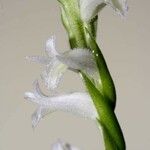
Spiranthes odorata
Marsh ladies'-tresses · Fragrant ladies'-tresses · Marsh lady's tresses · Common ladies' tresses
Description
Source: leafsnapSpiranthes odorata, marsh lady's tresses or common lady's tresses, is a species of flowering plant in the orchid family, native to the southeastern United States, from Texas eastwards and northwards to Delaware. It grows in moist, partially shaded environments with acidic or neutral soil. An herbaceous perennial, this orchid grows up to 50 cm (20 in) tall and broad. The flowers are borne in dense vertical rows on sturdy green spikes, in a slightly twisted pattern (hence Spiranthes, "twisted flower"). This effect is due to uneven cell growth. The flowers, which appear in late summer and autumn, are white, hooded and fragrant (hence the specific epithet odorata). This plant is pollinated by bumblebees, notably Bombus pensylvanicus, Bombus fervidus, Bombus impatiens, and Bombus nevadensis.In the UK, the cultivar ‘Chadd’s Ford’ has gained the Royal Horticultural Society’s Award of Garden Merit. Requiring a fertile soil in partial shade, it is hardy down to −10 °C (14 °F), but in frosty areas needs a dry mulch during the winter months. Botanically it is not actually a Spiranthes odorata but a different species called Spiranthes bightensis.
Care Guide
💧 Water
☀️ Light Full sun
🌡️ Temperature 0–35°C
What is the name of the plant?
The plant is named Marsh lady's tresses.
What is the botanical name of Marsh lady's tresses?
The botanical name of Marsh lady's tresses is Spiranthes odorata.
💨 Humidity
🪴 Soil 6-7
🌱 Fertilizer
One spring application of fertilizer is generally enough for Marsh lady's tresses, though repeated feedings can maximize growth. Apply fertilizer every four to six weeks. Fertilization improves the leaves' appearance and function, helping maintain uniform color and a healthy texture. It also promotes root development and nutrient uptake, supporting the plant's long-term health.
🪴 Pot & Repot
✂️ Pruning
The marsh lady's tresses is a plant that produces fragrant, spiraled blooms and requires minimal pruning. The best time to prune is from early to late spring. During this period, focus on removing dead stems and thinning out overcrowded areas to improve airflow. Regular maintenance promotes healthy growth, improves the plant's shape and flowering, and reduces the risk of disease.
🌿 Propagating
🐛 Diseases & pets
☠️ Toxicity
Characteristics
- Plant Type
- Herb
- Life Cycle
- Perennial
- Genus
- Spiranthes
- Family
- Orchidaceae
- Hardiness Zone
- 3-10
- Mature Height
- 23 cm to 61 cm
- Leaf Type
- Deciduous
- Flower Color
- White