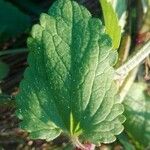
Stachys arvensis
Field stachys · Field woundwort · Hedge-nettle · Corn woundwort · Staggerweed
Description
Source: leafsnapStachys arvensis is a species of flowering plant in the mint family known by the common names field woundwort and staggerweed. It is native to Europe, Western Asia, and North Africa. It is known on other continents as an introduced species and widespread weed. It grows in many types of habitat, including disturbed areas, and often in moist spots. It is an annual herb producing a branching stem up to about 60 centimetres (24 in) in maximum height. The stem is squared in cross-section and it is covered in rough hairs. The oppositely arranged leaves have hairy, serrated or toothed blades up to 2 or 3 centimetres (3⁄4 or 1+1⁄4 in) long which are borne on short petioles. The inflorescence is made up of interrupted clusters of flowers borne in the axils of the leaf pairs. Each cluster has up to 6 flowers with pinkish corollas in hairy purple-tinged calyces of sepals.
Care Guide
💧 Water
Staggerweed, native to temperate regions, thrives in moderately moist soil and requires consistent hydration. For optimal growth, it is recommended to water it weekly. As an outdoor herbaceous plant, staggerweed is well-suited to take advantage of natural rainfall patterns.
How can I water my Staggerweed plant effectively?
To water Staggerweed, there are several options for watering tools such as a garden hose with a spray nozzle or a watering can. This plant is not too particular about the water it receives and can thrive with rainwater, tap water, or filtered water. It is generally recommended to avoid watering from overhead as this can harm the leaves and flowers and potentially lead to disease. Instead, a drip irrigation system is often the best method for watering Staggerweed, ensuring that water is evenly and directly applied to the soil. When watering a container-grown Staggerweed, you can use a cup, watering can, or tap to apply water directly to the soil.
What should I do if I give my Staggerweed too much or too little water?
Underwatering Staggerweed is easily fixed by watering it more consistently when you notice it's lacking moisture. Overwatering, on the other hand, can be much more serious and lead to diseases that cause the plant to decline and die. To prevent this, choose a sunny location with well-draining soil to help dry out excess water. If you overwater a potted Staggerweed, consider repotting it in a new container with better drainage to avoid waterlogged soil.
How often do I need to water my Staggerweed?
Staggerweed requires regular watering throughout the growing season. In spring, water the plant once a week. As the season progresses and the weather gets warmer, increase the watering to two to three times per week. Going beyond this rate can harm the Staggerweed. It is important to keep the soil moist but not wet, regardless of how often you need to water. Watering Staggerweed in a pot is slightly different. Due to the faster drying of pot soil, you should water a container-grown Staggerweed a few times per week, compared to once a week for an in-ground plant.
How much water does my Staggerweed plant need?
Determining the right amount of water for your Staggerweed can be done in a few different ways. Some gardeners prefer to gauge the soil's moisture by feeling it. This method involves watering until the top six inches of soil feel moist. Another approach is to use a specific measurement. Generally, giving your Staggerweed around two gallons of water per week is recommended, but this can vary depending on temperature and soil dryness. It's important to avoid overwatering if your plant needs less water. When growing Staggerweed in a container, you'll need to use a different method. Ensuring that all layers of soil are moist is important, and you can check for moisture by sticking your finger in the soil. You can also water until you see a slight trickle of excess water coming out of the pot's drainage holes.
How can I know if I'm giving enough water to my Staggerweed?
Avoiding overwatering your Staggerweed can be a challenge. These plants need weekly soil moisture due to their deep roots. However, they are highly prone to root rot and browning if overwatered. Underwatering is less of a concern as Staggerweed can survive without additional watering for some time. However, if left without water for too long, it will wilt and develop dry leaves.
☀️ Light Full sun
Staggerweed grows best in areas that provide full sun but can tolerate lower light levels. Too little sunlight may cause slower growth and paler leaves, while excessive sun can damage the plant. Its native habitat offers abundant sun exposure.
What are the sunlight requirements for Staggerweed (Stachys arvensis)?
Staggerweed requires full sun exposure, which means it needs more than 6 hours of sunlight daily. However, it can also tolerate partial sun conditions, where it receives about 3-6 hours of sunlight. It's essential to observe the movement of sunlight through your garden to choose spots that offer a good balance of light and shade, ensuring the plant's well-being. Staggerweed is well-suited for zones that provide complete solar exposure, but it can adapt to lesser light. Insufficient sunlight may result in slower growth and paler leaves, where excessive sun can damage the plant. This plant's natural habitat supports its need for ample sunlight.
How do I use artificial light for indoor Staggerweed plants?
For indoor Staggerweed plants requiring adequate lighting, especially when natural sunlight is scarce, artificial lights can offer an effective solution. Optimal growth is achieved by using artificial lighting to compensate, particularly during winter or in less sunny spaces. LED lights are recommended due to their ability to provide specific light wavelengths needed by the plants. For full sun plants, 30-50W per square foot of artificial light is required, partial sun plants need 20-30W, and full shade plants require 10-20W. The light source should be placed 12-36 inches above the plant, simulating natural sunlight conditions as closely as possible. Moreover, mimicking the natural daylight duration is crucial, with most plants benefiting from 8-12 hours of light per day.
What are the symptoms of light deficiency in Staggerweed?
When cultivated under inadequate light, Staggerweed may exhibit several symptoms indicating light deficiency. These symptoms include smaller new leaves compared to older ones, leggy or sparse growth due to longer spaces between leaves or stems, faster leaf drop as the plant conserves resources for new leaves, delayed or halted new growth, lighter-colored new leaves signifying insufficient chlorophyll, and chlorosis where leaves turn yellow due to chlorophyll breakdown from excessive sunlight. Other symptoms of poor light management include sunscald, which appears as pale or necrotic areas on plant tissue, leaf curling as a defense against excessive sunlight, wilting from loss of turgor pressure, and leaf scorching characterized by brown, dry edges on leaves.
What solutions can address Staggerweed's light deficiency symptoms indoors and outdoors?
To address light deficiency symptoms in Staggerweed, several strategies can be adopted for indoor and outdoor settings. Indoors, gradually move plants to progressively sunnier locations until they receive a minimum of 6 hours of direct sunlight daily. Utilizing a south-facing window and keeping curtains open during the day maximizes sunlight exposure. If a plant is large or not easily movable, consider supplemental artificial lighting, keeping lamps on for at least 8 hours a day. Outdoors, acclimatize your plants by moving them to sunnier spots weekly to avoid sunburn. Note that parts of the plant affected by insufficient sunlight may not recover fully, but new growth will be healthy with proper light exposure. For ground plants, reducing obstructions such as pruning trees can improve sunlight access. Transplanting smaller plants during their dormant period to a location with better sunlight and drainage is also beneficial.
🌡️ Temperature 15–35°C
Staggerweed is native to temperate regions and prefers temperatures of 68 to 95 °F (20 to 35 °C). Each season, adjust conditions as needed to mimic its native temperature environment for optimal growth.
What is the ideal temperature range for growing Staggerweed?
Staggerweed thrives in temperate climates, with an ideal temperature range between 68 to 95 °F (20 to 35 °C). To ensure optimal growth, it's important to adjust the surrounding environment each season to mimic these conditions. Although Staggerweed has some cold tolerance and usually does not require additional measures when temperatures are above 0°C, precautions should be taken to protect it from colder temperatures by using materials like plastic film or fabric for insulation.
How does Staggerweed react to low temperatures, and what should be done?
Staggerweed has a moderate tolerance to low temperatures and performs best when kept above 20°C. In winter, it's crucial to maintain temperatures above 0°C. If temperatures fall below -10°C, Staggerweed's leaves may droop, and severe cold can lead to wilting and leaf drop. To mitigate frost damage, trim the affected parts and protect the plant from future cold by wrapping it with non-woven fabric or cloth and erecting a wind barrier.
What are the effects of high temperatures on Staggerweed and how can they be managed?
During the summer, it's important to keep Staggerweed's temperature below 35°C. Exposure to temperatures above 41°C can lead to lighter leaf color, dry and withered leaf tips, curling leaves, and an increased risk of sunburn. Managing high temperature stress involves trimming sunburned and dried parts, relocating the plant to a shaded area or using a shade cloth to protect it, and watering the plant in the mornings and evenings to maintain soil moisture.
What is the botanic name of Staggerweed?
The botanical name of Staggerweed is Stachys arvensis.
💨 Humidity
🪴 Soil 6-7
🌱 Fertilizer
Staggerweed responds well to regular, light applications of fertilizer to encourage healthy leaf development. Apply fertilizer to Staggerweed about once a month during the summer months. Nitrogen is important for foliage, and supplying nitrogen-rich sources helps Staggerweed thrive.
🪴 Pot & Repot
✂️ Pruning
Staggerweed features soft, hairy leaves and whorled flowers. To maintain its shape and encourage healthy growth, prune it from early to late spring, which also helps remove any damaged foliage and prevents legginess. Regular maintenance not only enhances its aesthetic appeal but also manages its invasive potential, promoting vigorous development.
🌿 Propagating
🐛 Diseases & pets
☠️ Toxicity
Characteristics
- Plant Type
- Herb
- Life Cycle
- Annual, Perennial
- Genus
- Stachys
- Family
- Lamiaceae
- Hardiness Zone
- 8-10
- Mature Height
- 61 cm
- Mature Spread
- 15 cm to 25 cm
- Leaf Color
- Green
- Leaf Type
- Semi-evergreen
- Flower Color
- Pink, Purple
- Flower Size
- 0.76 cm to 1.27 cm
- Bloom Time
- Mid spring, Late spring, Summer, Fall
- Planting Time
- Spring
- Harvest Time
- Summer, Fall, Early winter
- Native Area
- Turkey, Sweden, Slovakia, Montenegro, Slovenia, Morocco, Croatia, Russia, Germany, Jordan, Estonia, Latvia, Belgium, Portugal, Netherlands, France, Tunisia, Poland, Greece, North Macedonia, Ukraine, Lebanon, Serbia, Lithuania, China, Afghanistan, Syria, Italy, Spain, Switzerland, Denmark, Israel, Albania, Ireland, United Kingdom, Algeria