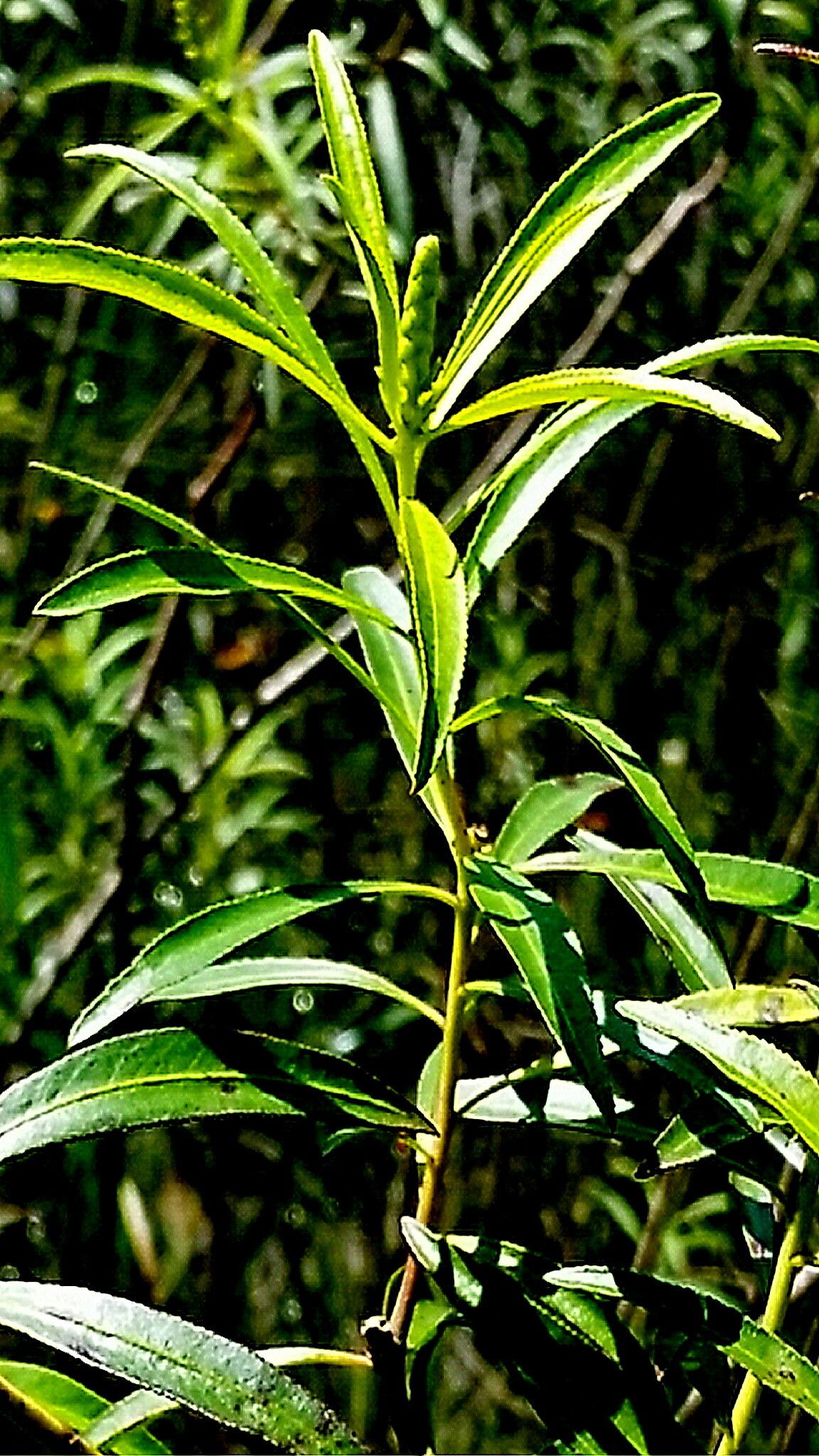
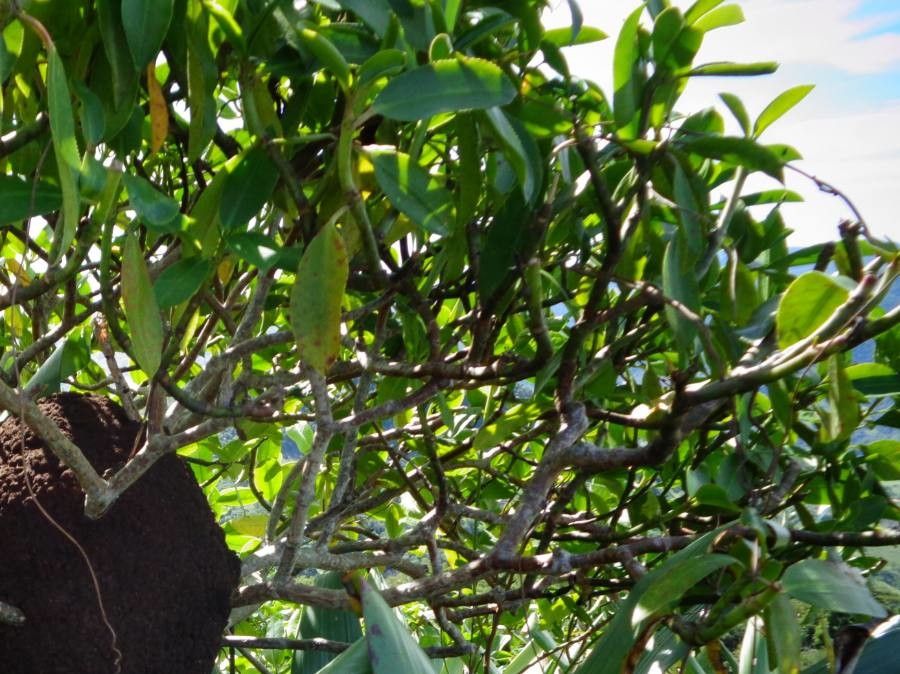
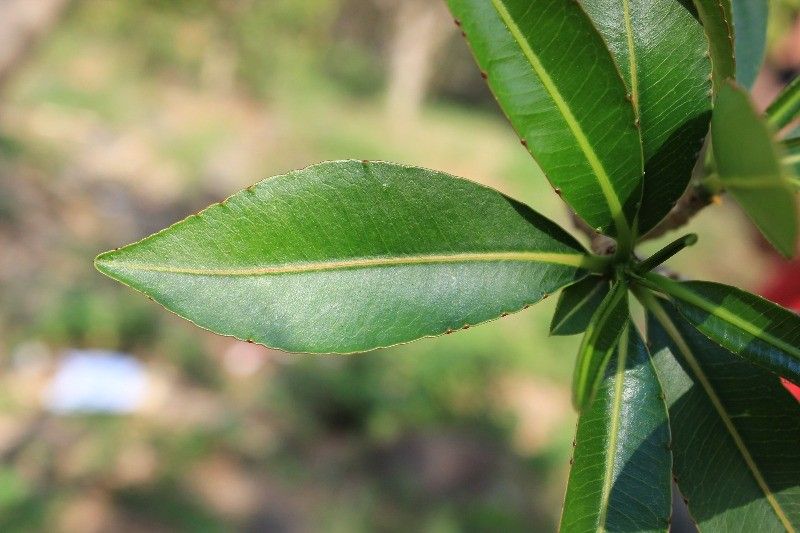
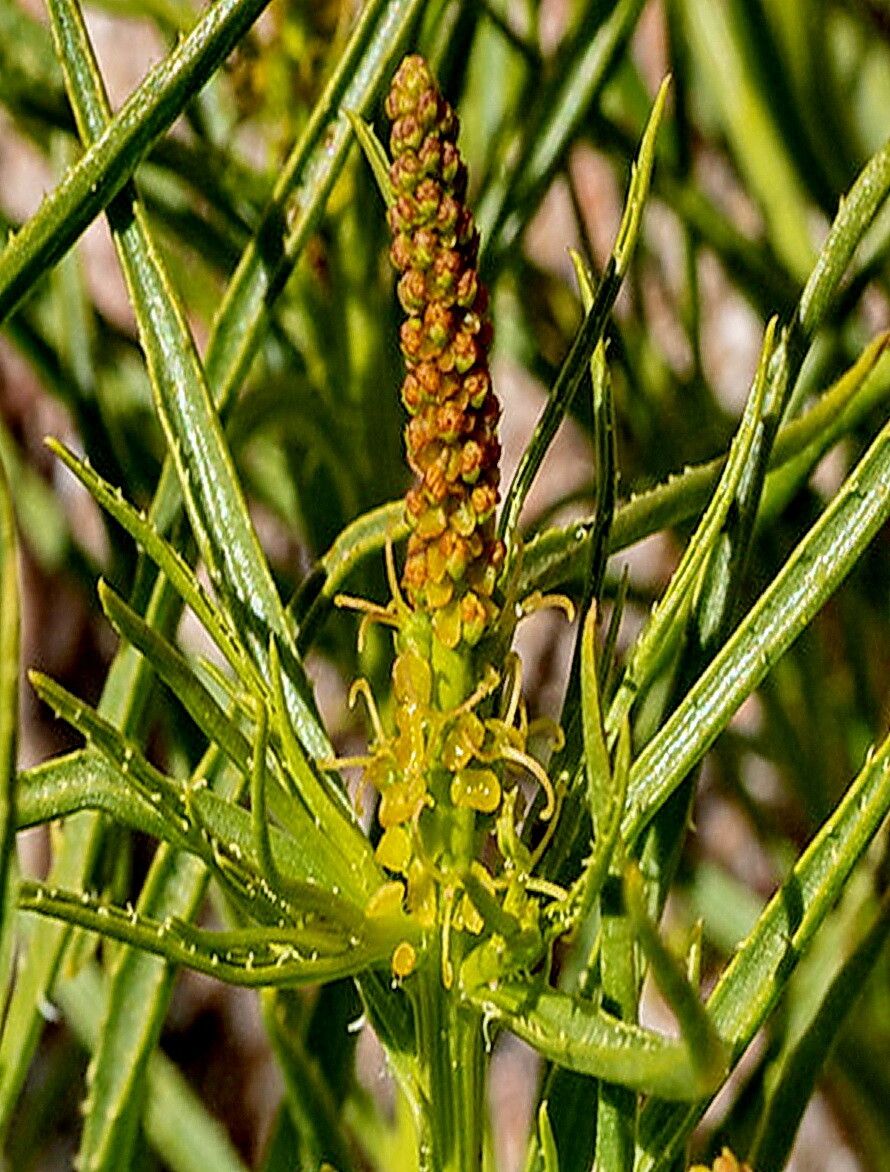
Stillingia spinulosa is a species of flowering plant in the euphorb family known by the common name annual toothleaf. It is native to the Southwestern United States where it occurs in the creosote scrub of the deserts. It is an annual or perennial herb producing a clump of thick, leafy stems approaching a meter in maximum height. The alternately arranged leaves have shiny pointed oval blades 2 to 4 centimeters long and up to 1.2 centimeters wide which are lined with sharp teeth. The inflorescence is a stout spike of flowers 1 to 2 centimeters long. The plant is monoecious, and each spike has several male flowers at the tip and 1 or 2 fruit-bearing female flowers below these. Neither type of flower has petals. The ovary of the female flower develops into a three-lobed greenish capsule about half a centimeter wide. There is a tiny rough-surfaced seed in each of the three chambers of the fruit.
Annual toothleaf is disease-resistant and typically not prone to ailments. Regarding care, this plant is fairly low-maintenance. When grown outdoors it needs only minimal watering, and larger specimens generally do not require pruning. Smaller plants, however, should be pruned after they have finished blooming. Annual toothleaf is suitable for anyone with an outdoor area, such as a garden or deck, and does not require a lot of experience in plant care.
How to keep Stillingia Spinulosa.
Light
Annual toothleaf comes from open habitats, like sunny meadows and forest edges, that provide abundant light. It does best in Full Sun but will also tolerate Partial Sun, showing adaptability to different light levels.
Temperature
Annual toothleaf comes from tropical areas, where the weather is generally warm and humid. Consequently, it is adapted to high heat and humidity. It is sensitive to sudden temperature shifts and prefers a steady thermal environment, so avoiding temperature fluctuations indoors is important. It typically does not tolerate cold and needs higher temperatures to grow. If the surrounding temperature falls too low, the plant may stop growing or even die.
Pruning
To promote the health and growth of annual toothleaf, it's important to prune the plant carefully from early to late spring. Start by removing any damaged stems and thinning out crowded areas to improve airflow. This practice not only encourages healthy growth but also enhances the plant's structure and helps prevent disease. Remember to always use clean, sharp tools to minimize the risk of spreading pathogens.
Botanical profile.
- Plant Type
- Shrub
- Life Cycle
- Annual
- Genus
- Stillingia
- Family
- Euphorbiaceae
- Hardiness Zone
- 9-11
- Mature Height
- 30 cm to 61 cm
- Mature Spread
- 30 cm to 49 cm
- Leaf Color
- Light Green, Olive Drab
- Leaf Type
- Deciduous
- Flower Size
- 0.25 cm to 0.51 cm
- Bloom Time
- Late spring, Early summer, Mid summer
- Planting Time
- Spring, Summer, Autumn
- Harvest Time
- Late summer, Early fall, Mid fall
- Native Area
- Mexico
Other names.
Reader questions.
What is the botanical name of Annual toothleaf?
The botanical name of Annual toothleaf is Stillingia spinulosa.