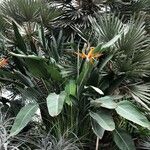
Strelitzia reginae
پرنده بهشتی · Bird of Paradise · Bird of paradise plant · Bird-Of-Paradise · Queen's bird-of-paradise
Description
Source: leafsnapStrelitzia reginae, commonly known as the bird of paradise plant, is a tropical perennial native to South Africa. It belongs to the Strelitziaceae family and is celebrated for its striking orange and blue flowers that resemble the head of a bird. This plant can grow up to 6 feet tall and features large, paddle-shaped leaves that can reach up to 18 inches in length. The bird of paradise plant thrives in full sun or partial shade and requires well-draining soil. Although it can tolerate drought conditions, it needs regular watering during its growing season in spring and summer. The plant can be propagated through division or by seed. Beyond its ornamental value, Strelitzia reginae has several medicinal uses in traditional African medicine. It is used to treat various ailments such as fever, headaches, respiratory infections, and skin conditions. Overall, Strelitzia reginae is a visually striking tropical perennial, making it a popular choice for gardens around the world.
💡 According to legend, there was a fairy who missed meeting her lover and was unable to transform into a bird. Instead, she turned herself into a bird-shaped flower, which we now know as the bird of paradise flower.
🌳 Besides being popular in gardens for its striking blooms, the bird of paradise has been used in sustainable horticulture. Its distinctive form and pest resistance make it a desirable component of ecological landscapes. Research indicates the bird of paradise could be employed in phytoremediation, using its ability to accumulate certain heavy metals to improve soil quality without harming the plant.
🎭 Splendor, loyalty, affection, hopefulness
Care Guide
💧 Water Every 7 days
The Bird of Paradise plant flourishes in subtropical climates. It needs consistent moisture but can tolerate short periods of dryness. The plant prefers well-draining soil that is rich in humus and requires watering once a week. As an indoor evergreen, regular misting helps mimic its native humid environment, encouraging lush foliage and vibrant blooms.
When Should I Water My Bird Of Paradise?
The ideal time to water a Bird of Paradise is when the top 1 to 2 inches of soil are dry to the touch. Observing the plant's leaves can also provide indications for the need for water; wilted, lackluster, or yellowing leaves suggest the plant is under-watered. Additionally, during its pre-flowering stage and in conditions of warm temperatures and high sunlight exposure, the Bird of Paradise has increased water requirements. However, be cautious not to water too early or too late to avoid risks such as root rot or plant dehydration.
How Should I Water My Bird Of Paradise?
Watering your Bird of Paradise effectively involves using bottom-watering techniques to ensure the roots receive adequate moisture without over-saturating the soil or wetting the foliage, which can lead to fungal diseases. Use a watering can with a narrow spout to direct water straight to the base of the plant, minimizing moisture on the leaves and focusing hydration at the root level.
How Much Water Does Bird Of Paradise Really Need?
Bird of Paradise requires deep watering sessions, with the recommended volume for a mature plant in a medium-sized pot being between 500-750 milliliters. However, the actual amount can vary based on factors such as pot and plant size, with a smaller pot needing around 250-500 milliliters. Ensuring the soil is moist but not waterlogged is key to avoiding over or under-watering. Proper hydration is indicated by vibrant and upright leaves and a moist, but not soggy, soil environment.
What Kind of Water is Best for Bird Of Paradise?
The best type of water for Bird of Paradise is distilled, rainwater, or filtered water, due to its sensitivity to chlorine, fluoride, and other minerals that may be present in tap water. Allowing tap water to sit for about 24 hours before use can help evaporate chlorine; using room temperature or lukewarm water is ideal as cold water can shock the plant's system.
How Do Bird Of Paradise's Watering Needs Change with the Seasons?
Bird of Paradise's watering needs vary through the seasons; spring requires regular watering to support growth, while summer calls for less frequent watering. During autumn, gradually reduce watering frequency as the plant prepares for dormancy, and in winter, reduce watering further, allowing the soil to dry out more between sessions, as the plant's water requirement decreases.
☀️ Light Full sun
Bird of paradise performs best with plenty of sunlight, though it can cope with moderate light levels. Native to areas with abundant sun, too little light can cause poor growth and a failure to flower. Conversely, too much sun can scorch the leaves.
What are the sunlight requirements for the Bird of Paradise?
The Bird of Paradise requires full sun exposure for optimal growth, characterized by more than 6 hours of sunlight per day. However, it can also adjust to conditions of partial sun, which involves about 3-6 hours of sunlight. It's essential to observe the movement of sunlight through your garden to choose the best spots that offer a balance of light and shade, ensuring your plants remain healthy and happy.
How does sunlight affect the growth of the Bird of Paradise?
Sunlight plays a critical role in the health and flowering of the Bird of Paradise. Originating from sun-rich environments, this plant thrives under abundant sunlight exposure but can tolerate moderate light conditions. Insufficient light can lead to weak growth and a failure to flower, while too much direct sunlight might cause leaf scorching. Observing your plant's light environment is crucial to adjust placement for optimal growth and flowering.
Can artificial lighting be used for Bird of Paradise indoors, and what are the recommendations?
Yes, artificial lighting can support the growth of Bird of Paradise indoors, especially when natural sunlight is insufficient, such as during winter or in less sunny spaces. LED lights are recommended because they can be adjusted to provide specific light wavelengths needed by the plant. For full sun plants, 30-50W per square foot is advisable; partial sun plants require 20-30W per square foot, and full shade plants need 10-20W per square foot. The appropriate distance for the light source is 12-36 inches above the plant to mimic natural sunlight, and it's important to match the natural daylight hours, with most plants needing 8-12 hours of light per day.
What are the symptoms of inadequate lighting for a Bird of Paradise?
Indoor Bird of Paradise plants, especially during winter, may experience inadequate lighting, which can lead to several symptoms: slower or ceased new growth due to the plant entering survival mode; smaller new leaves compared to previous ones; leggy or sparse growth resulting in a thin, stretched appearance; chlorosis, where leaves lose their green color and turn yellow due to chlorophyll breakdown; sunscald characterized by pale, bleached areas on plant tissue; leaf curling as a defense mechanism against excessive sunlight; wilting due to increased transpiration and hydration problems; and leaf scorching, identified by brown, dry edges on leaves. These symptoms indicate the need for adjusting the plant's light exposure.
What solutions can help a Bird of Paradise suffering from inadequate sunlight?
To alleviate symptoms of inadequate sunlight for Bird of Paradise, consider these solutions based on the plant's location: Indoors, gradually move the plant to a location with at least 6 hours of direct sunlight daily, using a south-facing window and keeping curtains open during the day. If the plant is large or not easily movable, artificial lighting such as desk or ceiling lamps or professional plant grow lights can provide additional light for at least 8 hours daily. Outdoors, move plants gradually to sunnier spots to avoid sunburn, adapting to increased light intensity step by step. On the ground, reduce obstructions like trees by pruning, and for smaller plants, consider transplanting during the plant's dormant period to a location with ample sunlight and good drainage. Regardless of efforts, parts of the plant affected by previous inadequate sunlight may not recover fully, but new growth should be healthy with improved light conditions.
🌡️ Temperature 20–37.8°C
The bird of paradise does best in moderate to warm conditions, with temperatures ranging from 68 to 100 °F (20 to 38 °C). In its native habitat it prospers in warm coastal regions where temperatures rarely drop below 50 °F (10 °C). In winter, keep it above 50 to 55 °F (10 to 13 °C) to avoid frost damage. In summer it can tolerate somewhat higher temperatures but should be kept out of direct sun during the hottest part of the day.
What are the ideal temperature conditions for a Bird of Paradise plant?
The Bird of Paradise (Strelitzia reginae) flourishes in environments that are moderate to warm, favoring a temperature range of 68 to 100°F (20 to 38°C). It thrives particularly well in warm coastal climates where the temperature seldom drops below 50°F (10°C). During the winter, it's crucial to maintain the temperature above 50 to 55°F (10 to 13°C) to prevent frost damage. While it can tolerate higher temperatures in the summer, it should be protected from direct sunlight during the hottest parts of the day. It's important to note that the Bird of Paradise is susceptible to cold and should be moved indoors during autumn to a bright location away from direct heat sources, ensuring temperatures remain above the minimum threshold for healthy growth.
How should you care for a Bird of Paradise plant in low temperature conditions?
The Bird of Paradise prefers warm climates and struggles in low temperatures, thriving best when kept above a certain minimum temperature. In winter, temperatures should not drop below a specific lower limit. Exposure to temperatures below this minimum can lead to leaves lightening in color, and after frost damage, the leaves may turn brown or black, accompanied by wilting and drooping. To counteract low temperature damage, trim off the frost-damaged parts and move the plant indoors to a warm spot, ideally near a south-facing window for ample sunlight. It's also advisable to avoid placing the plant near heaters or air conditioning vents to prevent air from becoming excessively dry.
What steps should be taken for a Bird of Paradise plant in high temperature conditions?
During the summer months, the Bird of Paradise should be kept below a certain maximum temperature. Exceeding this temperature can cause the leaves to lighten and increase the risk of sunburn. To care for a plant in high temperature conditions, trim away the sunburned and dried-up parts and move the plant to a location that offers shade during the midday and afternoon sun. Watering the plant in the morning and evening helps keep the soil consistently moist, providing relief from the high heat.
💨 Humidity normal (40-60%)
This plant will thrive in moderate humidity, which is probably the level in your home. However, misting it a few times a week can be very beneficial. Make sure the room has good ventilation.
🪴 Soil 6-7
🌱 Fertilizer
Appropriate fertilization is essential for the Bird of Paradise's health and appearance. Fertilize the Bird of Paradise in summer, repeating the application monthly throughout the season. Nutrients fuel growth and sustain the plant's structures. Fertilizing improves the Bird of Paradise's floral display, ensuring the best blooms.
🪴 Pot & Repot 2-3 years
When repotting Bird of paradise, pick a pot 1-2 inches (2.5–5.1 cm) larger that provides good drainage. Use a well-draining potting mix. Repot in spring or fall, making sure the root ball sits slightly lower than the rim of the flower pot. Water thoroughly after repotting and place it in a warm spot with indirect sunlight.
✂️ Pruning
The bird of paradise plant flourishes with regular pruning, which is best performed from late winter to early spring. During this time, remove any dead leaves and spent flowers. It's also helpful to thin out congested areas to improve light and air circulation. These steps encourage new blooms, prevent overgrowth, and promote overall vitality in your garden.
🌿 Propagating
🐛 Diseases & pets
☠️ Toxicity
Characteristics
- Plant Type
- Herb
- Life Cycle
- Perennial
- Genus
- Strelitzia
- Family
- Strelitziaceae
- Hardiness Zone
- 10-12
- Mature Height
- 1.22 m to 1.83 m
- Mature Spread
- 30 cm to 91 cm
- Leaf Color
- Green, Gray, Silver, Blue
- Leaf Type
- Evergreen
- Flower Color
- Orange, Blue
- Flower Size
- 7.62 cm to 10.16 cm
- Bloom Time
- All year round
- Planting Time
- Spring
- Harvest Time
- All year round
- Native Area
- South Africa