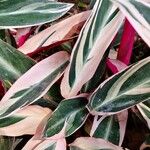
Stromanthe thalia
مارانتا · Stromanthe Triostar · Never-never plant · Maranta · Tri color shell ginger
Description
Source: wikipedia (CC BY-SA)Stromanthe thalia is a plant species in the arrowroot family Marantaceae, native to the Brazilian rainforest. It is also known by the synonym Stromanthe sanguinea.
💡 This plant is part of the prayer plant family and has a unique behavior: it folds its leaves at night, revealing their colorful undersides. This movement, known as nyctinasty, is common to all prayer plants. One theory suggests that these movements help the plant follow the sun throughout the day to capture as much light as possible.
🌳 Tricolor stromanthe is mainly appreciated for its decorative qualities, yet its potential uses, such as phytofiltration, could be interesting to explore. The ability of houseplants to enhance indoor air quality implies that tricolor stromanthe might help reduce indoor pollutants, although there are few studies specifically on this species.
Care Guide
💧 Water Every week
The tricolor stromanthe thrives in environments with high humidity and prefers soil that is moist yet well-drained. To replicate its natural conditions, it's best to follow a weekly watering routine. Often grown indoors, the tricolor stromanthe needs consistent moisture during its growing season to maintain its vibrant foliage.
What should I do if I give too much or too little water to my Tricolor stromanthe plant?
To determine if you have watering problems with your plant, carefully observe it. Signs of overwatering include yellow leaves with yellow-brown patches at the tips, as well as severe drooping and curling of the leaves due to root rot and difficulty in absorbing more water. If you have a Tricolor stromanthe indoors, be cautious of overwatering as it cannot tolerate standing water. If you notice overwatering, stop watering and allow the soil to air out for 3-5 days. If you notice signs of root rot, you will need to act quickly by removing the plant from the pot or ground, washing off the roots, removing any dead or decaying roots, and replanting with new soil. Underwatering is also a concern, particularly for the Tricolor stromanthe which is sensitive to drought conditions. Signs of underwatering include curled, pendulous, lifeless leaves, gradual yellowing from the bottom, and browning edges of the leaves. To address underwatering, increase the frequency of watering and consider adjusting humidity levels or changing the plant's location if necessary.
How often should I give water to my Tricolor stromanthe?
To effectively water your Tricolor stromanthe, follow these guidelines: During spring, water the plant once a week. In summer, increase the watering frequency compared to spring, but decrease it during winter. However, remember that the timing may vary based on factors like humidity, temperature, and soil type. To determine the right watering frequency, regularly check the soil condition using your finger or a Soil Moisture Meter. The soil should be kept moist but not soggy. Water the plant when the top 1.5-2 inches of soil have dried out, and adjust the watering schedule accordingly by testing the soil. Potted plants are more susceptible to overwatering, so ensure that the pot has proper drainage holes and well-draining soil. Before watering, make sure there is no excess water in the plant tray. If your Tricolor stromanthe is planted in the ground, it will benefit from rainfall. Ideally, it needs about 1 inch of rain per week for healthy growth. If rainfall is insufficient, water the plant once a week to compensate. Humidity also plays a role in proper watering. Although the plant can tolerate normal room humidity, it prefers higher humidity, around 40 to 60 percent. Higher humidity levels keep the soil moist for longer. For indoor plants, place a small humidifier nearby. For outdoor plants, misting them throughout the day can increase humidity.
How should I water my Tricolor stromanthe correctly?
Here are some easier-to-follow instructions on watering your Tricolor stromanthe: 1. If your plant is in a small indoor pot, you can take it to the kitchen sink and use the faucet to water it. Hold the pot and stop watering when water starts coming out of the drainage holes. Avoid doing this during winter or in cold climates, as it could harm the plant's roots. 2. If your local tap water has a high proportion of fluorine, chlorine, or salts, consider using rainwater or lake water instead. 3. You can also water the plant by using a watering can, hose, or any tool of your choice. This method works well for overhead watering or watering directly into the soil. 4. For Tricolor stromanthe plants in the ground, if there isn't enough rain, aim the hose at the root system and water for more than 10 minutes to ensure thorough watering. 5. The Tricolor stromanthe prefers soft, acidic water with a pH of 6.5. If you have hard water, you can use an at-home water filter or let tap water sit out for 24 hours to remove minerals and salts. Filtered water or rainwater is a better option for these plants. 6. If it's raining, you can collect rainwater to use for your Tricolor stromanthe.
When is the best time to water my Tricolor stromanthe?
To keep tricolor stromanthe plants healthy, it is important to maintain humid conditions to keep them moist. However, it is crucial to prevent the roots from becoming rotten by avoiding excessive moisture. To ensure proper watering, it is recommended to wait until the top 1.5-2 inches of soil has dried out before watering again. The depth of soil testing should be proportional to the soil depth. For example, if the soil depth is around 5 inches, testing about 1.5 inches (about one-third of the soil depth) is sufficient, but larger pots may require more testing. If you have a Soil Moisture Meter, you can easily determine when to water by inserting it into the soil. When the moisture meter reads around 3, it is an indicator that watering is needed. If the reading is still higher than 3, waiting a bit longer for the soil to dry out is necessary. Following these guidelines will help you avoid overwatering your plants.
☀️ Light Partial sun
Tricolor stromanthe prefers a moderate amount of light, like the forest understory habitats where it naturally grows. While it can survive in lower-light situations, its growth may be reduced. Either lunarity or excessive exposure to sunlight can cause its leaf colors to fade or the foliage to become scorched.
What are the sunlight requirements for Tricolor stromanthe?
Tricolor stromanthe, with its botanical name Stromanthe thalia, flourishes best in conditions that mimic the forest understory where it naturally grows. It favors a moderate amount of sunlight, equivalent to partial sun or about 3-6 hours of sunlight daily. While it can tolerate full shade, receiving less than 3 hours of sunlight, its growth may be hindered under these conditions. Inadequate sunlight might result in the plant's leaves losing their vibrant colors and potentially becoming scorched due to overexposure. It's beneficial to observe the sunlight's movement in your garden to identify the perfect spots that offer a balance of light and shade, ensuring the well-being of your plants.
How can artificial lighting be used for Tricolor stromanthe indoors?
When natural sunlight is insufficient, especially during winter or in less sunny spaces, artificial lighting becomes a critical solution for the healthy growth of Tricolor stromanthe indoors. Optimal growth can be achieved by choosing the right type of artificial light, with LED lights being a popular and efficient option because they can be adjusted to provide the specific wavelengths needed by the plant. The requirements vary based on the plant's nature: full sun plants need 30-50W per square foot, partial sun plants require 20-30W per square foot, and full shade plants benefit from 10-20W per square foot of artificial light. The light source should ideally be placed 12-36 inches above the plant, mimicking natural sunlight, and kept on for 8-12 hours per day to simulate the length of natural daylight hours.
What are the signs of insufficient or excessive sunlight in Tricolor stromanthe?
Tricolor stromanthe displays several signs when it experiences insufficient or excessive sunlight. In low light conditions, the plant may exhibit slower or halted growth, lighter-colored new leaves indicating a lack of chlorophyll, and potentially chlorosis, where leaves lose their green color. Excessive sunlight can cause symptoms like sunscald, which results in pale or bleached areas on leaves, leaf curling as a defense mechanism against excessive exposure, wilting due to increased water loss, and leaf scorching, characterized by brown, dry, and crispy leaf edges. These signs help diagnose whether a plant is suffering from too little or too much sunlight exposure.
How can I alleviate symptoms of improper sunlight exposure for Tricolor stromanthe?
To optimize Tricolor stromanthe's growth and alleviate symptoms of improper sunlight exposure, gradual adaptation to changing light conditions is key. For indoor plants, shifting them to progressively sunnier spots each week until they receive 3-6 hours of direct sunlight daily can help, as can supplementing with artificial light if the plant is large or challenging to move. Ensure the artificial light is kept on for at least 8 hours daily. Outdoors, it's vital to move plants gradually to sunnier locations to avoid sunburn, taking care to make these changes in light intensity slowly. Additionally, reducing obstacles that block sunlight, such as pruning tree branches, or transplanting smaller plants to areas with better sunlight and drainage, can significantly benefit the plant's overall health and growth.
🌡️ Temperature 20–37.8°C
Tricolor stromanthe is native to tropical environments, where temperatures range from 20 to 38 ℃ (68 to 100 ℉). The plant favors temperatures between 20 and 24℃ (68 to 75 ℉) and cannot tolerate temperatures under 15℃ (59℉). In winter, it is advisable to keep the plant away from drafty windows and doors and to maintain a steady indoor temperature of 18–21℃ (64 to 70℉) to prevent damage to the foliage.
What is the ideal temperature range for Tricolor stromanthe?
The Tricolor stromanthe thrives in tropical environments where temperatures range between 20 to 38°C (68 to 100°F). It prefers temperatures between 20 and 24°C (68 to 75°F) for optimal growth. During the colder months, it's important to ensure that the plant is kept in a consistently warm environment, away from drafty windows and doors, with indoor temperatures maintained between 18 and 21°C (64 to 70°F) to prevent foliage damage. The plant is extremely sensitive to cold and should not be exposed to temperatures below 15°C (59°F), especially during winter, where it is advisable to maintain temperatures above 20°C.
What should I do if my Tricolor stromanthe is exposed to low temperatures?
If a Tricolor stromanthe is exposed to low temperatures, it may display symptoms such as the lightening of leaf color when temperatures fall below 1°C, with leaves turning brown or black and showing signs of wilting and drooping after frost damage. To remedy this, trim off the frost-damaged parts and immediately move the plant to a warm, indoor environment to protect it from the cold. It's best to place the plant near a south-facing window to ensure it receives ample sunlight, but keep it away from direct heat sources like heaters or air conditioning vents to avoid air dryness.
How should I care for my Tricolor stromanthe during high temperatures?
During the summer, Tricolor stromanthe should be kept in conditions below 38°C (100°F) to prevent heat stress. Exposure to temperatures above 43°C (109°F) can lighten the color of the leaves and make the plant more prone to sunburn. To manage these conditions, trim away any sunburned and dried parts of the plant, and relocate it to a spot that is protected from the intense midday and afternoon sun. Ensuring the plant is watered in the mornings and evenings will help keep the soil moist, further protecting it from heat stress.
💨 Humidity high (>60%)
This plant needs special care because it loves high humidity levels of 60-80% or more. The best way to achieve this is by placing a humidifier near the plant. Daily misting is also essential! Make sure the room has good ventilation.
🪴 Soil 5-6
🌱 Fertilizer
Tricolor stromanthe needs the most fertilizer during its active growth period, which is primarily in spring, summer, and early fall. Fertilization supplies essential nutrients that the soil may lack, supporting healthy root and stem development and the attractive foliage that is a key feature of this plant.
Why do I have to add fertilizer to my Tricolor stromanthe plant?
Plants, including the Tricolor stromanthe, depend on soil nutrients for their growth. However, it's not always guaranteed that the soil they grow in will have all the necessary nutrients. That's where fertilization and soil amendments come in, ensuring that your garden plants not only get the basic nutrients they need but also the specific ones they require. In the case of Tricolor stromanthe, fertilizer is essential for healthy root and stem development throughout the growing season. It also helps the plant produce beautiful leaves, which are the main attraction of this ornamental plant.
When should I fertilize my Tricolor stromanthe for the best results?
During the active growth phase of a Tricolor stromanthe, which usually occurs in spring, summer, and early fall, it will require the most fertilizer. After winter ends, you should feed it every two to four weeks until the arrival of fall. During fall, you can gradually reduce the amount of fertilizer given, ultimately stopping entirely in preparation for the low growth period in winter.
When is the best time to not put fertilizer on my Tricolor stromanthe?
For most of the year, from spring through fall, it's important to regularly feed your Tricolor stromanthe. The only exception is if you have given it too much fertilizer or fertilized it incorrectly, which can cause issues like fertilizer burn. In that case, you'll need to fix the problem before resuming regular feeding. However, during the winter, especially if you grow the plant indoors in a cold area, the Tricolor stromanthe will go into a dormant phase. It's important not to fertilize it during this time, as it won't benefit the plant's growth and could potentially cause fertilizer burn.
What fertilizer should I use for my Tricolor stromanthe plant?
The fertilizer for a Tricolor stromanthe requires a specific blend of nutrients, with each nutrient present in relatively low amounts. An ideal fertilizer for this plant will have an N-P-K ratio of 3-1-2. However, a general-purpose fertilizer with an even blend of nutrients can also work well in some cases. When using any fertilizer, including a balanced one, it is important to ensure that the ratio number representing the volume of each nutrient is at 10 or lower. You can choose to use either a granular or liquid-based fertilizer for your Tricolor stromanthe. If you opt for a liquid-based fertilizer, it is advisable to dilute the strength by half. While there are not many downsides to using granular fertilizer, it is often most practical to use liquid fertilizer, particularly if you prefer to feed your Tricolor stromanthe while watering it.
How should I feed my Tricolor stromanthe?
When it comes to fertilizing your Tricolor stromanthe, the fertilizer you buy will usually come with instructions that are important to follow. Specifically for this type of plant, it is best to fertilize just before or during watering. This will protect the roots from being burned by the fertilizer. If you use a slow-release granular fertilizer, sprinkle it on the soil and then water right away. For liquid fertilizer, dilute it with water, apply it to the soil, and then water a bit more. It is especially important to dilute the fertilizer by at least half in the spring and fall when the plant's growth is increasing or slowing down, respectively.
🪴 Pot & Repot 3-4 years
When repotting Tricolor stromanthe, select a container slightly larger than the current one that has good drainage. Do this in spring or fall and use a well-draining potting mix. Set the plant at the same depth it was previously. After repotting, water thoroughly and move it to a warm spot with bright, indirect light. Avoid watering too much to prevent root rot.
✂️ Pruning
To help your tricolor stromanthe thrive, start by lightly pruning it in early spring to promote new growth. Be sure to remove any faded leaves at the base of the plant and avoid cutting back too much. Always use sharp, clean tools to reduce the risk of infection. Regularly checking for pests and diseases can also improve the plant's health and vitality.
🌿 Propagating
🐛 Diseases & pets
☠️ Toxicity
Characteristics
- Plant Type
- Herb
- Life Cycle
- Perennial
- Genus
- Stromanthe
- Family
- Marantaceae
- Hardiness Zone
- 10-12
- Mature Height
- 61 cm to 91 cm
- Mature Spread
- 30 cm to 61 cm
- Leaf Color
- Green, Red
- Leaf Type
- Evergreen
- Flower Color
- White, Pink
- Flower Size
- 2.54 cm
- Bloom Time
- Summer, Early fall
- Planting Time
- Spring, Summer, Autumn
- Harvest Time
- Late summer, Fall
- Native Area
- Brazil