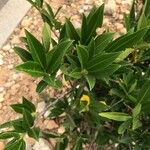
Strychnos pungens
Spiny-leaved monkey-orange · Umgwadi · Umgwai · Spine-leaved monkey-orange
Description
Source: leafsnapStrychnos pungens, commonly known as the spiny monkey orange or green monkey orange, is a small tree or shrub belonging to the Loganiaceae family. It is native to southern Africa and thrives in a variety of habitats including savannas, woodlands, and rocky hillsides. The leaves of Strychnos pungens are glossy green and leathery, emitting a distinctive smell when crushed. The plant produces small, fragrant white flowers that attract pollinators such as bees and butterflies. The fruit of Strychnos pungens is round, with a diameter of about 5 cm. It has a hard outer shell covered in sharp spines, which protect the edible pulp inside. The pulp has an acidic taste similar to citrus fruits but can be toxic if consumed in large quantities. For centuries, indigenous people have used Strychnos pungens for medicinal purposes, leveraging its anti-inflammatory, analgesic, antimalarial, and antitumor properties, among others. Overall, Strychnos pungens is a remarkable plant with distinctive features. Its medicinal properties make it valuable in traditional medicine, while its unique appearance makes it suitable for ornamental landscaping.
Care Guide
💧 Water Every 7 days
☀️ Light Partial sun
Spine-leaved monkey-orange is native to habitats like forest understories or rocky areas, where it experiences natural shade. It prefers partial sun but can adapt to full sun or full shade, demonstrating its versatile, hardy nature.
🌡️ Temperature 20–37.8°C
Spine-leaved monkey-orange shows good adaptability to temperature, being capable of withstanding higher heat and wider temperature fluctuations. In hot conditions, care should be taken with watering and providing suitable shade to avoid sunburn. However, spine-leaved monkey-orange is relatively sensitive to low temperatures; although it can tolerate a certain amount of cold, excessively low temperatures can cause frost damage.
💨 Humidity normal (40-60%)
This plant will thrive in moderate humidity, which is probably the level in your home. However, misting it a few times a week can be very beneficial. Make sure the room has good ventilation.
🪴 Soil 6-7
🌱 Fertilizer
Timing of fertilization is important for the Spine-leaved monkey-orange. Apply fertilizer in early spring and continue once a month until early summer. Fertilizer promotes attractive blooms and provides energy both during dormancy and in active growth periods.
🪴 Pot & Repot
✂️ Pruning
The spine-leaved monkey-orange is characterized by its spine-like leaves and juicy fruits. To promote healthy growth and fruit production, prune the plant in early spring to remove dead branches and shape it. Regular light pruning helps maintain its vigor, and using sterilized tools prevents disease. For the best care practices, refer to local horticultural guidelines.
🌿 Propagating
🐛 Diseases & pets
☠️ Toxicity
Characteristics
- Plant Type
- Shrub
- Life Cycle
- Perennial
- Genus
- Strychnos
- Family
- Loganiaceae
- Hardiness Zone
- 10-12
- Mature Height
- 4.88 m to 10.06 m
- Mature Spread
- 3.05 m to 6.1 m
- Leaf Color
- Dark Green
- Leaf Type
- Deciduous
- Flower Color
- White
- Flower Size
- 1.02 cm to 1.52 cm
- Bloom Time
- Mid fall, Late fall, Early winter
- Planting Time
- Spring, Summer
- Harvest Time
- Late winter, Early spring, Mid spring
- Native Area
- Malawi, Angola, Mozambique, Tanzania, Zimbabwe, South Africa, Zambia, Namibia, Congo (DRC), Botswana, Congo