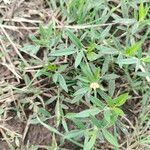
Stylosanthes humilis
Townsville stylo · Townsville-lucerne · Wild lucerne · Annual stylo · Alfafinha do nordeste
Description
Source: leafsnapStylosanthes humilis, commonly known as Townsville stylo or Townsville lucerne, is a perennial legume that belongs to the Fabaceae family. It is native to tropical and subtropical regions of Australia and has been introduced into many other countries for forage production. This plant boasts a deep taproot system, enabling it to tolerate drought conditions and flourish in poor soils. It can grow up to 1 meter tall, with trifoliate, oval-shaped leaves that are hairy on both sides. The flowers are small, yellowish-white, and tubular in shape. Stylosanthes humilis is a valuable forage crop due to its high protein content, which can reach up to 25%, making it an excellent feed source for livestock such as cattle, sheep, goats, and horses. Additionally, its ability to fix nitrogen from the atmosphere helps improve soil fertility. The plant can be grown alone or intercropped with other crops, such as maize or sorghum. Its ability to regenerate after grazing makes it suitable for rotational grazing systems. Besides its use as livestock feed, Stylosanthes humilis also possesses medicinal properties. Traditionally, indigenous Australians have used the leaves as an antiseptic agent to treat skin infections. Overall, Stylosanthes humilis is an important crop due to its high nutritional value, soil fertility improvement properties, and drought tolerance—making it particularly suitable for areas with limited water availability.
Care Guide
💧 Water Every 7 days
☀️ Light Full sun
Caribbean stylo is a sun-loving, perennial herbaceous plant native to open habitats and commonly found in meadows and grasslands. It prefers full sun but can tolerate partial sun.
🌡️ Temperature 20–37.8°C
Caribbean stylo comes from tropical areas, where the climate is generally warm and humid. Consequently, it is well suited to high temperatures and moisture. It does not tolerate sudden temperature shifts and prefers a consistent thermal environment, so avoiding indoor temperature fluctuations is important. It typically cannot endure cold and needs elevated temperatures for growth. If the surrounding temperature becomes too low, the plant may stop growing or even die.
💨 Humidity
🪴 Soil 6-7
🌱 Fertilizer
Caribbean stylo requires the most fertilizer during its period of active growth, which occurs mainly in spring, summer, and early fall. Fertilization is needed to supply essential nutrients that may be deficient in the soil, promoting healthy root and stem development as well as the attractive foliage that is a key characteristic of this plant.
🪴 Pot & Repot
✂️ Pruning
🌿 Propagating
🐛 Diseases & pets
☠️ Toxicity
Characteristics
- Plant Type
- Herb
- Life Cycle
- Perennial
- Genus
- Stylosanthes
- Family
- Fabaceae
- Hardiness Zone
- 9-11
- Mature Height
- 0 cm to 91 cm
- Mature Spread
- 30 cm to 49 cm
- Leaf Color
- Green, Dark Green
- Leaf Type
- Deciduous
- Flower Color
- Yellow
- Flower Size
- 0.51 cm to 0.76 cm
- Bloom Time
- Summer, Early fall, Mid fall
- Planting Time
- Spring, Summer, Autumn
- Harvest Time
- Late summer, Fall, Early winter
- Native Area
- Colombia, Mexico, Guatemala, Venezuela, Peru, Brazil, Nicaragua