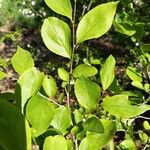
Styrax americanus
American snowbell · Mock orange · Snowbell
Description
Source: leafsnapStyrax americanus, the American snowbell or mock-orange, is a plant species native to the southeastern United States and the Ohio Valley. It has been reported from Texas and Florida to Virginia and Missouri. It generally grows in swamps and on floodplains and in other wet locations. Styrax americanus is a shrub or small tree up to 5 m (17 feet) tall. Leaves are elliptic to ovate, up to 10 cm (4 inches) long. Flowers are borne in the axils of some of the leaves.Two varieties of this species exist: Styrax americanus var. americanus (American snowbell) common to swamp forests and wet habitats ranging from West Virginia south to Florida and west to Texas and Missouri. Styrax americanus var. pulverulentus (downy American snowbell) common to wet pine flatwoods ranging from South Carolina south to Florida and west to Texas and Missouri.
Care Guide
💧 Water
American snowbell thrives in environments with high humidity but can also adapt to moderate drought conditions. It needs watering every three weeks to maintain health. This plant prefers soil that stays consistently moist and flourishes in temperate climates with regular rainfall. As a result, it's especially well-suited for moist woodland areas.
☀️ Light Partial sun
American snowbell prefers environments that receive plenty of sunlight each day. In its natural range it typically reaches maturity in locations with moderate sun, though it can tolerate areas with high solar exposure. Too much sun or very little sunlight can impair its vigorous growth. Its sunlight requirements do not change significantly across different growth stages.
What are the sunlight requirements for American snowbell?
American snowbell thrives in environments that offer a good balance of sunlight throughout the day. It requires partial sun, which is approximately 3-6 hours of sunlight daily, or full sun, which is above 6 hours of sunlight each day. Regardless of its native or adapted habitat, ensuring it receives an ample amount of daily sun exposure is essential for its optimal growth. However, it's important to note that both overexposure and extreme lack of sun can adversely affect the plant's growth. Observing how sunlight moves through your garden will help you choose the best spots that provide both light and shade, ensuring the happiness of your plants.
How can artificial lighting benefit indoor American snowbell plants?
Indoor American snowbell plants require adequate lighting to ensure optimal growth, especially when natural sunlight is insufficient, such as during winter or in less sunny spaces. Artificial lights, like LED lights, are a vital solution in these scenarios. They can be customized to provide specific wavelengths of light that plants need for photosynthesis. For full sun plants, 30-50W/sq ft of artificial light is recommended, partial sun plants need 20-30W/sq ft, and full shade plants require 10-20W/sq ft. The light source should be placed 12-36 inches above the plant to mimic natural sunlight, and most plants will benefit from 8-12 hours of light per day, depending on their species-specific needs.
What are the symptoms of insufficient light for American snowbell plants?
When American snowbell plants are grown indoors with insufficient light, several symptoms may indicate light deficiency. These include small leaves, leggy or sparse growth, faster leaf drop, slower or no new growth, lighter-colored new leaves, chlorosis (leaves turning yellow), sunscald, leaf curling, wilting, and leaf scorching. These symptoms reflect the plant's struggle to adapt to low light conditions by conserving resources, halting growth, or activating defense mechanisms against overexposure to sunlight.
What strategies can be used to improve light conditions for American snowbell?
To optimize light conditions for American snowbell, employing strategies tailored to indoor and outdoor environments is crucial. Indoors, gradually shifting the plant to sunnier spots each week until it receives 3-6 hours of direct sunlight daily can help. If moving the plant isn't feasible due to its size, consider using artificial lighting, such as a desk or ceiling lamp for at least 8 hours daily, or investing in professional plant grow lights. Outdoors, it's important to gradually move plants to sunnier locations, avoiding sudden changes in light intensity to prevent sunburn. Additionally, for both indoor and outdoor plants, minimizing obstructions, such as by pruning trees or relocating the plants to areas with more sunlight and good drainage, can significantly enhance the light exposure. Note that parts of the plant affected by insufficient sunlight may not recover, but new growth should be healthy with improved light conditions.
🌡️ Temperature 10–32.2°C
The American snowbell is native to habitats where temperatures range from 50 to 89.6 °F (10 to 32 ℃). It does best within that span. During colder or hotter seasons, adjust temperatures to replicate those conditions.
What are the ideal temperature conditions for growing American snowbell (Styrax americanus)?
American snowbell thrives best in environments where the temperature ranges from 50 to 89.6 °F (10 to 32 °C). It is native to these conditions and grows optimally within this temperature range. Adjustments may be necessary during the colder or hotter seasons to mimic these preferable conditions. Notably, American snowbell possesses strong cold resistance, so special frost protection measures generally aren't needed during winter. However, if winter temperatures are expected to drop below -25°C, it's important to protect the plant by wrapping its trunk and branches with materials such as non-woven fabric or cloth. Also, watering the plant abundantly before the first freeze in autumn is recommended to ensure the soil remains moist and enters winter in a frozen state, helping prevent drought and water scarcity during winter and early spring.
How should American snowbell be cared for during low temperatures?
American snowbell is cold-tolerant, best thriving when temperatures are above 10°C and should ideally be kept above -15°C during winter. If temperatures fall below -25°C, there might not be immediate noticeable changes during winter, but come spring, the plant’s branches may become brittle and dry, and no new shoots will emerge. In spring, it's advisable to prune away any dead branches that have failed to produce new leaves, as a part of the plant's care regime for recovery from low temperature exposure.
What care does American snowbell need when exposed to high temperatures?
During the summer season, American snowbell should be kept below 32°C to avoid heat stress. Should the temperature exceed 35°C, the plant's leaves may become lighter in color, and the tips may dry up and wither, increasing susceptibility to sunburn. In such cases, trimming away the sunburned and dried-up parts is recommended. Moving the plant to a location that offers shade during the midday and afternoon sun or using a shade cloth can protect it from excessive exposure. Additionally, watering the plant in the morning and evening to maintain soil moisture can help alleviate stress from high temperatures.
💨 Humidity
🪴 Soil 6-8
🌱 Fertilizer
The timing of fertilizing an American snowbell is important. Start feeding it in early spring and continue once a month until early summer. Fertilizer promotes attractive blooms and supplies energy during both dormant periods and active growth.
🪴 Pot & Repot
✂️ Pruning
The American snowbell is known for its delicate, bell-shaped flowers and smooth gray bark. To ensure healthy growth and enhance its overall appearance, it is best to prune this plant in early spring. Using thinning cuts during pruning helps to improve air circulation, stimulates blooming, and promotes a healthy, fuller shape. This practice also reduces the risk of pest problems.
🌿 Propagating
🐛 Diseases & pets
☠️ Toxicity
Characteristics
- Plant Type
- Tree, Shrub
- Life Cycle
- Perennial
- Genus
- Styrax
- Family
- Styracaceae
- Hardiness Zone
- 6-8
- Mature Height
- 1.83 m to 3.05 m
- Mature Spread
- 1.83 m to 3.05 m
- Leaf Color
- Green, Yellow, Red
- Leaf Type
- Deciduous
- Flower Color
- White
- Flower Size
- 2.54 cm
- Bloom Time
- Mid spring, Late spring
- Planting Time
- Autumn
- Harvest Time
- Late summer, Early fall, Mid fall