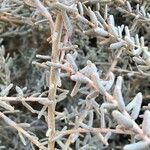
Suaeda nigra
Bush seepweed · Seepweed · Mojave sea-blite · Moquin's sea-blite · Torrey seepweed
Description
Source: leafsnapSuaeda nigra, often still known by the former name Suaeda moquinii, is a species of flowering plant in the amaranth family, known by the vernacular names bush seepweed or Mojave sea-blite.
Care Guide
💧 Water
Bush seepweed is a drought-tolerant plant that naturally grows in saline environments. It can thrive with minimal water, needing to be watered only once every two to three weeks. Its resilience makes it an excellent choice for xeriscaping and rock gardens, as it efficiently uses the limited rainfall typical of its native habitat.
☀️ Light Full sun
Bush seepweed grows best when it gets uninterrupted sunlight throughout the day. It has no known tolerance for reduced light, because its native environment is largely open. Excessive sun exposure does not seem to harm the plant, while a shortage of sunlight can restrict its growth.
What are the sunlight requirements for Bush Seepweed?
Bush Seepweed, or Suaeda nigra, requires above 6 hours of sunlight daily to thrive, as full sun exposure throughout the day is essential for its growth. It's crucial to pick spots in your garden that ensure a balance of light and shade, watching how sunlight travels to provide optimal conditions for the plant. Lack of sunshine inhibits growth, although Bush Seepweed does not risk overexposure to sunlight. Artificial lighting can be a solution for indoor plants, especially during less sunny periods. LED lights are recommended, with specific light intensities suggested for plants depending on their sunlight requirements: full sun plants need 30-50W/sq ft, partial sun 20-30W/sq ft, and full shade plants 10-20W/sq ft of artificial light. The light should be placed 12-36 inches above the plant for 8-12 hours a day to mimic natural sunlight conditions.
What are the symptoms of inadequate light for Bush Seepweed, and how can they be addressed?
When Bush Seepweed does not receive sufficient sunlight, it may display symptoms such as smaller new leaves, leggy or sparse growth, faster leaf drop, no new growth, lighter-colored new leaves, and symptoms of overexposure like chlorosis, sunscald, leaf curling, wilting, and leaf scorching. To counter light deficiency indoors, gradually increase the plant's exposure to sunlight or use artificial light, aiming for at least 6 hours of direct sunlight daily by using a south-facing window or professional grow lights. Outdoors, move the plants to sunnier spots gradually to prevent sunburn. If trees block sunlight, consider pruning to improve sunlight access. For small plants, consider transplanting to a sunnier location during their dormant period, ensuring good drainage and ample sunlight.
🌡️ Temperature 0–37.8°C
Bush seepweed is adapted to a native climate with temperatures ranging from 68 to 100.4 °F (20 to 38 ℃). To promote optimal growth, try to replicate these conditions and maintain these temperatures across the different seasons.
What are the ideal temperature conditions for growing Bush seepweed?
Bush seepweed thrives in a climate with temperatures ranging from 68 to 100.4 °F (20 to 38 °C). For optimal growth, it is crucial to maintain these temperature conditions throughout the year. Although Bush seepweed exhibits strong cold resistance, and special frost protection is generally not necessary, in extreme cases where winter temperatures are expected to fall below -35°C, taking measures to protect the plant is advisable. Wrapping the trunk and branches with non-woven fabric or cloth can provide necessary cold protection. Additionally, watering the plant abundantly before the first freeze of autumn to keep the soil moist can help prevent drought and water scarcity during winter and early spring.
How does Bush seepweed respond to low temperatures, and what measures should be taken?
Bush seepweed is cold-tolerant and performs best when temperatures stay above 20°C. During winter, it's essential to keep it above 0°C to ensure its health. If temperatures dip below -35°C, the branches may become brittle and dry by spring, and the plant may fail to produce new shoots. In response to such damage, it's recommended to prune away any dead branches in the spring to encourage new growth and maintain the health of the bush.
What are the effects of high temperatures on Bush seepweed, and how can they be mitigated?
During the summer, it is important to keep the temperatures around Bush seepweed below 38°C. Exceeding 43°C can cause the leaves to lighten in color, dry and wither at the tips, and increase the plant's susceptibility to sunburn. To mitigate these effects, dead or sunburned parts should be trimmed away. Moving the plant to a shaded location or using a shade cloth can protect it from the intense midday and afternoon sun. Additionally, regular watering in the morning and evening can help maintain soil moisture and reduce temperature stress.
💨 Humidity
🪴 Soil 6-7
🌱 Fertilizer
🪴 Pot & Repot
✂️ Pruning
Bush seepweed is a salt-tolerant shrub that benefits from pruning between early and late spring. Key techniques include removing dead branches to improve air circulation and prevent pests, which encourages dense foliage. These practices help support the growth of bush seepweed in its native arid habitats.
🌿 Propagating
🐛 Diseases & pets
☠️ Toxicity
Characteristics
- Plant Type
- Herb, Shrub
- Life Cycle
- Annual, Perennial
- Genus
- Suaeda
- Family
- Amaranthaceae
- Hardiness Zone
- 3-11
- Mature Height
- 0.2 m to 1.52 m
- Mature Spread
- 0.91 m to 1.22 m
- Leaf Color
- Dark Green
- Leaf Type
- Evergreen
- Flower Color
- Yellow, Green
- Flower Size
- 2.54 cm
- Bloom Time
- Mid summer, Late summer, Early fall
- Planting Time
- Spring, Summer, Autumn
- Harvest Time
- Fall
- Native Area
- Bahamas, Mexico, Cuba