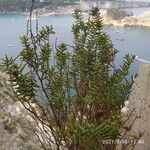
Suaeda vera
Shrubby Sea Blite · Shrubby Seablite · Alkali seepweed
Description
Source: leafsnapSuaeda vera is a halophytic plant species that belongs to the family Amaranthaceae. Commonly known as "Sea Blite," it is found in coastal areas of Europe, Asia, and North Africa. The plant features a succulent stem with small, green or reddish leaves and can grow up to 50 cm tall. It also bears small, greenish-yellow flowers. Thriving in saline soils with high salt concentrations, Suaeda vera is a key species in salt marsh ecosystems. It plays a crucial role in stabilizing coastal dunes and preventing soil erosion caused by wind or water. The leaves of Suaeda vera are edible and have been used as food by indigenous people for centuries. They are highly nutritious, containing vitamins A, C, and E, as well as minerals such as calcium and iron. In addition to its ecological importance, Suaeda vera has medicinal properties due to its antioxidant content, which helps protect against oxidative stress caused by free radicals. Overall, Suaeda vera is an important halophytic plant species with significant ecological, nutritional, and medicinal value. It is a fascinating subject of study for researchers in fields such as ecology, botany, and nutrition science.
Care Guide
💧 Water Every 7 days
The shrubby sea-blite is well-suited for coastal salt marshes, as it is adapted to survive in saline environments and withstand drought conditions. This hardy plant requires minimal watering, typically every 2-3 weeks. As a halophyte, the shrubby sea-blite flourishes outdoors with natural rainfall, making it an excellent choice for seaside gardens or areas with brackish irrigation.
How should I water my Shrubby sea-blite plant?
Your Shrubby sea-blite is not particular about how you water it, so you can use any common watering tool. Whether it's a watering can, hose, or even a cup, they will all do the job. Just make sure to water the soil directly and evenly, ensuring all parts of the root system get the water they need. Using filtered water is helpful to avoid harmful particles from tap water. Additionally, it's best to use water that is at or slightly above room temperature, as extremely cold or hot water can be a bit of a shock to the Shrubby sea-blite. However, overall, the Shrubby sea-blite is usually responsive to any kind of water you provide.
What should I do if I give too much or too little water to my Shrubby sea-blite plant?
For outdoor plants, especially newly planted ones or seedlings, lack of watering can be an issue. It is important to water them consistently for a few months when they are small or recently planted. Once the roots are established, Shrubby sea-blite can rely on rain for most of its water needs. When you have Shrubby sea-blite planted in pots, overwatering is more likely to happen. If you accidentally overwater your plant, you should take immediate steps to correct the situation. First, stop watering the plant to minimize the impact of overwatering. Then, remove the plant from its pot to check its roots. If no root rot is found, you may return the plant to its container. However, if root rot is present, trim the affected roots and apply a fungicide to prevent further damage. Finally, repot the Shrubby sea-blite in well-draining soil. In the case of underwatering, simply water the Shrubby sea-blite more frequently. This is generally an easy fix. If the plant's leaves droop, dry out, and fall off due to underwatering, they will quickly recover after receiving sufficient water. It is important to adjust your watering frequency as soon as you notice underwatering.
How often do I need to water my Shrubby sea-blite?
If your area does not receive enough rainfall, it is important to provide adequate watering for your outdoor plants. During the spring and fall, watering every 2 weeks should be sufficient. However, in the summer when plants require more water, watering should be done more frequently. In the winter, when plant growth slows down and water needs decrease, watering should be reduced. For the Shrubby sea-blite, watering should be done more often if it is young or newly planted to help it establish and grow. When it comes to potted plants, there are two ways to determine watering frequency for the Shrubby sea-blite. The first option is to follow a predetermined watering schedule, such as once a week or every other week. However, this method may not be suitable for the specific conditions of your growing environment. Another approach is to monitor soil moisture. It is generally recommended to wait until the top two to four inches of soil, about ⅓ to ½ depth of the pots, have completely dried out before watering again.
How much water does my Shrubby sea-blite have to have?
When watering your Shrubby sea-blite, you may be surprised to find that it doesn't always require a lot of water. If only a few inches of soil have dried since the last watering, giving it about five to ten ounces of water each time can support healthy growth. You can also determine the water volume based on the moisture of the soil. Keep track of how many inches of soil have dried between waterings. To ensure that your Shrubby sea-blite gets enough moisture, water it enough to moisten all the dry soil layers since the last watering. If more than half of the soil is dry, consider giving more water until you see excess water draining from the pot's holes. If your Shrubby sea-blite is planted in a rainy outdoor area, it may not need additional watering. When it's young or getting established, make sure it receives 1-2 inches of rain per week. As it grows and establishes, it can rely solely on rainwater. Only in hot weather with no rainfall for 2-3 weeks should you consider giving it a thorough watering to prevent stress.
How do I know if I'm giving enough water to my Shrubby sea-blite?
The Shrubby sea-blite is more often affected by overwatering, and there are clear signs to watch for in such cases. An overwatered plant will have yellowing leaves and may lose some. Additionally, overwatering can cause the plant's overall structure to shrink and may lead to root rot. Conversely, an underwatered plant will also start to droop and might have brown or fragile leaves. Regardless of whether you see signs of overwatering or underwatering, it's important to take action and restore your Shrubby sea-blite's health.
☀️ Light Full sun
Shrubby sea-blite is found in open habitats, such as sunny meadows and forest edges, which offer abundant light. It does best in Full Sun but can also tolerate Partial Sun, adapting well to different sunlight conditions.
What are the sunlight requirements for Shrubby sea-blite?
Shrubby sea-blite, or Suaeda vera, flourishes in environments that provide full sun, defined as more than 6 hours of sunlight daily. It can also adapt to partial sun conditions, meaning about 3-6 hours of sunlight. These conditions mimic its natural habitat in sunny meadows and forest edges. It's important to monitor the movement of sunlight in your garden to position your plants ideally, ensuring they receive the optimal balance of light and shade for healthy growth.
How can artificial lighting support indoor Shrubby sea-blite plants?
When natural sunlight is insufficient, particularly during winter or in less sunny indoor areas, artificial lighting becomes essential. It promotes faster and healthier growth by compensating for the lack of sunlight. LED lights are recommended for their ability to provide specific wavelengths needed by plants. For full sun plants, 30-50W/sq ft of artificial light is necessary, while partial sun plants require 20-30W/sq ft. Position the light source 12-36 inches above the plant for 8-12 hours per day to mimic natural daylight conditions effectively.
What are common symptoms of insufficient light in Shrubby sea-blite?
Shrubby sea-blite may show various signs when not receiving enough light: smaller leaves than previous ones, leggy or sparse growth due to elongated spaces between leaves or stems, faster leaf drop to conserve resources, slower or halted new growth indicating survival mode, lighter-colored new leaves due to a lack of chlorophyll, and symptoms of too much light such as chlorosis, sunscald, leaf curling, wilting, and leaf scorching. These symptoms reflect the plant's struggle with inadequate or excessive sunlight.
What solutions can help improve light conditions for Shrubby sea-blite?
To address insufficient light: Indoor plants can be gradually moved to sunnier spots, receiving at least 6 hours of direct sunlight, or supplemented with artificial light for 8 hours daily. Outdoor plants should be moved gradually to avoid sunburn. Reducing obstructions and transplanting during the plant's dormant period may also help. For excessive sunlight, protective measures and proper watering can mitigate damage. Note that parts of the plant previously affected by poor lighting may not recover, but new growth can thrive with improved conditions.
🌡️ Temperature 15–35°C
Shrubby sea‑blite shows considerable adaptability to a range of climatic conditions, from very hot summers to cold winters. Still, it has an ideal temperature range for growth. If temperatures get too high, the plant becomes vulnerable to heat and humidity stress, which can lead to its death. In areas where temperatures approach the lower edge of its cold tolerance, providing insulation to protect the plant is important.
💨 Humidity
🪴 Soil 6-8
🌱 Fertilizer
Fertilize your Shrubby sea-blite in early spring to encourage healthy growth. Regular feeding boosts overall health, leading to vigorous growth, better resilience in harsh conditions, and improved resistance to pests and diseases. Keep a consistent fertilization schedule for your Shrubby sea-blite to maintain foliage that is vivid in color and lush in appearance.
🪴 Pot & Repot
✂️ Pruning
The shrubby sea-blite is a salt-tolerant shrub characterized by its fleshy leaves. To promote growth and maintain its shape, prune the plant from early to late winter. Concentrate on removing dead branches and thinning out dense areas to improve air circulation, which will enhance flowering, improve its appearance, and help prevent diseases.
🌿 Propagating
🐛 Diseases & pets
☠️ Toxicity
Characteristics
- Plant Type
- Shrub
- Life Cycle
- Perennial
- Genus
- Suaeda
- Family
- Amaranthaceae
- Hardiness Zone
- 7-10
- Mature Height
- 0.91 m to 2.13 m
- Mature Spread
- 0.49 m to 1.52 m
- Leaf Color
- Dark Green, Olive Drab
- Leaf Type
- Evergreen
- Flower Color
- Green
- Flower Size
- 0.15 cm
- Bloom Time
- Mid summer, Late summer, Early fall
- Planting Time
- Spring, Summer, Autumn
- Harvest Time
- Fall
- Native Area
- Libya, Egypt, Tunisia, Montenegro, Cyprus, Greece, Croatia, Morocco, Portugal, Italy, Spain, Israel, Albania, United Kingdom, Algeria, France