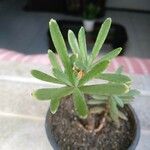
Suriana maritima
Bay-cedar · Guitar · Tassel plant · Bois Matelot
Description
Source: leafsnapSuriana maritima, commonly known as bay cedar or sea shore lily, is a small shrub that belongs to the Surianaceae family. It is native to the coastal regions of Florida, the Caribbean islands, and Central and South America. The plant can grow up to 3 meters in height and has a spreading habit with multiple stems covered in small green leaves. The leaves of Suriana maritima are simple, alternate, and ovate with serrated margins. The plant produces small yellow flowers that bloom from late spring through summer. These flowers are followed by fleshy red berries that contain one or two seeds. Suriana maritima is well-adapted to sandy soils typically found along coastal areas, where it can tolerate salt spray from ocean waves. Additionally, it has a high tolerance for drought conditions, making it an ideal choice for xeriscaping projects. Traditionally, bay cedar has been used by indigenous people as a medicine for various ailments such as fever, coughs, and colds due to its anti-inflammatory properties. Furthermore, its wood has been used to make tools such as fishing nets due to its durability. Overall, Suriana maritima is an attractive shrub with ornamental value, suitable for landscaping projects along coastal areas. It thrives under harsh environmental conditions while providing aesthetic appeal through its colorful foliage and flowering habit throughout the year.
🎭 Defense, Paranormal, Abilities, Restoration
Care Guide
💧 Water Every 7 days
Bay cedar is well-suited for coastal environments where moisture levels are low, demonstrating a remarkable tolerance to drought. In keeping with its native sandy habitats, it only needs watering every 2 to 3 weeks. Its resilience to salt spray and fluctuating rainfall makes bay cedar an excellent choice for seaside gardens, as it can enhance ecosystems without the need for frequent irrigation.
How should I water my Bay cedar?
Your Bay cedar is not picky when it comes to watering methods. You can use common tools like watering cans, hoses, or even cups to water it. It's important to water directly onto the soil and make sure all areas are equally moistened to provide water to the entire root system. It's recommended to use filtered water to avoid harmful particles from tap water. Using water at or slightly above room temperature is preferred, as extremely hot or cold water can shock the plant. However, the Bay cedar generally responds well to any type of water.
What should I do if I give my Bay cedar too much or too little water?
Outdoor plants, especially newly planted ones or seedlings, are often at risk of not being watered enough. It's important to ensure they receive adequate watering for the first few months, especially when they are small or recently planted. This is because once the roots are established, Bay cedar can usually rely on rainfall. If you have Bay cedar planted in pots, overwatering is more likely to happen. If you accidentally overwater your Bay cedar, it's important to take immediate action to address the situation. Stop watering your plant right away to minimize the impact of overwatering. Then, remove your Bay cedar from its pot and check its roots for any signs of root rot. If none of the roots have developed root rot, you can return the plant to its container. However, if you find any affected roots, trim them away and consider applying a fungicide to prevent further damage. Lastly, repot your Bay cedar in well-draining soil. In the case of underwatering, simply water the Bay cedar more frequently. Underwatering is generally easy to fix. When a plant is underwatered, its leaves may droop, dry out, and fall off. However, after sufficient watering, the leaves will quickly regain their fullness. It's important to correct your watering frequency as soon as you notice signs of underwatering.
How often do I need to water my Bay cedar?
Most outdoor plants can rely on rainfall for their water needs. However, if you live in an area with low rainfall, you should water your plants every 2 weeks during spring and fall. In the summer, you will need to water them more frequently. In winter, when plants need less water due to slower growth, you can water them less often or not at all. Young or newly planted Bay cedar plants require more frequent watering to help them establish and grow. For potted plants, there are two main ways to determine how often to water your Bay cedar. The first is to follow a predetermined schedule, such as watering once a week or once every other week. However, this may not be ideal as it doesn't consider the specific growing conditions of your plant. Another approach is to base your watering frequency on soil moisture. It's generally best to wait until the top two to four inches of soil (about 1/3 to 1/2 of the pot depth) have dried out completely before watering again. Keep in mind that during summer, your plant will likely need more water than the predetermined schedule suggests.
How much water does my Bay cedar plant require?
To water your Bay cedar, you don't always need a lot of water. If only a few inches of soil have dried since the last watering, give it about five to ten ounces of water each time. You can also gauge the water volume based on soil moisture. Take note of how many inches of soil have dried out between waterings. To ensure your Bay cedar gets the right amount of moisture, water enough to moisten all the dry soil layers since the last watering. If more than half of the soil is dry, give more water. Keep adding water until excess water drains from the pot. If your Bay cedar is planted in a rainy outdoor area, it may not need extra watering. When it's young or establishing, make sure it gets 1-2 inches of rain per week. As it grows, it can rely solely on rainwater. Only during hot weather with no rain for 2-3 weeks, consider giving it a thorough watering to prevent stress.
How do I know if I'm watering my Bay cedar enough?
Overwatering is a common issue for Bay cedar, and there are specific signs to watch for. When a Bay cedar is overwatered, its leaves turn yellow and may fall off. Overwatering can also cause the plant's structure to shrink and lead to root rot. Conversely, an underwatered Bay cedar will start to wilt and may have brown or brittle leaves. If you notice any signs of overwatering or underwatering, it is important to take action and restore the health of the Bay cedar.
☀️ Light Full sun
Bay cedar does best with ample sunlight, reflecting its naturally sunny native environment. It will tolerate locations with less sun, but in diminished light it may not reach optimal maturity. Excessive shade limits growth, causes stress and has a negative impact on its health. Changes in light intensity at different stages of growth do not present an issue for this plant.
What are the sunlight requirements for Bay cedar?
Bay cedar, or Suriana maritima, thrives best under full sun conditions, requiring more than 6 hours of sunlight daily. It can also grow in partial sun, defined as about 3-6 hours of sunlight per day. It's crucial to monitor the sunlight patterns in your garden to ensure spots chosen for your plants offer a good mix of light and shade, promoting optimal growth and plant health. In its native habitat, which is notably sunny, Bay cedar flourishes, reflecting its preference for abundant sunlight. Although it can survive in less sunny locations, growth may not be ideal, and too much shade can hinder its growth significantly.
How does artificial lighting benefit Bay cedar grown indoors?
When natural sunlight is insufficient, especially in winter or in less sunny spaces, artificial lighting serves as an essential aid for the growth of indoor Bay cedar plants. LED lights are recommended because they can be adjusted to provide specific wavelengths needed by the plant. The required intensity of artificial light varies; full sun plants need 30-50W/sq ft, partial sun plants need 20-30W/sq ft, and full shade plants require 10-20W/sq ft. The artificial light source should be positioned 12-36 inches above the plant to mimic natural sunlight conditions, with most plants benefiting from 8-12 hours of light per day.
What are some common symptoms of insufficient light in Bay cedar, and how can they be addressed?
Symptoms of insufficient light in Bay cedar include small new leaves, leggy or sparse growth, faster leaf drop, slower or halted growth, lighter-colored new leaves, chlorosis, sunscald, leaf curling, wilting, and leaf scorching. Indoor solutions for insufficient light include gradually moving the plant to a sunnier spot to receive at least 6 hours of direct sunlight daily, using a south-facing window, or employing artificial light like desk or ceiling lamps for a minimum of 8 hours daily. Outdoor plants should be gradually acclimated to sunnier locations to prevent sunburn. Reducing obstructions can also help; for instance, pruning trees that block sunlight or transplanting smaller plants to a location with ample sunlight and good drainage during their dormant period.
🌡️ Temperature 20–37.8°C
Bay cedar is native to areas where temperatures fall between 68 and 100 °F (20 to 38 ℃). Adapted to warmer conditions, it grows best within that range. Because it favors this temperature band, steps should be taken during cooler seasons to keep conditions within those limits.
What is the ideal temperature range for Bay cedar?
Bay cedar thrives in environments where temperatures range from 68 to 100 °F (20 to 38 °C). It is extremely heat-loving, so adapting to higher temperatures within this range is best for its growth. During cooler seasons or when temperatures drop, it's important to make adjustments to maintain these temperature conditions, such as moving the plant indoors near a bright window but away from direct heat sources like heaters to ensure it remains above 20°C, especially during winter.
How does low temperature affect Bay cedar and what should I do?
Bay cedar is not tolerant of low temperatures and thrives best when the temperature is above 20°C. It should be kept above 5°C during winter to prevent damage. Exposure to temperatures below 1°C may cause the leaves to lighten in color, and after frost damage, the leaves may gradually turn brown or black, with symptoms including wilting and drooping. If frost damage occurs, trim off the frost-damaged parts and move the plant indoors to a warm environment for cold protection. It's advisable to place it near a south-facing window for ample sunlight while avoiding proximity to heaters or air conditioning vents to prevent air dryness.
What should I do if Bay cedar is exposed to high temperatures?
During the summer, it's critical to ensure that Bay cedar's exposure to temperatures stays below 38°C. If temperatures exceed 43°C, the plant's leaves may lighten, indicating sunburn. To address this, trim away the sunburned and dried-up parts of the plant. Then, move the plant to a location that provides shade during the midday and afternoon sun, which are typically the hottest parts of the day. Additionally, water the plant in the morning and evening to keep the soil moist and help the plant cope with high temperatures.
💨 Humidity
🪴 Soil 6-7
🌱 Fertilizer
The best time to fertilize a Bay cedar is in early spring as it breaks dormancy. This supports overall growth and flower development. Fertilization improves the foliage, stems, and branches and encourages flowers that are large, vibrant, and long-lasting. It helps transport nutrients from the roots to the flowers and enhances the plant’s health and resistance to disease.
🪴 Pot & Repot
✂️ Pruning
Bay cedar is a coastal shrub renowned for its salt tolerance and dense, evergreen foliage. To encourage healthy growth and maintain its shape, prune it from early to late winter. Be careful to avoid heavy pruning. Regular light pruning, however, can improve airflow and reduce the risk of pests while also supporting robust growth in the spring.
🌿 Propagating
🐛 Diseases & pets
☠️ Toxicity
Characteristics
- Plant Type
- Tree, Shrub
- Life Cycle
- Perennial
- Genus
- Suriana
- Family
- Surianaceae
- Hardiness Zone
- 10-11
- Mature Height
- 1.52 m to 6.1 m
- Mature Spread
- 1.52 m to 2.44 m
- Leaf Color
- Green
- Leaf Type
- Evergreen
- Flower Color
- Yellow
- Flower Size
- 2.54 cm
- Bloom Time
- Late spring, Summer, Early fall, Mid fall
- Planting Time
- Spring, Summer, Autumn
- Harvest Time
- Mid summer, Late summer, Fall
- Native Area
- Sri Lanka, Belize, India, Honduras, Mexico, Guatemala, Philippines, Madagascar, Pakistan, Fiji, Panama, Jamaica, China, Colombia, Cuba, Vietnam, Mozambique, Venezuela, Brazil, Nicaragua