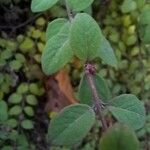
Symphoricarpos orbiculatus
مروارید قرمز · Coralberry · Round snowberry · Indian-currant · Buck Brush
Description
Source: leafsnapSymphoricarpos orbiculatus, commonly called coralberry, buckbrush or Indian currant is a woody species of flowering plant in the honeysuckle family.
🌳 Coralberry is an upright shrub featuring oval leaves and pale flowers that transition into distinctive clusters of purplish berries. These berries remain largely unchanged throughout much of the winter, bringing vibrant color to a winter garden. Coralberry is best planted in areas where it has room to spread, such as an open woodland garden. Its attractive appearance and dense, spreading growth make it an ideal ground cover for challenging and inaccessible slopes.
Care Guide
💧 Water Every 1-2 weeks
Coralberry thrives in environments with moderate moisture and is adaptable to both wet and dry conditions. To optimize its growth, particularly during its active season, water the plant every 1-2 weeks. Allow the soil to dry out slightly between waterings, mimicking the natural precipitation patterns typical of temperate regions.
What is the best way to water my Coralberry plant?
To promote excellent root development, consider placing a garden hose at the base of your plants. Avoid spraying the leaves directly, especially if they are exposed to direct sunlight outdoors as they may need additional watering. Another option is to use bubblers to keep the roots moist, or soaker hoses that cover the entire garden or bed. When adding or removing plants, use these hoses to ensure deep root growth. Remove any excess water and allow the soil to dry before watering again. Watering at ground level can help prevent diseases. On a sunny day, it may be beneficial to spray the entire bush with water. Whether the plants are potted or in the ground, remember that Coralberry plants prefer deep watering rather than light sprinkling.
What should I do if I give Coralberry too much water or too little water?
If a Coralberry plant is overwatered, its leaves may turn yellow, drop off, and wilt. The plant may also appear dull and unhealthy, with mushy stems. When these signs start to show, it's best to adjust your watering schedule when possible. However, wilting can also be a sign of under watering. In this case, the leaves may become crispy and dry. If the soil is dry and simply watering is not enough, give the plant a thorough watering. Sufficient water will help the Coralberry recover, but the plant may still have dry and yellow leaves for a few days due to root damage. Once it returns to normal, the yellowing of the leaves will stop. Always check the moisture levels of the pot when growing Coralberry indoors. Avoid overwatering and look for signs of black spots. If these are present, allow the soil to dry by giving the plant a few days without water. Overwatering can lead to root rot, so if you notice discolored and slimy roots, consider transferring the plant to a different pot. Prevent root rot by avoiding overly soggy soil. When planting Coralberry outdoors, dig a little deeper and if the soil feels too dry when you check with your fingers, it could indicate under watering. Adequate watering is necessary for the plant to recover.
How much should I water my Coralberry plant?
The Coralberry plant prefers deep and infrequent watering. If it is planted in a pot, make sure to soak it in a gallon of water each time, as pots have limited water storage and the soil dries out quickly. In colder regions, water the plant every 3 to 5 days. Water it early in the morning when the soil is dry, both indoors and outdoors. You can check if watering is needed by feeling the soil inside the pot - if the top 2-3 inches are dry, it's time to water the plant thoroughly. During hot days, you may need to check the moisture daily as the soil can dry out rapidly. If you have a garden, you also need to irrigate the soil. In hot climates, watering once a week is sufficient, but make sure the top 2-3 inches of soil are dry before watering. Take into account the amount of rainwater the plant receives and avoid overwatering to prevent root rot. If there is ample rainfall, you may not need to water the plants additionally. Coralberry plants usually grow during spring and fall. When growing them outdoors, add mulch that is 3 to 4 inches deep to conserve water. Sandy soil drains faster, so plants in this soil type may need more frequent watering. On the other hand, plants in clay soil need less watering, with a 2-3 day gap between watering to avoid root rot. To keep track of watering, mark the dates on a calendar. If you notice the leaves drooping, it could be an indication that watering is overdue.
How much water does my Coralberry plant need?
The Coralberry plant generally needs about a gallon of water on a regular basis. For potted plants, water them deeply until you see water dripping at the bottom of the pot, then wait for the soil to dry before watering again. Use a water calculator or moisture meter to determine how much water you have given your plant in a week. During the flowering period, provide plenty of water, but allow the moisture to evaporate to avoid root rot. If the Coralberry is planted outdoors and has adequate rainfall, it may not need additional watering. When the Coralberry is young or newly planted, make sure it receives 1-2 inches of rain per week. As the Coralberry continues to grow, it can rely solely on rainfall. Only water it fully during the cooler times of the day if the weather is too hot or if there has been no rainfall for 2-3 weeks to prevent the plant from suffering heat damage. Additional watering will be necessary during extended dry periods.
Should I change how often I water my Coralberry depending on the time of year or the weather?
The Coralberry plant prefers rainwater but can be watered during dry weather. During spring and fall, keep the soil moist but not soggy. Alternating between dry and moist soil will promote growth. In the summer, hot weather can cause water to evaporate quickly, so water more frequently if there is no rainfall. During winter, the Coralberry needs less water and can be placed in well-draining soil. Once it goes dormant, it can rely on fall and winter rains. In spring, encourage growth by cultivating the plant. Good drainage is essential year-round, especially in pots. Water deeply once or twice a week, avoiding shallow sprinkles. Prevent drying out in fall and winter but avoid overwatering. Applying mulch helps with water conservation and healthy blooms.
☀️ Light Partial sun
Coralberry does best in a spot that gets sun for only a portion of the day, though it can tolerate places that are exposed to full sun all day or are largely shaded. Uneven sun exposure can impair its growth, reduce berry production, and harm its foliage.
What are the sunlight requirements for Coralberry?
Coralberry requires varying amounts of sunlight depending on its environment. It needs about 3-6 hours of sunlight (partial sun) to thrive but can also tolerate conditions of full sun or full shade, which is above 6 hours of sunlight. It's important to watch how sunlight moves through your garden to choose spots that offer a good balance of light and shade, ensuring the plant's happiness. Coralberry can flourish in locations with just a fraction of sun during the day, yet can also withstand areas that are sun-drenched all day or heavily shaded. An imbalance in sun exposure may deter berry formation and damage foliage.
How do I use artificial lighting for Coralberry grown indoors?
For Coralberry plants grown indoors, adequate lighting is crucial, especially when natural sunlight is insufficient. Artificial lights such as LED lights, which can be customized to provide specific wavelengths of light, are beneficial. For full sun plants, 30-50W/sq ft of artificial light is recommended, partial sun plants require 20-30W/sq ft, and full shade plants need 10-20W/sq ft. Position the light source 12-36 inches above the plant to mimic natural sunlight and keep it on for 8-12 hours per day to promote faster, healthier growth.
What are the symptoms of insufficient light in Coralberry?
When Coralberry is grown indoors with insufficient light, several symptoms may appear, including smaller new leaves, leggy or sparse growth, accelerated leaf drop, slower or ceased new growth, lighter-colored or pale new leaves, chlorosis (yellowing of leaves), sunscald, leaf curling, wilting, and leaf scorching. These symptoms indicate the plant is not receiving enough sunlight, affecting its photosynthesis process and overall health.
How can I address light deficiency symptoms in Coralberry?
To address light deficiency in Coralberry, gradually adapt the plant to receive more sunlight by shifting it to sunnier spots each week until it gets 3-6 hours of direct sunlight daily. For large or immobile plants, consider using artificial light, keeping a desk or ceiling lamp on for at least 8 hours daily or investing in professional plant grow lights. For outdoor plants, also move them gradually to avoid sunburn. If obstructions block sunlight, consider pruning or transplanting the plant to a sunnier location. Note that parts of the plant affected by insufficient sunlight may not recover, but new growth should be healthy with increased light exposure.
🌡️ Temperature 5–35°C
The coralberry plant originates from temperate regions and thrives in average temperatures of 41 to 95 ℉ (5 to 35 ℃). In winter it can withstand lows of 23 to 32 ℉ (-5 to 0 ℃), and in summer it tolerates highs of 86 to 95 ℉ (30 to 35 ℃). To cope with seasonal temperature changes, it is best grown in well-draining soil with moderate watering.
What is the native climate of the Coralberry plant?
The Coralberry plant, known botanically as Symphoricarpos orbiculatus, is native to temperate regions. It prefers average temperatures ranging from 41 to 95 °F (5 to 35 °C). During the winter season, it can withstand colder temperatures as low as 23 to 32 °F (-5 to 0 °C), and in the summer, it can endure higher temperatures from 86 to 95 °F (30 to 35 °C). The plant is adapted to fluctuate with the varying temperatures across different seasons by requiring well-draining soil and moderate watering.
How should Coralberry be cared for during winter?
Given its strong cold resistance, Coralberry typically does not need special frost protection during winter. However, if temperatures are anticipated to drop below the growth limit, which would be colder than 23 to 32°F (-5 to 0 °C), then it's crucial to protect the plant from the cold. This can involve wrapping the trunk and branches with non-woven fabric or cloth. Additionally, it's advisable to water the plant abundantly before the first freeze of autumn to ensure the soil remains moist and enters into a frozen state, which helps prevent drought and water scarcity for the plant during winter and early spring.
What are the symptoms of Coralberry experiencing too low or too high temperatures?
For Coralberry, being cold-tolerant means it generally thrives best at temperatures above a certain minimum suitable growth temperature. When winter temperatures fall below its tolerable growing temperature minimum but above its growth limit temperature, you might not notice any immediate changes. However, during spring, the branches may become brittle and dry, with no new shoots emerging. On the other hand, in high temperatures above the tolerable growing maximum, the leaves may lighten in color, tips might dry out and wither, and the plant could be more susceptible to sunburn.
What should I do if my Coralberry shows symptoms due to incorrect temperatures?
If your Coralberry has been exposed to temperatures too low and shows symptoms like brittle and dry branches without new shoots in spring, you should prune away the dead branches to encourage new growth. If the plant has experienced high temperatures, resulting in lightened leaf color, dried and withered tips, or sunburn, trim away the sunburned and dried-up parts. Moreover, moving the plant to a shaded location or using a shade cloth to protect it from midday and afternoon sun can be beneficial. Watering the plant in the morning and evening to maintain soil moisture will also help the plant recover.
💨 Humidity normal (40-60%)
This plant will thrive in moderate humidity, which is probably the level in your home. However, misting it a few times a week can be very beneficial. Make sure the room has good ventilation.
🪴 Soil 6-7
🌱 Fertilizer
To encourage healthy growth, fertilize your Coralberry in early spring. Routine fertilization improves its overall health, leading to vigorous growth, greater tolerance of challenging conditions, and enhanced resistance to diseases and pests. Follow a specific fertilization schedule for your Coralberry to maintain foliage that is vivid in color and has a full, lush appearance.
Why should I put fertilizer on my Coralberry plant?
To ensure your Coralberry plant's overall health, it is important to fertilize it regularly, regardless of the species you have. Providing the right amount of nutrients will promote vigorous growth and enhance the plant's ability to withstand challenging growing conditions, as well as fight off diseases and pests. Since the foliage of the Coralberry is its main appeal, taking measures to maintain its beauty is crucial. This involves establishing a consistent fertilization routine tailored to your specific Coralberry, resulting in vibrant, colorful leaves and an overall lush appearance.
When should I fertilize my Coralberry plant?
To ensure the healthy growth of your Coralberry, it is recommended to fertilize it during the late winter or early spring. This initial fertilization provides all the necessary nutrients for the Coralberry to thrive once the weather warms up. In warm climate regions, it is advantageous to provide an additional fertilizer feeding during early fall. This not only supplements the soil with nutrients for the upcoming growing season, but also helps the Coralberry to withstand the cold winter and prevent foliage damage. Fertilizing earlier in the fall ensures that the new branches have sufficient time to grow and endure the winter conditions.
When is the best time to not fertilize my Coralberry?
There are a few times during the year when you should avoid fertilizing your Coralberry. The first time is in the early and mid-winter months when the plant is dormant and does not require feeding. It is also not recommended to fertilize during late spring and summer when the weather is generally hotter and drier. Fertilizing during this time can have a detrimental effect on the Coralberry. To prevent any issues, it is best to follow a fertilization schedule that only includes feeding in early spring and early fall.
What kind of fertilizer does my Coralberry plant need?
Coralberries primarily need nitrogen for their growth, but phosphorus and potassium are also important. A balanced fertilizer like a 10-10-10 can be effective because it provides all three nutrients in decent amounts. However, using a fertilizer with a more precise ratio, such as 10-6-4, often leads to even better growth. You can choose between a granular or liquid-based fertilizer when feeding your Coralberry.
How do I add nutrients to my Coralberry plant?
Fertilizing your Coralberry is easy when using granular fertilizer. Simply sprinkle the fertilizer on the soil at the appropriate time. The slow-release property of granular fertilizer gradually provides nutrients to the soil over time. It's generally recommended to lightly water your Coralberry before applying the fertilizer. Another option is to use liquid fertilizer, although it is less commonly used. To do this, mix the fertilizer with water and pour it around the base of your Coralberry. Occasionally, it may be helpful to conduct a soil test prior to fertilizing to determine if any adjustments to the pH are necessary.
🪴 Pot & Repot
✂️ Pruning
To improve the health and appearance of coralberry bushes, it's best to prune them in early spring. This encourages better air circulation and stimulates new growth. Start by removing any dead or damaged wood, and then trim back any branches that are growing too far or out of shape. Pruning helps promote healthier growth and can increase the potential for fruiting. Always use sharp and clean tools to prevent the spread of disease.
🌿 Propagating
🐛 Diseases & pets
☠️ Toxicity
Characteristics
- Plant Type
- Shrub
- Life Cycle
- Perennial
- Genus
- Symphoricarpos
- Family
- Caprifoliaceae
- Hardiness Zone
- 5-9
- Mature Height
- 0.91 m to 1.83 m
- Mature Spread
- 1.22 m to 2.44 m
- Leaf Color
- Green, Blue
- Leaf Type
- Deciduous
- Flower Color
- Pink, White
- Flower Size
- 2.54 cm
- Bloom Time
- Early summer, Mid summer
- Planting Time
- Spring, Autumn
- Harvest Time
- Mid summer, Late summer, Fall, Winter
- Native Area
- Mexico