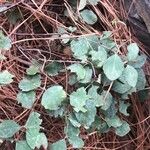
Symphoricarpos oreophilus
Mountain snowberry · Whortleleaf snowberry
Description
Source: leafsnapSymphoricarpos oreophilus is a North American species of flowering plant in the Caprifoliaceae, or honeysuckle family, known by the common name mountain snowberry. It has a wide distribution in western Canada, the United States, and northwestern Mexico. It is found in mountainous areas such as the Cascades, the Sierra Nevada, the Rockies, and the Sierra Madre Occidental from British Columbia to the Copper Canyon region of Chihuahua, from the coastal states as far inland as the Black Hills, the Oklahoma Panhandle, and trans-Pecos Texas.Symphoricarpos oreophilus is a deciduous shrub growing erect or spreading or trailing. Depending on environmental conditions it may reach 30 centimetres (12 in) to 1.5 metres (4.9 ft) in mature height. The fruit is a white drupe containing two nutlets, each of which contains a seed. The plant grows from a rhizome. It reproduces vegetatively by sprouting from the rhizome and by layering, and sexually via seed.Symphoricarpos oreophilus is common in many types of habitat in western North America, and it may dominate some ecosystems, such as sagebrush. It is also an indicator species of certain habitat types where Douglas-fir (Pseudotsuga menziesii), white fir (Abies concolor), ponderosa pine (Pinus ponderosa), subalpine fir (A. lasiocarpa), Gambel oak (Quercus gambelii), and/or quaking aspen (Populus tremuloides) make up the overstory. It grows in all successional stages in pinyon-juniper woodlands. It is usually found in open habitat, as it does not easily tolerate shade. In heavily forested regions it grows in open areas and breaks in the canopy.Many types of animal use this plant for food, especially in the early spring, when it is one of the first plants to bear leaves. Deer, elk, and livestock browse the foliage. Some small mammals use the shrubs for cover. Birds such as the yellow-billed magpie consume the fruits. The saponin-containing berries are inedible to humans.
Care Guide
💧 Water
Mountain snowberry thrives best with consistent weekly watering, which mimics its natural habitat and supports lush growth. This plant flourishes in moderate climates and benefits significantly from rainwater, as it enhances nutrient absorption and is healthier than using tap water. Maintaining the optimal soil moisture level is essential for the plant's development.
☀️ Light Partial sun
Mountain snowberry occurs naturally in habitats such as forest understories or rocky areas, where it grows in natural shade. It prefers partial sun but can adjust to full sun or full shade, illustrating its versatile and hardy nature.
🌡️ Temperature 0–32.2°C
Mountain snowberry can tolerate a wide range of temperatures, yet its distribution may still be restricted by different combinations of moisture and heat. It does best in warm summer climates with sufficient rainfall or watering. Long periods of cloudy, rainy weather or prolonged high temperatures can increase the chance of Mountain snowberry dying. In winter, adequate protection from the cold can improve the plant's survival.
💨 Humidity
🪴 Soil 6-8
🌱 Fertilizer
The best time to fertilize a Mountain snowberry is in early spring, when it is coming out of dormancy and starting active growth. Fertilizing supplies important nutrients for healthy growth. Although Mountain snowberry has relatively low fertilizer needs, applying fertilizer annually can improve its survival and encourage better, longer-lasting flowers.
🪴 Pot & Repot
✂️ Pruning
To keep mountain snowberry healthy and thriving, it's important to prune it from early to late spring. This helps remove any dead or crossing branches, maintains its shape, and promotes healthy growth. Thinning out the older wood encourages new shoots to grow, which improves air circulation and allows more sunlight to reach the plant. Regular pruning in line with its growth cycle boosts its vigor and enhances flower production.
🌿 Propagating
🐛 Diseases & pets
☠️ Toxicity
Characteristics
- Plant Type
- Herb
- Life Cycle
- Perennial
- Genus
- Symphoricarpos
- Family
- Caprifoliaceae
- Hardiness Zone
- 3-7
- Mature Height
- 0.61 m to 1.22 m
- Mature Spread
- 0.91 m to 1.52 m
- Leaf Color
- Green, Dark Green
- Leaf Type
- Deciduous
- Flower Color
- Pink, White
- Flower Size
- 0.51 cm to 1.02 cm
- Bloom Time
- Late spring, Early summer
- Planting Time
- Spring, Summer
- Harvest Time
- Late summer, Early fall, Mid fall
- Native Area
- Mexico, Canada