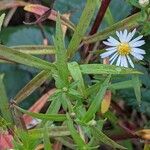
Symphyotrichum lanceolatum
White panicle aster · Eastern Line Aster · Lance-leaf Aster · Lance-leaved Or Panicled Or White Panicled Aster · Michaelmas Daisy
Description
Source: leafsnapSymphyotrichum lanceolatum (formerly Aster lanceolatus and Aster simplex) is a species of flowering plant in the family Asteraceae native to North America. Common names include panicled aster, lance-leaved aster, and white panicled aster. It is a perennial, herbaceous plant that may reach 1.5 meters (5 feet) tall or more, sometimes approaching 2 m (6+1⁄2 ft). The lance-shaped leaves are generally hairless but may feel slightly rough to the touch on the top because of tiny bristles. The flowers grow in clusters and branch in panicles. They have 16–50 white ray florets that are up to 14 millimeters (1⁄2 inch) long and sometimes tinged pink or purple. The flower centers consist of disk florets that begin as yellow and become purple as they mature. The species occurs in a wide variety of mostly moist and open habitats, including riparian areas (areas between land and a river or stream), meadows, and ditches. Panicled aster has a stout rhizome and can spread to form a clonal colony as well as reproduce by wind-blown seed. Because of its rhizomatic spreading and its production of chemicals that can be detrimental to other plants around it, the species can do damage to ecosystems outside of its native range, as it has in Europe where it has been introduced. Symphyotrichum lanceolatum is currently divided into subspecies and varieties which have minor differences in appearance and vary in chromosome counts as well as distribution, with some overlap. It is a conservationally secure species whose late-summer and fall appearing flowers play an important role for late-season pollinators and nectar-seeking insects such as bumblebees, wasps, and hoverflies. In addition to being used by indigenous peoples of the Americas for medicinal purposes, it has been cultivated as an ornamental garden plant and used in the cut flower industry.
🌳 The white-panicle aster is a common wildflower that attracts a diverse range of pollinators, including moths, beetles, and bees. Known for its daisy-like flowers, this plant is often cultivated for its beauty. It is also drought-tolerant and can thrive in poor soil conditions.
🎭 Love
Care Guide
💧 Water
☀️ Light Full sun
🌡️ Temperature 0–35°C
💨 Humidity
🪴 Soil 6-7
🌱 Fertilizer
🪴 Pot & Repot
✂️ Pruning
🌿 Propagating
🐛 Diseases & pets
☠️ Toxicity
Characteristics
- Plant Type
- Herb
- Life Cycle
- Perennial
- Genus
- Symphyotrichum
- Family
- Asteraceae
- Hardiness Zone
- 3-9
- Mature Height
- 1.52 m to 2.13 m
- Mature Spread
- 46 cm to 91 cm
- Leaf Color
- Green, Blue, Purple
- Leaf Type
- Evergreen
- Flower Color
- White
- Flower Size
- 0.25 cm to 1.52 cm
- Bloom Time
- Mid summer, Late summer
- Planting Time
- Spring, Autumn
- Harvest Time
- Fall
- Native Area
- Mexico