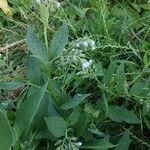
Symphytum caucasicum
Blue comfrey · Caucasian Comfrey · Comfrey
Description
Source: leafsnapSymphytum caucasicum, commonly known as Caucasian comfrey, is a perennial herbaceous plant belonging to the Boraginaceae family. Native to the Caucasus region of Eurasia, it thrives in moist meadows and along riverbanks. This plant boasts a robust root system that can extend up to 2 meters deep into the soil. Its leaves are large, hairy, and lance-shaped, with a rough texture. The bell-shaped flowers vary in color, ranging from white to shades of pink or purple. Caucasian comfrey has been valued for centuries for its medicinal properties. It contains allantoin, a compound that promotes cell growth and regeneration, making it a useful treatment for wounds, burns, bruises, and skin conditions like eczema and psoriasis. In traditional medicine, Caucasian comfrey is also prized for its anti-inflammatory properties, which can help alleviate arthritis pain and other inflammatory conditions such as bronchitis and gastritis. However, it is important to use Caucasian comfrey with caution due to its high levels of pyrrolizidine alkaloids, which can cause liver damage if consumed excessively over time. Therefore, it should only be taken under medical supervision. Beyond its medicinal uses, Caucasian comfrey is grown ornamentally for its attractive foliage and flowers, making it a beautiful addition to any garden landscape design.
Care Guide
💧 Water Every 7 days
Caucasian comfrey does well in humid areas and prefers consistent moisture. To keep the plant well-hydrated, water it every 1 to 2 weeks. Being an herbaceous perennial, it holds more water during its active growing season. Therefore, adjust your watering schedule to mimic its natural water cycle.
☀️ Light Partial sun
Caucasian comfrey occurs naturally in habitats like forest understories or rocky areas, where it receives natural shade. It favors partial sun but can tolerate full sun or full shade, showing its adaptable, hardy character.
🌡️ Temperature 5–35°C
Caucasian comfrey can tolerate a wide range of temperatures, although its distribution may still be restricted by various combinations of moisture and heat. It performs best in warm summer conditions with sufficient rainfall or irrigation. Extended periods of cloudy, rainy weather or prolonged high temperatures can raise the chance of Caucasian comfrey dying. In winter, appropriate protection from cold can increase the plant’s survival.
💨 Humidity
🪴 Soil 6-7
🌱 Fertilizer
The best time to fertilize a Caucasian comfrey is in early spring, as it is coming out of dormancy and beginning active growth. Fertilizing supplies essential nutrients needed for healthy growth. While Caucasian comfrey has relatively low fertilizer requirements, feeding it annually can improve its survival and result in better, longer-lasting flowers.
🪴 Pot & Repot
✂️ Pruning
Caucasian comfrey features lush green foliage and bell-shaped flowers. To promote healthy growth, prune the plant from early to late spring. This involves removing dead stems and thinning out crowded areas. Be sure to use clean, sharp tools to reduce damage and minimize the risk of disease. This will help control the plant’s spread and improve its appearance.
🌿 Propagating
🐛 Diseases & pets
☠️ Toxicity
Characteristics
- Plant Type
- Herb
- Life Cycle
- Perennial
- Genus
- Symphytum
- Family
- Boraginaceae
- Hardiness Zone
- 4-9
- Mature Height
- 61 cm
- Mature Spread
- 49 cm
- Leaf Color
- Green
- Leaf Type
- Deciduous
- Flower Color
- White
- Flower Size
- 1.02 cm to 2.03 cm
- Bloom Time
- Spring, Early summer, Mid summer
- Planting Time
- Spring, Summer, Autumn
- Harvest Time
- Summer, Early fall
- Native Area
- Russia, Iran, Armenia, Azerbaijan