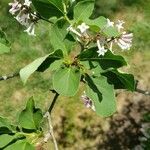
Syringa pubescens
Lilac · Ceriņi (LVL) · Miss Kim
Description
Source: leafsnapSyringa pubescens is a species of flowering plant in the lilac genus of the family Oleaceae, native to Korea and China (Gansu, Hebei, Henan, Hubei, Jilin, Liaoning, Ningxia, Qinghai, Shaanxi, Shandong, Shanxi, Sichuan).Growing to 6 m (20 ft) tall and broad, it is a substantial deciduous shrub with green leaves felted white beneath, and panicles of heavily scented, white-throated lilac flowers in early summer.The specific epithet pubescens means "downy", referring to the texture of the leaves.Three subspecies (formerly listed as separate species) are recognized : Syringa pubescens subsp. julianae - syn. S. julianae Syringa pubescens subsp. microphylla - syn. S. microphylla Syringa pubescens subsp. patula (also Syringa velutina) - syn. S. patula (Korean lilac, Manchurian lilac)The cultivar S. pubescens subsp. microphylla 'Superba' has gained the Royal Horticultural Society's Award of Garden Merit.According to some authorities Syringa meyeri C.K.Schneid. is a synonym of S. pubescens. The cultivar ‘Palibin’ has also won the AGM. However, the nearly palmate leaf venation of plants labelled S. meyeri is noticeably distinct from the pinnate venation of other forms of S. pubescens.
💡 Juliana lilacs are often referred to by the enchanting nickname "flower of heaven," likely due to their exquisite fragrance, which has been cherished since ancient times. Fittingly, the symbolic meaning or "flower language" associated with lilacs mirrors the grandeur of their nickname. Those born under the blessing of this flower are said to be favored by God and destined for a glorious life. However, their brilliance often leads them to seek shortcuts. It's important for them not to lose sight of their ultimate goals in their pursuit of success. In France, purple lilacs are particularly symbolic of first love.
Care Guide
💧 Water
Native to Eastern Asia, the Juliana lilac thrives in moderately moist soil and high humidity. It benefits from consistent watering, ideally twice a week, especially in the spring when it undergoes vigorous growth. Primarily grown outdoors, the Juliana lilac is valued for its ornamental qualities, displaying lush blooms when properly hydrated.
☀️ Light Full sun
Juliana lilac is native to open areas, such as sunny meadows and forest margins, which provide plentiful light. It thrives in Full Sun but can also tolerate Partial Sun, adapting well to a range of sunlight conditions.
What amount of sunlight is required for a Juliana lilac to thrive?
A Juliana lilac (Syringa pubescens) requires specific amounts of sunlight to flourish. For full sun exposure, it needs above 6 hours of sunlight daily. However, it can also grow in partial sun, which means about 3-6 hours of sunlight. It's crucial to observe the patterns of sunlight moving through your garden to find the optimal spots that offer a harmonious balance of light and shade. This ensures your Juliana lilac plants maintain their happiness and health.
🌡️ Temperature 0–32.2°C
Juliana lilac shows strong adaptability to a variety of climates, from scorching summers to cold winters. However, it does have a preferred temperature range for growth. When temperatures become too high, the plant is vulnerable to heat and humidity stress, which can cause it to die. In areas where temperatures approach the lower limit of its cold tolerance, it is important to use insulation to protect the plant.
What is the botanic name of Juliana lilac?
The botanic name of Juliana lilac is Syringa pubescens.
💨 Humidity
🪴 Soil 6-7
🌱 Fertilizer
The timing of fertilizing Juliana lilac is important. Apply fertilizer in early spring and continue monthly until early summer. Fertilizer encourages attractive blooms and supplies energy during both dormant and active growth periods.
🪴 Pot & Repot Every 12 months
✂️ Pruning
The Juliana lilac boasts fragrant flowers and dense foliage. For best results, prune it in early spring by removing dead wood and thinning the branches to improve air circulation. Avoid heavy pruning; instead, opt for light annual pruning to maintain its shape and encourage flowering. Always make your cuts just above an outward-facing leaf bud to ensure optimal health and aesthetics.
🌿 Propagating
🐛 Diseases & pets
☠️ Toxicity
Characteristics
- Plant Type
- Shrub
- Life Cycle
- Perennial
- Genus
- Syringa
- Family
- Oleaceae
- Hardiness Zone
- 3-8
- Mature Height
- 2.13 m to 3.96 m
- Mature Spread
- 2.13 m to 3.05 m
- Leaf Color
- Dark Green, Forest Green
- Leaf Type
- Deciduous
- Flower Size
- 1.02 cm to 1.52 cm
- Bloom Time
- Mid spring, Late spring
- Planting Time
- Spring, Autumn
- Harvest Time
- Mid summer, Late summer, Early fall