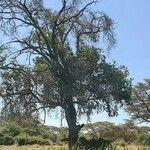
Syzygium guineense
Water-pear · White umdoni · Waterberry · Woodland waterberry · Bicoloured waterberry
Description
Source: leafsnapSyzygium guineense (Bambara: Kokisa) is a leafy forest tree of the family Myrtaceae, found in many parts of Africa both wild and domesticated. Both its fruits and leaves are edible; the pulp and the fruit skin are sucked and the seed discarded. It is sometimes called "waterberry", but this may also refer to other species of Syzygium. Syzygium guineense is a highly variable species, leading to debate concerning its taxonomy, including its subspecies. Frank White lists four subspecies: afromontanum, barotsense, guineense, and huillense, the last of which is a suffrutex. However, many other subspecies and varieties have been proposed.Its height is usually between 10 and 15 meters, but some specimens have been found as tall as 25 meters. The trunk is broad and fluted and the crown rounded and heavy, with a bark that is smooth when young, but becomes rough and black with age. The branches are dropping, the stems are thick and angular. The young leaves are purple-red in color, but as they mature their color becomes dark green; the leaves in general are shiny and smooth on both surfaces, with a tip that is long but rounded, on a short grooved stalk. The flowers of S. guineense have white, showy stamens, in dense branched heads 10 centimeters across, yielding a honey-sweet smell that attracts many insects. In southern Ethiopia S. guineense is a much-appreciated shade tree for both the homestead and the home garden. Wild forms occur from sea level to an altitude of 2,100 meters. It prefers moist soils with a high water table beside rivers, but this species will also grow in open woodland. It is considered a famine food, eaten by subsistence farmers when their crops fail.
Care Guide
💧 Water
The water pear is well-suited to humid, tropical environments and prefers consistent moisture. While it can tolerate moderate drought conditions, it thrives in high humidity. To keep the plant hydrated without causing waterlogging, weekly watering is recommended. As an evergreen, the water pear needs a reliable water supply to maintain its foliage throughout the year.
☀️ Light Partial sun
Water pear is native to habitats such as forest understories or rocky areas, where it occurs in natural shade. It prefers partial sun but can tolerate full sun or full shade, reflecting its versatile and hardy nature.
🌡️ Temperature 20–37.8°C
Water pear comes from tropical areas, where the climate is usually warm and humid. Consequently, it is well suited to high temperatures and humidity. It does not tolerate sudden shifts in temperature and prefers a steady thermal environment, so indoor temperature fluctuations should be avoided. It typically cannot withstand cold and needs warmer conditions to grow. If the surrounding temperature falls too low, the plant may stop growing or even die.
💨 Humidity
🪴 Soil 6-7
🌱 Fertilizer
Choose organic fertilizers (e.g., fish emulsion, compost) instead of chemical fertilizers for Water pear. Provide young plants with higher nitrogen and phosphorus during spring. Incorporate compost or fertilizer before or after planting. For mature plants, supplement in spring with a balanced fertilizer or one targeting specific deficiencies. Nutrient deficiency causes small leaves, short branches, yellow or bronze leaves, acidic fruits, premature fruit fall, and splitting.
🪴 Pot & Repot
✂️ Pruning
The water pear tree is known for its vigorous growth and shiny leaves. To maintain its health and productivity, it's essential to perform some key pruning tasks. In early spring, remove any dead branches and thin out crowded areas. This will encourage healthier growth and better fruit production, while also helping to maintain the tree's shape and deter pests. Always use clean, sharp tools for pruning and follow up with appropriate care.
🌿 Propagating
🐛 Diseases & pets
☠️ Toxicity
Characteristics
- Plant Type
- Tree
- Life Cycle
- Perennial
- Genus
- Syzygium
- Family
- Myrtaceae
- Hardiness Zone
- 10-12
- Mature Height
- 14.94 m to 29.87 m
- Mature Spread
- 4.88 m to 10.06 m
- Leaf Color
- Dark Green, Forest Green
- Leaf Type
- Evergreen
- Flower Color
- White
- Flower Size
- 0.51 cm to 0.76 cm
- Bloom Time
- Summer
- Planting Time
- Spring, Summer, Autumn
- Harvest Time
- Late summer, Early fall, Mid fall