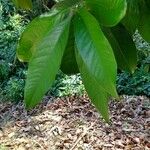
Syzygium malaccense
Malay apple · Pomarosa · Pomerac · Malaysian Apple · Otaheite-apple
Description
Source: leafsnapSyzygium malaccense, commonly known as the Malay apple or Otaheite apple, is a tropical fruit tree native to Southeast Asia and the Pacific Islands. It belongs to the Myrtaceae family and is closely related to other popular trees such as guava and eucalyptus. The tree can grow up to 12 meters tall, featuring a dense canopy of glossy green leaves. It produces small white flowers that develop into round or oblong-shaped fruits, measuring about 5-10 cm in diameter. The fruit has a waxy skin that can be red, pink, or yellow, depending on its maturity. The Malay apple has a sweet and slightly tangy flavor with crisp white flesh inside. It is commonly eaten fresh, but it can also be used in jams, jellies, sauces, and desserts. Besides its culinary uses, Syzygium malaccense possesses medicinal properties due to its high antioxidant content. Traditionally, the leaves are used to treat various ailments such as diarrhea and fever. Overall, Syzygium malaccense is an attractive tropical tree with delicious fruits that serve both culinary and medicinal purposes. This makes it an important plant for food security and traditional medicine practices across Southeast Asia, where it grows natively.
Care Guide
💧 Water Every 7 days
Malay apple thrives in humid tropical environments and prefers consistent moisture, though it can tolerate moderate drought conditions. Water the plant once every 2-3 weeks, allowing the soil to dry slightly between waterings. As an evergreen, the Malay apple requires regular watering to support its lush foliage in various climates.
How should I water my Malay apple tree?
Your Malay apple is not picky about how you water it. You can use any common watering tool, like watering cans, hoses, or cups. It's important to water directly onto the soil, making sure all areas are equally moistened to provide water to the entire root system. Using filtered water is recommended to avoid any harmful particles found in tap water. It's also best to use water at or slightly above room temperature, as very cold or hot water can shock the Malay apple. However, the Malay apple generally responds well to any type of water.
What should I do if I give my Malay apple too much or too little water?
Outdoor plants, especially newly planted ones or seedlings, can suffer from lack of watering. It's important to remember to water them enough for the first few months while they are still small or newly planted. Once the roots are established, Malay apple trees can rely on rainfall most of the time. When Malay apple trees are planted in pots, overwatering is more likely to occur. If you accidentally overwater your Malay apple, there are steps you can take to fix the situation. First, stop watering the plant immediately to minimize the impact of overwatering. Then, remove the tree from its pot to check the roots. If there are no signs of root rot, you can return the plant to its container. However, if you notice any root rot, trim away the affected roots and consider applying a fungicide to prevent further damage. Finally, repot the Malay apple in well-draining soil. On the other hand, if your Malay apple is underwatered, simply water it more frequently. Underwatering is usually easy to correct. If the leaves are drooping, drying out, or falling off, proper watering will make the leaves regain their fullness quickly. It's important to adjust your watering schedule as soon as you notice signs of underwatering.
How much water should I give to my Malay apple plant?
Most plants can grow naturally with rainfall, but if there is a lack of rainfall in your area, you should water your plants every 2 weeks during the spring and fall. In the summer, you will need to water them more frequently. In the winter, when plants need less water, you should water them sparingly or not at all. If you have a young or newly planted Malay apple, you should water it more often to help it establish and grow. For potted plants, there are two ways to determine how often to water your Malay apple. The first is to follow a predetermined watering schedule, such as once every week or once every other week. However, this may not always work as it does not consider the specific conditions of your growing environment. The second way is to monitor the soil moisture. It is best to wait until the top two to four inches of soil, about ⅓ to ½ depth of the pots, have completely dried out before watering again. The watering frequency may need to be adjusted during the summer when the plant's water needs are highest.
How much water does my Malay apple tree require?
Watering your Malay apple plant may not require a high volume of water. If only a few inches of soil have dried since the last watering, giving it around five to ten ounces of water should support healthy growth. You can also determine the water volume based on soil moisture. Take note of how many inches of soil have dried out between waterings. To ensure your Malay apple receives adequate moisture, water enough to moisten all the dry soil layers since the last watering. If over half of the soil has dried out, you may need to give more water than usual. In such cases, add water until you see excess water draining from the pot's holes. If your Malay apple is planted in an area that receives ample outdoor rain, it may not need extra watering. For young or establishing plants, provide 1-2 inches of rain per week. As the plant grows and establishes, it can survive solely on rainwater. Only if the weather is hot and there is no rainfall for 2-3 weeks, consider giving your Malay apple a thorough watering to prevent stress.
How do I know if I'm watering my Malay apple tree enough?
The Malay apple is often overwatered, which can be easily identified by certain signs. An overwatered plant will have yellow leaves and possibly shed some leaves. Moreover, excessive watering can cause the plant's structure to shrink and may lead to root rot. On the contrary, an underwatered Malay apple will start to droop and its leaves may turn brown or become brittle. Regardless of whether you observe signs of overwatering or underwatering, it is important to take action promptly and restore the health of your Malay apple.
☀️ Light Full sun
Native to environments that typically receive abundant light, the Malay apple needs plenty of sunlight for optimal growth and health. It has little tolerance for shade and does best in full sun. Its growth and vigor can decline if light is either too little or too much.
What are the sunlight requirements for Malay apple plants?
Malay apple plants, scientifically known as Syzygium malaccense, flourish under full sun conditions, requiring more than 6 hours of sunlight daily to achieve optimal growth and health. Originating in environments abundant in light, they do not tolerate shade well and can suffer negative impacts on their growth and vitality if either too little or too much light is provided. It's vital to observe the movement of sunlight through your garden, selecting locations that deliver a suitable mix of light and shade to ensure the plants' well-being.
How can artificial lighting be utilized for malay apple plants?
In scenarios where natural sunlight is inadequate, particularly during winter or in less sunny indoor locations, artificial lighting serves as an essential alternative for Malay apple plants. Proper growth can be supported by ensuring sufficient artificial light. LED lights are recommended due to their ability to offer specific light wavelengths needed by plants. For full sun plants, 30-50 watts per square foot is recommended, for partial sun plants 20-30 watts per square foot, and for full shade plants, 10-20 watts per square foot. The artificial light source should be positioned 12-36 inches above the plant to mimic natural sunlight and provided for 8-12 hours per day to emulate the natural day length.
What are the symptoms of light deficiency in Malay apple plants?
Malay apple plants show several symptoms when suffering from insufficient light exposure. These include small, underdeveloped leaves compared to older ones; leggy growth with elongated spaces between leaves or stems, giving the plant a sparse appearance; premature leaf drop as the plant conserves resources; halted growth as the plant enters survival mode; pale new leaves indicating a lack of chlorophyll; chlorosis, where leaves lose their green color; sunscald characterized by bleached areas on leaves or stems; leaf curling as a defense against too much light; wilting from excessive water loss; and leaf scorching evidenced by brown, crispy leaf edges. These symptoms highlight the plant's struggle with inadequate lighting conditions.
What solutions are there for light-deficient Malay apple plants?
To aid light-deficient Malay apple plants, gradually introducing them to brighter conditions is key, ensuring they receive at least 6 hours of direct sunlight daily. For indoor plants, utilizing a south-facing window or artificial light like desk or ceiling lamps for a minimum of 8 hours a day can supplement sunlight exposure. For outdoor plants, moving them progressively to sunnier spots each week can help avoid sunburn. Additionally, for plants on the ground, minimizing obstructions such as pruning trees can enhance sunlight access. If necessary, transplanting smaller plants during their dormant period to better-lit locations can significantly improve their exposure to sunlight.
🌡️ Temperature 20–37.8°C
The Malay apple naturally occurs in tropical regions where temperatures range from 68 to 100 °F (20 to 38 °C). It favors warm conditions, so keeping temperatures within this range is important. Adjust temperatures seasonally if necessary.
What is the ideal temperature range for Malay apple growth?
The Malay apple thrives in tropical environments where the temperature ranges from 68 to 100°F (20 to 38°C). It is a heat-loving plant, extremely sensitive to cold, and requires warm conditions to grow optimally. During winter, it's crucial to maintain temperatures above 20°C and ensure the plant is protected from temperatures close to or below 5°C to avoid detrimental effects.
What should I do if my Malay apple experiences low temperatures?
If your Malay apple is exposed to temperatures below its comfort range, especially during winter when it should be kept above 5°C, it may show symptoms like lightened leaf color, which can turn brown or black after frost damage, wilting, and drooping. In such cases, trim off the frost-damaged parts and move the plant indoors to a warm environment for cold protection. Positioning it near a south-facing window ensures it receives ample sunlight, but keep it away from direct heat sources like heaters or air conditioning vents to avoid air dryness.
How should I care for Malay apple during high temperatures?
During the summer, Malay apple should be kept below 38°C to prevent overheating and sunburn. If temperatures exceed 43°C, the leaves may lighten in color and the plant can suffer from sunburn. To care for a heat-stressed Malay apple, trim away sunburned and dried-up parts, move the plant to a shaded location especially from the midday and afternoon sun, and ensure the soil remains moist by watering in the morning and evening.
💨 Humidity
🪴 Soil 5-6
🌱 Fertilizer
Use organic fertilizers (e.g., fish emulsion, compost) instead of chemical fertilizers for Malay apple. Give young plants higher levels of nitrogen and phosphorus in spring. Incorporate compost or fertilizer into the soil before or after planting. For mature plants, supplement with a balanced fertilizer or one specific to any deficiencies in spring. Nutrient deficiency causes small leaves, short branches, yellow/bronze leaves, acidic fruits, premature fruit fall, and splitting.
🪴 Pot & Repot
✂️ Pruning
The Malay apple is a tropical evergreen tree known for its glossy leaves and edible fruits. To promote healthy growth, prune the tree in early spring. This will help remove dead branches, enhance new growth, and improve air circulation. Maintaining a strong canopy maximizes sunlight exposure and minimizes pest problems. Always use clean, sharp tools when pruning for the best results.
🌿 Propagating
🐛 Diseases & pets
☠️ Toxicity
Characteristics
- Plant Type
- Tree
- Life Cycle
- Perennial
- Genus
- Syzygium
- Family
- Myrtaceae
- Hardiness Zone
- 10-11
- Mature Height
- 10.06 m
- Mature Spread
- 5.49 m
- Leaf Color
- Green
- Leaf Type
- Evergreen
- Flower Color
- Pink, Red, Purple
- Flower Size
- 2.54 cm
- Bloom Time
- Early summer, Mid summer
- Planting Time
- Spring, Autumn
- Harvest Time
- Mid summer, Late summer, Early fall
- Native Area
- India, Malaysia, Indonesia, Cambodia, Vietnam, Myanmar, Bangladesh, Laos, Australia, Thailand, China