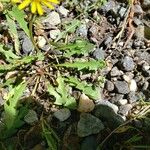
Taraxacum palustre
Marsh dandelion · Fen Dandelion
Description
Source: leafsnapTaraxacum palustre, commonly known as marsh dandelion, is a perennial herbaceous plant in the Asteraceae family. Native to Europe and Asia, it has also been introduced and naturalized in many parts of North America. The plant can grow up to 50 cm tall and features a basal rosette of leaves that are deeply lobed with toothed edges. These dark green leaves can reach up to 30 cm in length. The flowers of Taraxacum palustre are bright yellow with ray florets surrounding central disk florets. They bloom from May through September on long stalks that rise above the basal rosette of leaves. The flowers eventually transform into fluffy white seed heads known as "dandelion clocks," which disperse their seeds via the wind. Taraxacum palustre prefers moist soils such as those found in marshes, wet meadows, ditches, and riverbanks, but it can also thrive in dry soils like those along roadsides or in disturbed areas such as lawns or gardens. It serves as an important food source for bees and other pollinators. The plant has been used for medicinal purposes for centuries, primarily for its diuretic properties that help increase urine production and aid kidney function. It also contains antioxidants that protect against cell damage caused by free radicals. Overall, Taraxacum palustre is an attractive wildflower with significant ecological and medicinal benefits, making it a valuable addition both in natural habitats and in cultivation.
Care Guide
💧 Water
☀️ Light Full sun
🌡️ Temperature 5–32.2°C
💨 Humidity
🪴 Soil 6-7
🌱 Fertilizer
🪴 Pot & Repot
✂️ Pruning
🌿 Propagating
🐛 Diseases & pets
☠️ Toxicity
Characteristics
- Plant Type
- Herb
- Life Cycle
- Perennial
- Genus
- Taraxacum
- Family
- Asteraceae
- Hardiness Zone
- 4-8
- Mature Height
- 10 cm to 30 cm
- Mature Spread
- 15 cm to 25 cm
- Leaf Color
- Green, Dark Green
- Leaf Type
- Semi-evergreen
- Flower Color
- Yellow
- Flower Size
- 3.05 cm to 5.08 cm
- Bloom Time
- Spring, Early summer
- Planting Time
- Spring, Autumn
- Harvest Time
- Mid spring, Late spring, Early summer, Mid summer
- Native Area
- Germany, Denmark, France, Ireland, United Kingdom, Croatia, Belgium, Netherlands