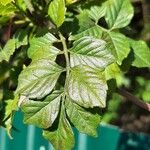
Tecomaria capensis
Cape honeysuckle · Cock-a-doodle-do · Dayglo
Description
Source: leafsnapTecomaria capensis, commonly known as Cape Honeysuckle, is a fast-growing evergreen shrub native to South Africa. Belonging to the Bignoniaceae family, it can reach up to 3 meters in height and 2 meters in width. The plant features glossy green, pinnately compound leaves with 5 to 7 leaflets. Cape Honeysuckle produces clusters of tubular orange or red flowers year-round, with peak blooming in late summer and fall. These vibrant flowers are highly attractive to hummingbirds and butterflies. The plant thrives in full sun or partial shade and requires well-drained soil. While it can tolerate drought conditions once established, regular watering during dry spells is beneficial. Due to its appealing foliage and striking blooms, Tecomaria capensis is a popular choice for hedges, screens, borders, or as standalone specimens in gardens. Minimal maintenance is required for this plant, though pruning after the flowering season can help with shaping or removing dead wood. Tecomaria capensis has no significant pest issues but may be susceptible to root rot if planted in poorly drained soil. Overall, Tecomaria capensis is an excellent choice for gardeners seeking an easy-to-grow shrub that offers year-round visual interest with its bright blooms and glossy foliage, while also attracting pollinators like hummingbirds to their garden space.
🌳 The bark of Cape honeysuckle has historically been used to brew a health-promoting tea. Recently the plant has drawn attention for its orange-red pigments, which are useful for dyes and inks. Its flowers, interestingly, produce an oil that could act as a natural insect deterrent and might inspire eco-friendly pest control methods.
🎭 Subconscious force of truth, sincere intention
Care Guide
💧 Water Every 7 days
☀️ Light Full sun
Cape honeysuckle flourishes with abundant sunlight yet can tolerate moderate light levels. Native to areas that receive plenty of sun, it depends on this ample light for healthy growth. Too little light can reduce flower production, while too much can scorch the leaves.
🌡️ Temperature 20–37.8°C
The natural growth conditions for cape honeysuckle call for a minimum temperature of 20 ℃ (68 ℉), although it can tolerate temperatures up to 38 ℃ (100.4 ℉). With a preferred temperature range of 20 to 38 ℃ (68 to 100.4 ℉), it is appropriate for cultivation in warm-climate areas. In winter, the plant needs cooler temperatures to promote metabolic activities, which can be achieved by positioning it in a cooler location or by reducing how often it is watered.
💨 Humidity
🪴 Soil 6-7
🌱 Fertilizer
Fertilization is essential for caring for Cape honeysuckle. Consistent feeding during the growing season maintains the energy needed for its showy leaves and supports overall growth. Failing to fertilize can lead to unhealthy leaves, reduced ornamental value, and stunted or weak growth that is prone to breakage.
🪴 Pot & Repot 2-3 years
Repot Cape honeysuckle in early spring into a pot only slightly larger than the current one that has adequate drainage. Use a well-draining potting mix and position the root ball at the same level as before. Gently loosen any root-bound roots. After repotting, water generously and place the plant in a warm, shady spot. Regular pruning maintains its size and encourages new growth.
✂️ Pruning
🌿 Propagating
🐛 Diseases & pets
☠️ Toxicity
Characteristics
- Plant Type
- Vine
- Life Cycle
- Perennial
- Genus
- Tecomaria
- Family
- Bignoniaceae
- Hardiness Zone
- 9-11
- Mature Height
- 2.13 m to 3.05 m
- Mature Spread
- 2.13 m to 3.05 m
- Leaf Color
- Green
- Leaf Type
- Evergreen
- Flower Color
- Orange, Red, Yellow
- Flower Size
- 2.54 cm to 5.08 cm
- Bloom Time
- All year round
- Planting Time
- Spring, Autumn
- Harvest Time
- All year round
- Native Area
- Malawi, Lesotho, Angola, Mozambique, South Africa, Zambia, Eswatini, Congo (DRC), Tanzania, Central African Republic