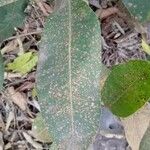
Terminalia arjuna
Arjun · White murdh · Kumbuk · తెల్ల మద్ది
Description
Source: leafsnapTerminalia arjuna is a large deciduous tree native to India, commonly found in the dry, deciduous forests of the Indian subcontinent. Belonging to the Combretaceae family, it can grow up to 30 meters in height. The tree features smooth, grey bark that peels off in irregular patches, revealing a pinkish layer underneath. The leaves of Terminalia arjuna are simple, oblong or elliptic-shaped with pointed tips, and can grow to be 10-20 cm long. The flowers are small, white or yellowish-green, with five petals that bloom between March and June. The fruit of Terminalia arjuna is an oblong drupe measuring about 2-4 cm long, with five wings on top. It contains one or two seeds inside, which are used for propagation. Terminalia arjuna has been used for centuries in Ayurvedic medicine, as it contains several bioactive compounds such as flavonoids, tannins, and saponins, which have antioxidant properties. Traditionally, it has been used to treat various ailments such as heart diseases like angina pectoris (chest pain), hypertension (high blood pressure), and dysentery (inflammation of the intestines). In addition to its medicinal properties, Terminalia arjuna serves several other purposes. Its hardwood is resistant to termites, making it ideal for timber production. The tree provides shade during hot summers due to its large canopy cover and helps prevent soil erosion by stabilizing soil on slopes. Overall, Terminalia arjuna is an important plant species both ecologically and medicinally, offering various benefits that have made it an integral part of Indian culture since ancient times.
Care Guide
💧 Water Every 7 days
Arjuna thrives in moist environments and needs regular weekly watering for healthy growth. Although it can tolerate short periods of dryness, it prefers consistently moist soil. With a resilient root system, it is well-adapted to its native riverbank and wetland habitats, and can handle changes in moisture levels.
☀️ Light Full sun
Arjuna flourishes with plentiful sunlight, reflecting its natural habitat. The plant's overall health and growth rely heavily on abundant sun. Excessive or insufficient exposure can impede its development, producing harmful effects such as discoloration and a weakened structure. Every stage of this plant's life cycle requires steady sun exposure.
🌡️ Temperature 20–37.8°C
Arjuna is suited to a warm native habitat, requiring temperatures from 68 to 100.4 °F (20 to 38 ℃). It tolerates seasonal temperature variations, so modest shifts toward cooler or warmer conditions are not harmful.
💨 Humidity
🪴 Soil 6-7
🌱 Fertilizer
Fertilizing is essential for Arjuna care. Regular feeding during the active growing season preserves the energy required for its showy foliage and supports overall development. Failing to fertilize can lead to unhealthy leaves, reduced ornamental value, and stunted or weak growth that is prone to breaking.
🪴 Pot & Repot
✂️ Pruning
Pruning arjuna trees from early to late winter improves their health and appearance. Key techniques include removing dead wood, thinning crowded branches, and shaping the tree. Pruning during this dormant phase reduces stress on the tree, encourages new growth, and can potentially improve medicinal yields.
🌿 Propagating
🐛 Diseases & pets
☠️ Toxicity
Characteristics
- Plant Type
- Tree
- Life Cycle
- Perennial
- Genus
- Terminalia
- Family
- Combretaceae
- Hardiness Zone
- 10-12
- Mature Height
- 20.12 m to 24.99 m
- Mature Spread
- 20.12 m
- Leaf Color
- Green, Bronze
- Leaf Type
- Evergreen
- Flower Color
- White, Cream
- Flower Size
- 8.89 cm to 12.70 cm
- Bloom Time
- Late spring, Early summer
- Planting Time
- Winter, Spring
- Harvest Time
- Late summer, Early fall, Mid fall
- Native Area
- Sri Lanka, Bangladesh, India