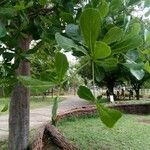
Terminalia mantaly
Satellite Tree. · Madagascar almond · Amandier de Madagascar · Tadah Tangan · Ketapang Kencana
Description
Source: leafsnapTerminalia mantaly is a tree species belonging to the family Combretaceae. It is commonly found in the tropical regions of Madagascar, where it can grow up to 20 meters tall. The tree features a straight trunk with grayish-brown bark that peels off in thin flakes. Its leaves are simple, alternate, and elliptical, with pointed tips and smooth margins. Terminalia mantaly produces small white flowers that cluster at the ends of branches. These flowers bloom during the summer months and eventually give way to small fruits, each containing a single seed. This plant has several medicinal properties and is used by traditional healers to treat a variety of ailments, including diarrhea, dysentery, fever, coughs, colds, and skin infections such as eczema and psoriasis. In addition to its medicinal uses, Terminalia mantaly has several other benefits. Its hard wood is resistant to termites, making it valuable for timber production. The tree also provides shade for crops like coffee or cocoa, which thrive under its canopy. Furthermore, its deep root system helps stabilize soil on steep slopes or riverbanks, making it useful for erosion control. Overall, Terminalia mantaly plays an important role both ecologically and economically within Madagascar's tropical forests, making it a species worth conserving.
Care Guide
💧 Water Every 7 days
☀️ Light Full sun
The Madagascar almond tree prefers steady, direct sunlight. Originating from areas with plentiful sunshine, it does best beneath an open sky. Both too little and too much light can impede its growth, highlighting its tendency to favor a well-lit environment.
🌡️ Temperature 20–37.8°C
The Madagascar almond tree prefers temperatures similar to its native habitat, about 68 to 100 °F (20 to 38 °C). In colder months, make sure to set your indoor thermostat to mimic these conditions as closely as possible.
💨 Humidity
🪴 Soil 6-7
🌱 Fertilizer
Fertilizing is essential for the care of the Madagascar almond tree. Regular nutrient applications during the growing season maintain the energy required for its showy foliage and support overall growth. If fertilization is neglected, leaves can become unhealthy, the tree’s ornamental value may decline, and growth can be stunted or weak and more susceptible to breaking.
🪴 Pot & Repot
✂️ Pruning
🌿 Propagating
🐛 Diseases & pets
☠️ Toxicity
Characteristics
- Plant Type
- Tree
- Life Cycle
- Perennial
- Genus
- Terminalia
- Family
- Combretaceae
- Hardiness Zone
- 10-12
- Mature Height
- 10.06 m to 20.12 m
- Mature Spread
- 2.13 m
- Leaf Color
- Green
- Leaf Type
- Evergreen
- Flower Color
- White, Cream
- Flower Size
- 5.08 cm
- Bloom Time
- Mid spring, Late spring, Early summer, Mid summer
- Planting Time
- Spring, Autumn
- Harvest Time
- Early spring, Mid summer, Late summer, Fall, Winter
- Native Area
- Madagascar