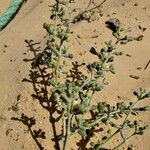
Tetraena alba
White Bean-caper
Description
Source: leafsnapTetraena alba (synonym Zygophyllum album) is a species of plant in the family Zygophyllaceae which is found in arid regions of Africa and the Arabian Peninsula. It is a salt tolerant plant and dominates many of the plant communities in which it grows.
Care Guide
💧 Water
The white bean-caper, native to arid regions, exhibits excellent drought tolerance and only needs to be watered every 2-3 weeks. It thrives in outdoor environments, especially in well-draining soil that mimics its natural desert habitat.
☀️ Light Full sun
White bean-caper is found in open habitats, like sunny meadows and forest edges, where light is abundant. It performs best in Full Sun but can also tolerate Partial Sun, adapting to different sunlight levels.
What are the sunlight requirements for White bean-caper?
White bean-caper needs full sun exposure, which is above 6 hours of sunlight daily, but it can also tolerate partial sun, approximately 3-6 hours of sunlight. It's crucial to observe how sunlight moves through your garden to find spots that offer the right balance of light and shade, ensuring optimal growth and happiness of your plants.
How does White bean-caper adapt to different lighting conditions?
Originating from open environments like sunny meadows and forest edges, White bean-caper is accustomed to ample light. It thrives in full sunlight, adapting well to various conditions of light. When natural light is insufficient, especially during winter or in less sunny spaces, artificial lighting can substitute, with LED lights recommended for their ability to be customized to the specific light wavelengths needed by plants. Full sun plants may require 30-50W/sq ft, partial sun plants 20-30W/sq ft, and full shade plants 10-20W/sq ft of artificial light.
What are symptoms of insufficient light in White bean-caper?
When White bean-caper does not receive adequate sunlight, it may show several symptoms. Small leaves, leggy or sparse growth, accelerated leaf drop, a halt in new growth, paler new leaves, chlorosis, sunscald, leaf curling, wilting, and leaf scorching are common signs. These symptoms signify that the plant is not receiving enough light or is getting too much, affecting its growth, color, and overall health negatively.
What solutions can help White bean-caper receive adequate sunlight?
To ensure White bean-caper receives ample sunlight, gradually move it to a sunnier spot, aiming for at least 6 hours of direct sunlight daily. If moving the plant isn't feasible, consider using artificial lights to compensate. For outdoor plants, it's essential to acclimate them gradually to prevent sunburn. Also, reducing obstructions that block sunlight, such as pruning trees or moving plants to less obstructed areas, can help. Remember, parts of the plant that were previously affected by light deficiency may not recover, but new growth should be healthy with improved light conditions.
🌡️ Temperature 20–37.8°C
White bean-caper is native to tropical areas, where the climate is generally warm and humid. As a result, it is adapted to high temperatures and humidity. It does not tolerate sudden temperature changes and prefers a steady temperature, so indoor temperature fluctuations should be avoided. It usually cannot withstand cold and requires warmer conditions for growth. If the surrounding temperature falls too low, the plant may stop growing or even die.
💨 Humidity
🪴 Soil 6-8
🌱 Fertilizer
Fertilization is essential for the care of the White bean-caper. Consistent feeding during the growing season maintains the energy needed for its showy leaves and supports overall growth. Failing to fertilize can lead to unhealthy foliage, reduced ornamental value, and stunted or weakened growth that is more likely to break.
🪴 Pot & Repot
✂️ Pruning
Prune white bean-caper plants from early to late winter to promote healthy growth. Be sure to remove any dead branches and thin out overcrowded areas to improve airflow and maintain a natural shape. Pruning at the right time enhances the plant’s vigor in spring and supports overall health. Additionally, using clean tools minimizes damage and helps strengthen the plant’s resistance to pests.
🌿 Propagating
🐛 Diseases & pets
☠️ Toxicity
Characteristics
- Plant Type
- Shrub
- Life Cycle
- Perennial
- Genus
- Tetraena
- Family
- Zygophyllaceae
- Hardiness Zone
- 9-11
- Mature Height
- 30 cm to 61 cm
- Mature Spread
- 49 cm to 91 cm
- Leaf Color
- Light Green, Gray
- Leaf Type
- Evergreen
- Flower Color
- White
- Flower Size
- 1.02 cm to 2.03 cm
- Bloom Time
- Mid spring, Late spring, Early summer
- Planting Time
- Spring, Summer, Autumn
- Harvest Time
- Summer
- Native Area
- Saudi Arabia, Libya, Somalia, Egypt, Tunisia, Turkey, Djibouti, Sudan, Cyprus, Eritrea, Greece, Yemen, Spain, Oman, Ethiopia, Algeria