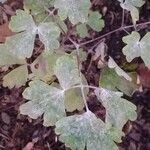
Thalictrum dioicum
Early meadow-rue · Quicksilver-weed
Description
Source: leafsnapThalictrum dioicum, commonly known as early meadow rue, is a herbaceous perennial plant belonging to the Ranunculaceae family. It is native to North America and is typically found in moist woodlands and meadows. This plant can grow up to 60 cm tall and forms clumps, with multiple stems arising from its base. The leaves are compound, featuring three finely divided leaflets that give them a delicate appearance. The flowers of Thalictrum dioicum are small and inconspicuous but have an interesting structure. They lack petals but are adorned with numerous stamens, giving them a fluffy look. The male flowers feature yellow stamens, while the female flowers display greenish-white pistils. Thalictrum dioicum is important for pollinators, attracting bees, butterflies, and other insects with its nectar-rich flowers. Additionally, it serves as a food source for some butterfly larvae. The plant prefers moist soil in partial shade or full sun but can tolerate dry conditions once established. It is easy to grow from seed or by dividing established clumps. In traditional medicine, Thalictrum dioicum has been used for its anti-inflammatory properties to treat various ailments such as arthritis and rheumatism. Overall, Thalictrum dioicum is an attractive native perennial that enhances woodland gardens with its beauty while providing ecological benefits, such as supporting pollinator habitats.
Care Guide
💧 Water
☀️ Light Partial sun
🌡️ Temperature 5–32.2°C
💨 Humidity
🪴 Soil 6-7
🌱 Fertilizer
🪴 Pot & Repot
✂️ Pruning
🌿 Propagating
🐛 Diseases & pets
☠️ Toxicity
Characteristics
- Plant Type
- Herb
- Life Cycle
- Perennial
- Genus
- Thalictrum
- Family
- Ranunculaceae
- Hardiness Zone
- 4-7
- Mature Height
- 30 cm to 61 cm
- Mature Spread
- 30 cm to 61 cm
- Leaf Color
- Green, Gray, Silver
- Leaf Type
- Semi-evergreen
- Flower Color
- Green, White, Purple, Yellow
- Flower Size
- 2.54 cm
- Bloom Time
- Mid spring, Late spring
- Planting Time
- Autumn
- Harvest Time
- Late spring, Early summer