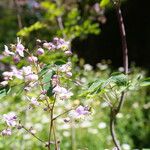
Thalictrum rochebruneanum
Yellow-filamentous meadow-rue
Description
Source: leafsnapThalictrum rochebruneanum, called the lavender mist meadow rue, is a species of flowering plant in the genus Thalictrum, native to the Korean Peninsula and Japan. A clumping perennial topped with a loose spray of small medium violet flowers with yellow stamens, and sometimes reaching 2 m (7 ft), it has gained the Royal Horticultural Society's Award of Garden Merit.
Care Guide
💧 Water 1-2 times a week
Common rue is an excellent choice for a xeriscape or rock garden because it is quite drought tolerant once it has been established. as a result You wont need to water rue until there are extended dry spells; water it less frequently. Avoid overwatering because it can lead to root rot.
☀️ Light
🌡️ Temperature
The rue is not sensitive to frost and is unaffected by temperatures as low as -4 °F (-20 °C). The rue loses its leaves after fructification in October and persists in the ground. The parts of the above-ground plant sprout once more in the spring. No specific winterizing precautions are required. It is advised to keep pot cultures in a cool environment.
💨 Humidity
🪴 Soil
🌱 Fertilizer
It is advisable to add some compost to the garden bed’s upper soil area in the spring. If compost is not available, fresh animal manure or similar light organic liquid fertilizer can be used instead. Most of the time, no more nutritional support is needed after. Potted plants should get a standard herbal fertilizer in the spring, right before blooming.
🪴 Pot & Repot
✂️ Pruning
A semi-woody perennial called rue blooms on fresh growth. Cut stems back to around 6 inches in the early spring to keep the plant healthy and looking its best. Avoid waiting too long or you might have to remove some flower buds. After the flowering season has over, you can prune as well.
🌿 Propagating
🐛 Diseases & pets
☠️ Toxicity
Steeped in rich history, the plant is also a medicinal herb. Blackfoot Indian girls would tie the flowers in their hair as "love medicine." The legend goes that Meadow Rue could capture the first male who laid eyes on them, while young men crushed the inflorescence with spittle in their palms, hoping that a maiden would accept their hand. Meanwhile, young boys made toy flutes from hollow stems. Also, the Ojibwa and Potowatomi put the seeds in a quarreling couple's food to ease their troubles. With regard to physical health, the seeds are known to stop cramps. Listed on the U.S. Dispensatory of 1916, roots of a purple variety (T. dasycarpum) have been used as a purgative and diuretic, reduce fever, and improve blood circulation. Meadow Rue root has also been used to ease palpitations, a call back to matters of the heart. Meadow Rue belongs to the Ranunculaceae (buttercup) family. Because many Ranunculaceae are toxic, do not ingest the plant without proper instruction from a professional. It has also been reported harmful to dogs if eaten in a large quantity.
Characteristics
- Plant Type
- Herbaceous perennial
- Genus
- Thalictrum
- Family
- Ranunculaceae
- Hardiness Zone
- 3-7
- Bloom Time
- Late summer
- Native Area
- Japan