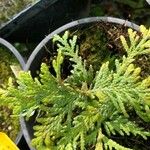
Thuja koraiensis
Korean arborvitae · Korean thuja · Korean Arbor-vitae
Description
Source: leafsnapThuja koraiensis, commonly known as Korean arborvitae, is a coniferous evergreen tree native to Korea and parts of China. Belonging to the Cupressaceae family, it can grow up to 20 meters tall with a trunk diameter of up to 60 centimeters. The tree features a conical shape and dense, green foliage. The leaves of Thuja koraiensis are scale-like and arranged in opposite pairs along the stem. Its small cones, measuring about 1-2 centimeters long, have woody scales that protect the seeds inside. Thuja koraiensis prefers moist soil conditions but can tolerate drought once established. It thrives best in full sun or partial shade and is often used as an ornamental tree in landscaping due to its attractive shape and foliage. The wood of Thuja koraiensis is highly valued for its durability, resistance to decay, and attractive grain patterns. It has been used for various purposes, including construction, furniture making, and the production of musical instruments. Overall, Thuja koraiensis holds both ornamental and economic value. Its beautiful appearance makes it a popular choice for landscaping, while its durable wood contributes to its economic importance.
Care Guide
💧 Water Every 7 days
The Korean thuja thrives in environments with moderate humidity and has balanced water needs. It typically requires watering every 1 to 2 weeks. This evergreen plant is drought-tolerant and retains its foliage throughout the year, which means it consistently absorbs water, even during the colder months.
☀️ Light Partial sun
The Korean thuja naturally occurs in habitats like forest understories and rocky areas, where it is subjected to natural shade. It favors partial sun but can tolerate both full sun and full shade, reflecting its versatile, hardy nature.
What are the sunlight requirements for Korean Thuja?
Korean Thuja (Thuja koraiensis) thrives in areas where it can receive different amounts of sunlight, depending on its needs. For full sun, it requires above 6 hours of sunlight, which is essential for optimal growth. If the plant is in partial sun, it should receive about 3-6 hours of sunlight. It's important to observe the movement of sunlight through your garden throughout the day and choose planting spots that offer the right balance of light and shade. This careful selection will ensure your Korean Thuja's happiness and health.
🌡️ Temperature 5–32.2°C
Korean thuja is highly adaptable to a range of climates, from blazing summers to cold winters. However, it still has a preferred temperature range for healthy growth. If temperatures rise too much, the plant can suffer heat and humidity stress that may kill it. In places where temperatures approach the lower limit of its cold tolerance, it is necessary to apply insulation to protect the plant.
What is Korean thuja?
Korean thuja, botanically known as Thuja koraiensis, is a specific species of plant. There are no additional essentials or symptoms detailed in the provided information.
💨 Humidity
🪴 Soil 6-8
🌱 Fertilizer
Korean thuja has specific nutrient needs and does not require heavy fertilization. Spring is the best time to apply fertilizer for optimal growth. Providing nutrients enhances its health, increases its resistance to pests and diseases, and helps sustain its long lifespan.
🪴 Pot & Repot
✂️ Pruning
Korean thuja is a tree known for its dense evergreen foliage and pyramidal shape. To keep it healthy, it's best to prune it from early to late winter while it's dormant. Start by removing any dead or diseased branches, and thin out crowded areas to improve air circulation. Regular pruning encourages healthy growth. Be sure to use clean, sharp tools to avoid causing damage to the tree.
🌿 Propagating
🐛 Diseases & pets
☠️ Toxicity
Characteristics
- Plant Type
- Tree
- Life Cycle
- Perennial
- Genus
- Thuja
- Family
- Cupressaceae
- Hardiness Zone
- 4-7
- Mature Height
- 4.57 m to 9.14 m
- Mature Spread
- 4.88 m
- Leaf Color
- White, Green
- Leaf Type
- Evergreen
- Flower Color
- Yellow, Red, Green, Brown
- Flower Size
- 0.51 cm to 1.02 cm
- Bloom Time
- Mid spring, Late spring
- Planting Time
- Spring, Autumn
- Harvest Time
- Late summer, Early fall, Mid fall
- Native Area
- Koppen, South Korea, China