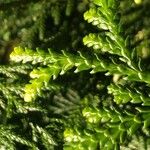
Thujopsis dolabrata
Hiba arborvitae · Asunaro · Hiba · Japanese-thuya · Hiba Arbor-vitae
Description
Source: leafsnapThujopsis () is a genus of conifers in the cypress family (Cupressaceae), the sole member of which is Thujopsis dolabrata. It is endemic to Japan, where it is named asunaro (あすなろ). It is similar to the closely related genus Thuja (arborvitae), differing in the broader, thicker leaves and thick cones. It is also called hiba, false arborvitae, or hiba arborvitae. A popular allegory for the meaning behind asunaro is asu wa hinoki ni narou (明日はヒノキになろう), literally "tomorrow it will become a hinoki cypress", i.e. the tree looks like a smaller version of the common hinoki cypress. In Japan, other than being called asunaro, it also goes by the name hiba (ひば). There are also a few regional variations, with asunaro being called ate (貴, 阿天) in Ishikawa, and atebi on Sado island. Thujopsis is a medium to large evergreen tree, reaching up to 40 m tall and 1.5 m trunk diameter, with red-brown bark which peels in vertical strips. The leaves are arranged in decussate pairs, scale-like, 3–10 mm long, glossy green above, and marked with vivid white stomatal bands below; they have a distinctive thick, almost fleshy texture. The seed cones are ovoid, 7–15 mm long and 6–10 mm diameter, with 6–12 thick scales, brown with a violet-white wax bloom when fresh. There are two varieties: Thujopsis dolabrata var. dolabrata. Central and southern Japan. Shoots less densely branched with slightly larger leaves, and strongly thickened cone scales. Thujopsis dolabrata var. hondai. Northern Japan. Shoots more densely branched with slightly smaller leaves, and less thickened cone scales.
💡 Although the Hiba is typically a tall tree, capable of reaching heights of up to 15 meters, there is a dwarf variety known as Thujopsis dolabrata 'Nana'. This particular cultivar is a low-spreading shrub that generally grows to about 30 centimeters in height.
Care Guide
💧 Water Every 1-2 weeks
Hiba, a plant native to Japan's damp woodlands, thrives in high humidity environments. It requires consistent watering every 1-2 weeks but should not be waterlogged. While hiba is best grown outdoors, it also benefits from mulching to help retain moisture and mimic its natural habitat.
How do I properly water my Hiba plant?
Watering your Hiba tree is a simple task. Just turn on your garden hose and use it to slowly soak the soil. A garden hose is ideal for mature trees that need a lot of water. However, smaller trees can be watered with a watering can or smaller tool. Remember to avoid overhead watering to prevent disease, especially when the tree is young.
What should I do if I give my Hiba plant too much or too little water?
Overwatering can occur if the soil does not drain properly, leading to the decline of your Hiba plant. To solve this issue, you can improve the soil drainage or move the plant to a better location. If your Hiba is in a pot, you may need to repot it with looser soil and a container that allows for better drainage. Overwatering can also make the plant susceptible to diseases, which should be treated promptly. On the other hand, if your Hiba is underwatered, simply increase the frequency of watering to help it recover. To determine if your plant is overwatered, check the foliage, especially the new growth. Discolored or easily breakable new growth indicates excessive moisture. Standing water or slow drainage in the plant's growing area are also signs of overly moist soil. For underwatered Hiba, the leaves may become sparse and brown. Consider recent rain or constant high temperatures as potential causes if you see these symptoms.
How many times should I water my Hiba plant?
Hiba trees are mature and can survive with little water, mainly relying on rainfall. In the hottest months, you may need to water them once a week, but in other seasons, watering may not be necessary. The exception is newly planted trees, which should be watered regularly to establish their roots. However, it is crucial to avoid overwatering, as Hiba trees do not tolerate standing water. When unsure, it is safer to not water them than to water them excessively.
How much water does Hiba require?
During the height of summer, watering your Hiba becomes necessary. Normally, giving the plant about one inch of water per week is sufficient. But, this may change if it has rained significantly. If it has rained an inch or more in a week, you don't need to water your Hiba. For newly planted Hiba, more water is required during the establishment period. Typically, this means watering once every one to two weeks for the first few growing seasons.
How should I water my Hiba tree during different times of the year?
The Hiba tree requires the most water during the summer when it's hottest. During this time, water it once a week if it hasn't rained. In other seasons, the Hiba can often survive without water. In spring and fall, there may be some instances where you'll need to give it water if it's very hot, but this is uncommon. Unlike other plants, the Hiba tree doesn't fully go dormant in winter, so it will keep growing even in the coldest months. However, water needs in winter are low because the cool temperatures don't dry out the soil quickly.
☀️ Light Full sun
Hiba prospers with a large amount of sunlight but can also endure stretches of lower light. Its vigorous growth in its native environment is partly due to plentiful sun exposure. Either too much or too little sunlight can negatively affect its health, deforming growth or causing discoloration.
What are the sunlight requirements for Hiba?
Hiba requires a lot of sunlight to thrive, ideally benefiting from more than 6 hours of sunlight a day for full sun exposure. It can also survive in partial sun conditions, which means about 3-6 hours of sunlight. It's crucial to monitor how sunlight moves through your garden to ensure that your Hiba plants get an optimal balance of light and shade, contributing to their growth and health.
How does sunlight affect Hiba's health and growth?
Sunlight plays a significant role in Hiba's health and growth, with the plant thriving best under abundant sunlight, similar to its natural habitat. However, both excessive sunlight and a lack of it can have negative impacts. Too much sunlight can distort the plant's growth and lead to discoloration, while insufficient sunlight may impede its robust growth. Artificial lighting can be a solution for indoor Hiba plants, particularly during winter or in less sunny areas, to ensure adequate light exposure for optimal growth.
What are the symptoms of insufficient sunlight in Hiba?
Hiba may show various symptoms when it doesn't get enough sunlight, including smaller new leaves, leggy or sparse growth, faster leaf drop, slower or no new growth, and lighter-colored new leaves. Too much sunlight can cause chlorosis, sunscald, leaf curling, wilting, and leaf scorching. These conditions reflect either a deficiency or an excess of sunlight, affecting the plant's ability to photosynthesize properly and maintain overall health.
How can I provide adequate sunlight to my Hiba plant?
To provide adequate sunlight for Hiba, consider gradually moving the plant to a sunnier spot, ensuring it gets at least 6 hours of direct sunlight daily. For indoor plants, utilize a south-facing window or consider artificial lighting with sufficient intensity based on the plant's needs, ensuring at least 8 hours of light daily. Outdoor plants should be acclimated to sunnier spots gradually to prevent sunburn. Additionally, for ground-planted Hiba, reduce obstructions like overhanging branches, or consider transplanting to a brighter location with ample sunlight and good drainage.
🌡️ Temperature 5–32.2°C
Hiba adapts well to a range of climate conditions, whether hot summers or cold winters. Nevertheless, it has an optimal temperature range for growth. If temperatures become too high, the plant is susceptible to heat and humidity stress, which can lead to its death. In areas where temperatures approach the lower limit of its cold tolerance, it is important to use insulation measures to protect the plant.
💨 Humidity
🪴 Soil 4-6
🌱 Fertilizer
Hiba has specific nutrient needs and does not require heavy fertilization. Spring is the best time to fertilize for optimal growth. Providing nutrients improves its health, strengthens its resistance to pests and diseases, and helps preserve its long lifespan.
Why should I use fertilizer on my Hiba tree?
In order to promote healthy growth for the Hiba plant, it's important to fertilize it during the spring. It's worth noting that this plant has a long lifespan and requires support. By adding nutrients to the soil, you can enhance the plant's overall health, which will enable it to better fend off common pests and diseases. This, in turn, will prevent stunted growth and extend its lifespan.
When should I fertilize my Hiba tree?
Hiba is unique compared to garden annuals and perennials, as it doesn't need an abundance of additional nutrients to thrive. The growing medium may not always provide sufficient nourishment for healthy growth. Fertilizing in the spring, before new growth emerges, is the optimal time to provide Hiba with the necessary nutrients.
When is the best time to not fertilize my Hiba plant?
Some plants need frequent fertilization, but not Hiba. It doesn't need a lot of extra nutrients and too much fertilizer can harm it. To care for it properly, only apply fertilizer in the spring and avoid using any in the summer, fall, and winter.
What kind of plant food does Hiba need?
The age of your plant affects the best kind of fertilizer it needs, but keep in mind that Hiba plants don't need a lot of extra nutrients. Choose a balanced plant food that will promote healthy root development and growth, but avoid fertilizers with high nitrogen content.
How can I provide nutrients for my Hiba plant?
To properly fertilize Hiba, timing and application technique are crucial. In the spring, apply the fertilizer at the base of the plant, focusing on avoiding the trunk. If you are using granulated fertilizer, cover the pellets with a thin layer of soil to ensure optimal absorption into the soil.
🪴 Pot & Repot 2-3 years
When repotting Hiba, select a pot 1-2 inches (2.5-5.1 cm) larger with ample drainage. Use a well-draining potting mix. Repot in spring or fall, making sure the root ball is slightly lower than the rim of the flower pot. Water thoroughly after repotting and place in a warm spot with indirect sunlight.
✂️ Pruning
Hiba is an evergreen conifer that features fan-like foliage and a pyramidal shape. To maintain its health and appearance, it should be pruned from early to late winter. During pruning, remove any dead branches, thin out the foliage, and shape the plant to enhance its aesthetics. Make clean, angled cuts to promote healing, encourage healthy growth, and prevent disease, as recommended by the RHS and local experts.
🌿 Propagating
🐛 Diseases & pets
☠️ Toxicity
Characteristics
- Plant Type
- Tree
- Life Cycle
- Perennial
- Genus
- Thujopsis
- Family
- Cupressaceae
- Hardiness Zone
- 6-8
- Mature Height
- 14.94 m to 39.93 m
- Mature Spread
- 4.57 m to 7.62 m
- Leaf Color
- Green
- Leaf Type
- Evergreen
- Flower Color
- Green, Blue, Black, Violet
- Bloom Time
- Mid spring, Late spring
- Planting Time
- Spring, Autumn
- Harvest Time
- Late summer, Early fall, Mid fall
- Native Area
- Japan