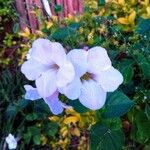
Thunbergia natalensis
Dwarf thunbergia · Natal blue bell · Natal blue thunbergia
Description
Source: leafsnapThunbergia natalensis is a species of flowering plant in the family Acanthaceae, that is native to parts of mainland Africa, including South Africa (Limpopo, Mpulamanga, KwaZulu-Natal, East Cape Province), Eswatini, Tanzania, Ethiopia, Malawi and Zimbabwe. It occurs in forest margins, bush and grassland. Normally evergreen, it responds to dry or cold winters by losing its leaves and going dormant. Common names include dwarf thunbergia, Natal blue thunbergia and Natal blue-bell.This handsome plant is cultivated in temperate regions for its masses of summer-flowering pale blue, trumpet-shaped blooms against dark hairy leaves. Growing to around 1 m (3.3 ft) tall, it is best displayed as groundcover in a partially-shaded position.
Care Guide
💧 Water
Dwarf blue thunbergia, originally from moist subtropical regions, prefers high humidity and consistent moisture. To keep the soil slightly damp, it is best to water the plant twice a week. This plant thrives outdoors, where it can benefit from natural rainfall, making it well-suited for areas that experience regular precipitation.
☀️ Light Partial sun
Dwarf blue thunbergia is native to habitats such as forest understories or rocky areas, where it grows in natural shade. It prefers partial sun but can adapt to full sun or full shade, demonstrating its versatile and hardy nature.
What are the sun requirements for Dwarf Blue Thunbergia?
Dwarf Blue Thunbergia (Thunbergia natalensis) thrives under specific sunlight conditions to ensure its happiness and healthy growth. It requires full sun exposure, which is defined as receiving more than 6 hours of sunlight daily, for optimal growth. However, it can also tolerate partial sun, meaning it can grow in conditions where it receives about 3 to 6 hours of sunlight. It's important for gardeners to observe the movement of sunlight through their garden throughout the day to identify spots that offer the perfect balance of light and shade to meet these needs.
🌡️ Temperature 20–37.8°C
Dwarf blue thunbergia originates from areas with moderate climates and prefers temperatures between 68 and 100 °F (20 and 38 ℃). To replicate its natural habitat, keep temperatures within this range, making seasonal adjustments if necessary.
What is the native climate for Dwarf Blue Thunbergia?
Dwarf Blue Thunbergia, scientifically known as Thunbergia natalensis, thrives in regions with moderate climates. It prefers temperatures that range between 68 to 100°F (20 to 38°C). To ensure healthy growth, it's important to maintain this temperature range, making adjustments during seasonal changes if necessary to mimic its natural habitat.
💨 Humidity
🪴 Soil 6-7
🌱 Fertilizer
The timing of fertilizing Dwarf blue thunbergia is important. Apply fertilizer in early spring and continue once a month until early summer. Fertilizer encourages attractive blooms and supplies energy during both dormant periods and active growth.
🪴 Pot & Repot
✂️ Pruning
The dwarf blue thunbergia, known for its vibrant blue flowers, benefits from pruning in early spring. This encourages bushy growth and produces more blooms. To improve air circulation, trim away dead stems and spent flowers. Cutting back up to one-third of the plant helps maintain a compact shape, enhancing its ornamental appeal.
🌿 Propagating
🐛 Diseases & pets
☠️ Toxicity
Characteristics
- Plant Type
- Shrub
- Life Cycle
- Perennial
- Genus
- Thunbergia
- Family
- Acanthaceae
- Hardiness Zone
- 9-11
- Mature Height
- 91 cm
- Mature Spread
- 0.61 m to 1.22 m
- Leaf Color
- Green
- Leaf Type
- Semi-evergreen
- Flower Color
- Blue
- Flower Size
- 5.08 cm to 7.62 cm
- Bloom Time
- Mid spring, Late spring, Summer
- Planting Time
- Spring, Summer, Autumn
- Harvest Time
- Summer, Early fall, Mid fall
- Native Area
- Malawi, South Africa, Eswatini, Ethiopia, Tanzania, Zimbabwe