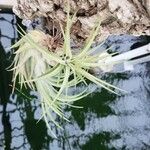
Tillandsia harrisii
Harris's Tillandsia · Harris’ tillandsia
Description
Source: leafsnapTillandsia harrisii, commonly known as Harris's air plant, is an epiphytic bromeliad native to the rainforests of Ecuador and Peru. This plant belongs to the Tillandsia genus and the Bromeliaceae family. Characterized by its unique appearance, Tillandsia harrisii features long, thin leaves that grow in a rosette formation. The green leaves have small scales that facilitate moisture absorption from the air. The plant can reach up to 10 inches in height and 6 inches in width. Caring for this air plant is straightforward as it does not require soil. Instead, it absorbs nutrients through its leaves from the surrounding environment. It prefers bright but indirect light and should be watered by misting or soaking once or twice a week. In the spring, Tillandsia harrisii produces striking pink flowers that bloom on long stalks, making it a visually appealing addition to any indoor garden or terrarium. In summary, Tillandsia harrisii is a fascinating epiphytic bromeliad with unique features that are easy to care for while enhancing the beauty of any space.
Care Guide
💧 Water Every 7 days
☀️ Light Partial sun
Harris's tillandsia is native to habitats like forest understories that provide natural shade. It prefers partial sun but can tolerate full sun if necessary.
🌡️ Temperature 20–37.8°C
Harris's tillandsia does best in warm conditions. If temperatures fall too low, the plant may stop growing or suffer frost damage. It tolerates high heat and humidity well and needs a steady level of moisture in its surroundings. Still, excessively high temperature and humidity can make it prone to fungal infections. In dry environments, regular watering and misting are needed to maintain sufficient air humidity. The plant is sensitive to sudden temperature swings, so keeping conditions relatively stable is important.
💨 Humidity
🪴 Soil
🌱 Fertilizer Every 30 days
🪴 Pot & Repot
✂️ Pruning
Harrisii Air Plants are relatively slow-growing and low-maintenance, so there is really no need for pruning. However, this plant is very hardy and will respond well to trimming. If you see any brown tips or mushy stems, as a result of overwatering, trim them off as soon as possible.
🌿 Propagating
🐛 Diseases & pets
☠️ Toxicity
All varieties of the Tillandsia genus, including the Harrisii Air Plant, are not reported to be toxic. This unique and striking epiphyte is safe for nearly all households with children and pets. The ASPCA has confirmed that it is highly unlikely for dogs and cats to fall ill after nibbling a bit of the leaf.
Characteristics
- Plant Type
- Herb
- Life Cycle
- Perennial
- Genus
- Tillandsia
- Family
- Bromeliaceae
- Hardiness Zone
- 9-11
- Mature Height
- 30 cm
- Mature Spread
- 30 cm
- Leaf Color
- Green, Gray, Silver
- Leaf Type
- Evergreen
- Flower Color
- Lavender
- Flower Size
- 2.03 cm to 3.05 cm
- Bloom Time
- Summer
- Planting Time
- Spring, Autumn, Winter
- Harvest Time
- Late summer, Early fall, Mid fall
- Native Area
- Guatemala