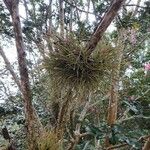
Tillandsia recurvata
Ball-moss · Bunch-moss · Small ballmoss · Old Man's Beard · Air plant
Description
Source: leafsnapTillandsia recurvata, commonly known as ball moss, is a species of epiphytic plant that belongs to the Bromeliaceae family. It is native to the southern United States, Mexico, Central America, and South America. This plant is notable for its unique, small spherical shape and gray-green coloration. It typically grows up to 10 cm in height and 15 cm in width. Ball moss is an air plant that does not require soil for growth, as it absorbs nutrients from the air through its leaves. It attaches itself to trees or other objects using its roots, which serve only for anchorage. Tillandsia recurvata produces small purple flowers that bloom from late winter through early spring. These flowers are followed by small seed pods containing numerous tiny seeds. This plant can be found in various habitats, including forests, deserts, and coastal areas where it can tolerate high levels of salt spray. Overall, Tillandsia recurvata is an intriguing epiphytic species with unique characteristics that make it an attractive addition to any plant collection or garden setting.
🌳 Ball moss is an effective bioindicator for evaluating air quality. Researchers rely on its sensitivity to airborne pollutants as an ecological tool for tracking urban pollution levels. Its physiological reactions to contaminants provide valuable information and function as an early warning system for ecosystem health.
Care Guide
💧 Water Every 7 days
Ball moss thrives in high humidity by absorbing moisture from the air. While it can survive drought, it requires daily watering when kept indoors. Regular misting helps imitate its natural environment and improves its hydration. By replicating its native conditions, you can provide the best care for this epiphytic plant.
What should I do if Ball moss gets too much water?
Overwatering can cause serious problems for Ball moss because their stems and leaves are prone to rotting. Unlike other plants, overwatering mainly affects the center of the leaves, where water becomes trapped. This trapped water can suffocate the leaves and create an environment for microorganisms to thrive. In fact, overwatering is the main reason why Ball moss kept as houseplants often die. However, if Ball moss is grown outdoors, the risk of overwatering is lower due to better ventilation, which promotes healthier growth. The signs of overwatering in Ball moss include a darkened base and mushy roots. Leaves will also turn yellow and eventually drop off. If your Ball moss shows these signs, it's important to remove any dead or dying parts and thoroughly dry the plant. Placing it on a dry surface with good airflow, such as using a fan, can assist in the drying process. If left untreated, the rot will continue to spread, eventually causing the Ball moss to die.
What do I do if I don't water the Ball moss enough?
To recognize when the plant needs watering, look for wrinkled appearance, rolled and loose leaves, and dry, brown leaf tips. Ball moss will look droopy if it's not getting enough water, but it can be revived with spraying or soaking. However, if the leaf tips are already dry and brown, they cannot be saved, so establishing a proper watering schedule is crucial.
How much water does Ball moss need?
Generally, you should mist the plant around three to four times every week. However, if you live in a dry area or your plant is really thirsty, then you'll need to water it more often. When it comes to Ball moss, it's recommended to soak it in a bowl of water for 30 minutes to 1 hour every 1 to 2 weeks. The frequency of soaking can vary depending on the season
How should I water Ball moss?
Ball moss absorbs water through the skin of its leaves in the wild as water condenses on the leaves at night. To mimic this as a houseplant, mist water onto the leaves, being careful not to let water accumulate in the center. Water accumulation for more than 2-3 days can promote bacteria growth and suffocate the leaves. It's best to mist at night and use unchlorinated water, such as rainwater or stream/lake water. Ball moss needs water with minerals and nutrients, so distilled water isn't recommended long-term. Alternatively, you can soak the plant for 30 minutes to 1 hour, but make sure to dry the moss properly by placing it on its side or upside down on a paper towel or dry dish towel for about 2 hours. More frequent soaking is necessary in summer or if the plant is in a dry location. Pay attention to the water temperature and keep it between 60-80 degrees Fahrenheit. Water the plant when it appears wrinkled or has loose, rolled leaves. Underwatered moss may appear droopy but can be revived by continuous spraying or soaking. Once the leaf tips turn brown, they cannot be revived, so setting up a suitable watering schedule is important. Consider environmental factors like humidity and temperature when determining how often to water. Warmer temperatures and high humidity require more water, while air circulation increases evaporation rate, possibly needing more frequent watering.
How does Ball moss find water in its natural habitat?
Ball moss, in their natural habitat, absorbs moisture from humid air. These low-maintenance houseplants require a watering method that mimics their wild growth. Instead of traditional flower pots, they do well in rocky soil and thrive when attached to the side of an object. People often use coconut shells, large seashells, or wireframes to house Ball moss.
☀️ Light Full sun
Ball moss thrives when fully exposed to sunlight, getting enough light for proper growth. It can adapt to locations where the light is somewhat reduced. Because it comes from sun-rich habitats, cloudy conditions can hinder its growth. Conversely, excessive sun can dry it out and make it turn brown.
What are the sunlight requirements for Ball Moss?
Ball Moss requires a specific amount of sunlight depending on its environment to prosper. It thrives in full sun exposure, meaning it needs above 6 hours of sunlight daily, but it can also adapt to partial sun, needing about 3 to 6 hours of sunlight. It's noted that observing how sunlight moves through your garden is crucial for choosing the best spots for your plants. Ensuring a balance of light and shade is vital for their growth and happiness.
How does sunlight affect the growth of Ball Moss?
Sunlight plays a significant role in the growth and health of Ball Moss. Originating from environments with ample sunlight, the plant prospers in full exposure to the sun, which allows for adequate growth. However, it can acclimatize to slightly dimmed sunlight conditions. Insufficient sunlight, especially overcast conditions, could impede its growth. Conversely, too much sunlight may cause the plant to dehydrate and turn brown. Artificial lighting can be a solution for indoor plants where natural sunlight is insufficient, with specific guidelines on light type, duration, and distance from the plant.
What are the symptoms of incorrect sunlight exposure for Ball Moss?
Ball Moss can show various symptoms when exposed to incorrect sunlight conditions. Light deficiency may not be easily noticeable due to its adaptability, but common symptoms include lighter-colored or pale new leaves, slower or no new growth, chlorosis (leaf yellowing), sunscald, leaf curling, wilting, and leaf scorching. These symptoms are indicators that the plant is not receiving the optimal light conditions for its health and growth.
What solutions are recommended for Ball Moss experiencing light-related issues?
For Ball Moss facing light-related growth issues, a few solutions can help. Indoors, gradually moving the plant to a sunnier location or using artificial light, such as a desk or ceiling lamp for at least 8 hours daily or professional grow lights, can provide necessary sunlight exposure. Outdoors, gradually acclimating the plant to sunnier spots can prevent sunburn, while reducing obstructions like pruning trees or transplanting to better-lit areas can improve sunlight access. These steps aim to provide the Ball Moss with its required sunlight for healthy growth.
🌡️ Temperature 20–37.8°C
Reflecting the conditions where ball moss grows, the required temperature range is 20 to 38 ℃ (68 to 100.4 ℉). In colder seasons, keep the plant in a place with stable temperatures above 20 ℃ (68 ℉).
What are the ideal temperature requirements for Ball moss?
Ball moss thrives in temperatures ranging from 20 to 38°C (68 to 100.4°F). It's vital to maintain an environment above 20°C (68°F) during colder seasons. In winter, it's recommended to move the plant indoors if temperatures drop below 0°C, positioning it near a south-facing window for adequate sunlight. Indoor cultivation should ensure stable temperatures above 20°C, and it's important to avoid placing the plant near heaters or air conditioners to prevent the air from becoming too dry. For outdoor overwintering, provide sheltered location, possibly with plastic film or fabric wrapping, and reduce watering to keep the soil slightly moist.
How should you care for Ball moss when temperatures fall below its preferred range?
Ball moss, preferring temperatures above 20°C, exhibits no immediate symptoms to minor dips below this range but can suffer from exposure to temperatures below -5°C, experiencing withered and drooping leaves, potentially leading to the plant drying up. When faced with low temperatures, trim any frostbitten areas and move the plant to a warm indoor setting near a south-facing window for enough sunlight. It's also crucial to avoid placing Ball moss near heaters or air conditioning vents to prevent excessive air dryness.
What steps should be taken if Ball moss is exposed to temperatures above its tolerance?
During the summer, ensure Ball moss is not exposed to temperatures exceeding 38°C to prevent dry, withered leaf tips, halted growth, and a potential for root rot. Excessive sunlight may also cause sunburn. If exposed to high temperatures, trim back the withered portions of the plant and relocate it to a shaded area, particularly away from intense midday and afternoon sunlight. To further assist the plant during these conditions, water it during cooler times such as in the morning or evening to maintain moisture.
💨 Humidity high (>60%)
This plant needs special care because it loves high humidity levels of 60-80% or more. The best way to achieve this is by placing a humidifier near the plant. Daily misting is also essential! Make sure the room has good ventilation.
🪴 Soil
🌱 Fertilizer
To encourage the growth of ball moss, use a diluted balanced water-soluble fertilizer every three months, particularly in the spring and summer. Be cautious not to over-fertilize, especially during the cooler months. Apply the fertilizer by spraying it onto the foliage. After applying, ensure there is adequate ventilation to achieve the best results.
🪴 Pot & Repot
✂️ Pruning
To improve the health of your plants and prevent fungal infections, it's beneficial to prune ball moss in early spring. This helps enhance air circulation and support the overall well-being of the plant. Start by removing any dead or overly dense growth. Be sure to use sterilized scissors to make clean cuts close to the base of the plant. This practice encourages vigorous growth during the active growing season, allowing for optimal recovery.
🌿 Propagating
🐛 Diseases & pets
☠️ Toxicity
Characteristics
- Plant Type
- Herb
- Life Cycle
- Perennial
- Genus
- Tillandsia
- Family
- Bromeliaceae
- Hardiness Zone
- 9-12
- Mature Height
- 20 cm
- Mature Spread
- 20 cm
- Leaf Color
- Green, White, Gray, Red
- Leaf Type
- Evergreen
- Flower Color
- Purple, Violet
- Flower Size
- 1.02 cm to 1.52 cm
- Bloom Time
- Late spring, Early summer, Mid summer
- Planting Time
- Spring
- Harvest Time
- Early summer, Mid summer
- Native Area
- Honduras, Mexico, Guatemala, Peru, Panama, Jamaica, Colombia, Bahamas, Cuba, Bolivia, Venezuela, Brazil, El Salvador, Nicaragua, Ecuador, Costa Rica