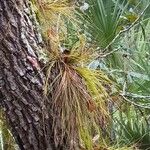
Tillandsia setacea
Southern needleleaf · Needle-leaved air plant
Description
Source: leafsnapTillandsia setacea, the southern needleleaf, is a species of flowering plant in the genus Tillandsia. It has a scattered, disjunct distribution in the southeastern United States (Florida, Georgia), northwestern and southern Mexico (Jalisco, Sinaloa, Nayarit, Chiapas, Oaxaca, Campeche), Guatemala, the West Indies (Cayman Islands, Cuba, Hispaniola, Jamaica, Puerto Rico) and the State of Pará in northeastern Brazil.
Care Guide
💧 Water
The Southern needleleaf plant, originating from tropical rainforests, thrives in high humidity environments. It requires balanced watering, needing water on a weekly basis. As an evergreen, it keeps its vibrant green leaves throughout the year. To ensure optimal growth indoors, it's important to maintain consistent humidity levels.
☀️ Light Full sun
Southern needleleaf comes from habitats such as forest understories that provide natural shade. It favors partial sunlight but can tolerate full sun if needed.
What are the sunlight requirements for Southern needleleaf?
Southern needleleaf, or Tillandsia setacea, thrives in environments that mimic its natural forest understory habitat, preferring partial sun but able to tolerate full sun when necessary. Full sun is defined as receiving above 6 hours of sunlight per day, while partial sun refers to getting about 3-6 hours of sunlight. It's important to watch how sunlight moves through your garden carefully, choosing spots that provide the right balance of light and shade to ensure the plants' happiness.
How does artificial lighting assist in the growth of indoor Southern needleleaf plants?
Indoor Southern needleleaf plants require adequate lighting for optimal growth, especially when natural sunlight is insufficient, such as in winter or less sunny spaces. Artificial lights, particularly LED lights which can be customized to provide specific wavelengths needed by the plant, offer a vital solution. Full sun plants need 30-50W/sq ft of artificial light, partial sun plants need 20-30W/sq ft, and full shade plants need 10-20W/sq ft. The artificial light source should be placed 12-36 inches above the plant to mimic natural sunlight, and the lights should be on for 8-12 hours per day to mimic natural daylight hours, promoting faster and healthier growth.
What are the symptoms of incorrect lighting for Southern needleleaf?
Symptoms of incorrect lighting in Southern needleleaf can vary, showing resilience to different light conditions. In low light, new leaves may grow smaller, and there can be leggy or sparse growth due to longer spaces between leaves or stems, making the plant look weak. Faster leaf drop, slower or no new growth, and lighter-colored new leaves are also signs of insufficient light. Conversely, symptoms like chlorosis, sunscald, leaf curling, wilting, and leaf scorching indicate excessive sunlight exposure. These conditions highlight the plant's struggles with either too much or too little light, impacting its overall health and appearance.
What solutions can be applied for Southern needleleaf experiencing light-related issues?
For Southern needleleaf experiencing light-related issues, indoor solutions include gradually moving plants to sunnier locations until they receive at least 6 hours of direct sunlight daily, preferably by a south-facing window. When natural light is not enough, artificial light, such as desk or ceiling lamps, should be used for at least 8 hours daily or investing in professional plant grow lights. For outdoor plants, moving them gradually to spots with better sunlight can help, but avoid drastic changes to prevent sunburn. Minimizing obstructions like pruning blocking trees and, for smaller plants, considering transplanting during their dormant period to a location with ample sunlight and good drainage can improve light access. It's noted that parts of the plant affected by insufficient sunlight might not recover, but new growth will be healthy with improved light exposure.
🌡️ Temperature 20–37.8°C
Southern needleleaf grows best in warm conditions. If temperatures fall too low, the plant may stop growing or suffer frost damage. It tolerates high heat and humidity well and needs a steady level of moisture in its surroundings. Nevertheless, very high temperatures and humidity can make it prone to fungal infections. In dry environments, regular watering and misting are required to keep the air humidity sufficient. The plant is sensitive to abrupt temperature changes, so maintaining a fairly stable temperature is important.
What are the essential care requirements for Southern needleleaf?
Southern needleleaf, botanically known as Tillandsia setacea, thrives in warm environments and requires a consistent level of moisture. It is tolerant of high temperatures and humidity but is susceptible to fungal infections if conditions are excessively humid. The plant needs regular watering and misting in dry conditions to maintain adequate air humidity. It's sensitive to sudden temperature changes, so maintaining a stable temperature is crucial. In winter, if temperatures drop below 5°C, it's recommended to move the plant indoors, preferably near a south-facing window, avoiding places near heaters or air conditioners to prevent excessive dryness. Indoor temperatures above 20°C are beneficial, and watering should be reduced if temperatures fall below this, waiting until the soil surface is dry before watering again to prevent root rot. For outdoor overwintering, ensure the plant is sheltered and consider using a temporary greenhouse or wrapping with plastic film or fabric, keeping the soil slightly moist.
How does low temperature affect Southern needleleaf and what are the solutions?
Southern needleleaf prefers warm environments and does not tolerate low temperatures well, thriving best when the temperature is above 20°C. During winter, it should be kept above 5°C to avoid damage. When the temperature falls below 1°C, the leaves may not show immediate symptoms, but after three to five days, they begin to wither and droop, and in severe cases, the entire plant may dry up. The solution is to trim any frostbitten areas and immediately move the plant to a warm indoor environment. Placing the plant near a south-facing window ensures ample sunlight, and it's important to avoid placements near heaters or air conditioning vents to prevent excessive air dryness.
What are the effects of high temperature on Southern needleleaf and how can it be managed?
During the summer, it's advised to keep Southern needleleaf below 41°C, as temperatures above 45°C can cause the leaves to dry and wither at the tips, stunt growth, and make the plant more susceptible to root rot. Excessive sunlight may also lead to sunburn. To manage high-temperature stress, remove the withered parts and relocate the plant to a shaded area, especially away from the midday and afternoon sun. It's best to water the plant in the morning and evening to keep both the plant and its environment moist.
💨 Humidity
🪴 Soil
🌱 Fertilizer
🪴 Pot & Repot
✂️ Pruning
The Southern needleleaf plant features thin, needle-like leaves and thrives in humid environments. To maintain its health, it's best to prune the plant in early spring, removing any dead or damaged leaves. Be sure to use sterile tools to prevent the spread of disease. This practice will improve air circulation and light penetration, reducing the risk of mold and pests. However, prune sparingly to avoid putting stress on the plant.
🌿 Propagating
🐛 Diseases & pets
☠️ Toxicity
Characteristics
- Plant Type
- Herb
- Life Cycle
- Perennial
- Genus
- Tillandsia
- Family
- Bromeliaceae
- Hardiness Zone
- 9-11
- Mature Height
- 10 cm to 20 cm
- Mature Spread
- 5 cm to 10 cm
- Leaf Color
- Green, Blue
- Leaf Type
- Evergreen
- Flower Color
- Purple, Lavender
- Flower Size
- 1.02 cm to 2.03 cm
- Bloom Time
- Summer
- Planting Time
- Summer, Autumn
- Harvest Time
- Late summer, Early fall, Mid fall
- Native Area
- Guatemala, Cuba, Jamaica