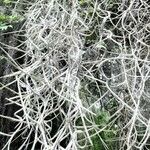
Tillandsia usneoides
خزه اسپانیایی · Old Man's Beard · Spanish moss · Vegetable hair
Description
Source: leafsnapTillandsia usneoides, commonly known as Spanish moss, is a flowering plant in the Bromeliaceae family. It is native to the southeastern United States, Mexico, Central America, and South America. Spanish moss is an epiphyte, meaning it grows on other plants without harming them, as it obtains nutrients from the air and rainwater. The plant has long, thin stems that can reach up to 20 feet in length and are covered in grayish-green scales. It produces small, yellow-green flowers that bloom from late spring through early summer. Historically, Spanish moss has been used for various purposes including home insulation and mattress stuffing. Additionally, it serves as a habitat for many animals, such as birds, insects, and small mammals. Spanish moss thrives in warm temperatures with high humidity levels but can tolerate drought conditions if necessary. It grows best in areas with filtered sunlight or partial shade. Overall, Tillandsia usneoides is an intriguing plant with unique characteristics, making it a popular choice among gardeners looking to diversify their plant collections or create a natural habitat for wildlife in their backyards.
💡 The air plant is unique as it is the only plant that grows entirely in air without being rooted in soil. This unusual growth method has become its most appealing feature in the market. Additionally, air plants can be creatively used to make plant frescoes, which is truly remarkable.
🌳 Although it appears delicate, spanish moss has strong fibers that were commercially harvested for use in mattress fillings, furniture coverings, and car seats. The plant fascinated historic societies because of its weaving potential. Florida's Seminole Indians once spun spanish moss into fine yarn up until the 1950s. It functions as a bioindicator of environmental cleanliness by absorbing heavy metals and pollutants.
🎭 Diverse
Care Guide
💧 Water Every 7 days
Spanish moss flourishes in humid environments and is also drought-tolerant. For optimal growth, it needs to be watered weekly. Since it is an epiphytic plant, it absorbs moisture from the air, which makes it perfect for indoor spaces with high humidity.
What should I do if I give too much water to Spanish moss?
Overwatering is a serious problem for Spanish moss because it can cause the stems and leaves to rot. Unlike other plants, overwatering primarily affects the center of the leaves, creating a waterlogged condition. This trapped water suffocates the leaves and provides a breeding ground for microorganisms. In fact, overwatering is the leading cause of death for Spanish moss as a houseplant. Outdoor Spanish moss is less susceptible to overwatering due to better ventilation. Symptoms of overwatering include darkened base, mushy roots, yellowing leaves, and leaf loss. If your Spanish moss shows signs of overwatering, remove the affected parts and dry the plant thoroughly. Place it on a dry surface with good air circulation, and consider using a fan if the plant is large enough. Once rot sets in, the Spanish moss will gradually decline and eventually die.
If Spanish moss doesn't get enough water, what should I do?
Knowing when to water the plant is indicated by certain signs. Look for wrinkles or loose rolling leaves. In more serious cases, the leaf tips may dry out and turn brown. When Spanish moss lacks water, it will have a droopy appearance. Continuous spraying or soaking can revive it. However, once the leaf tips turn brown, they cannot recover, making it crucial to establish a proper watering schedule.
How often do I need to water Spanish moss?
For most plants, misting three or four times a week is sufficient. However, if you live in a particularly dry area or if your plant seems to need more water, you should increase the frequency. As for Spanish moss, it is recommended to soak it in water for 30 minutes to 1 hour every 1-2 weeks. During the spring and fall, some people choose to soak it once a week, while in the summer they do it more often, and in winter less often. Of course, the specific watering needs may vary depending on your city's climate, but the differences are generally minimal. Once you've had the plants for a few weeks, you'll become familiar with their care requirements and be able to establish a watering schedule that suits them.
How do you give Spanish moss water?
Spanish moss absorbs water through its leaves, especially at night when water condenses on them. As a houseplant, you can replicate this by misting the leaves, making sure not to over spray and avoiding water accumulation in the center of the leaves. Water accumulation for more than 2-3 days can lead to bacterial growth and suffocation of the leaves. Using unchlorinated water, such as rainwater or stream/lake water, is best. Spanish moss derives nutrients from water, so giving it water with minerals and nutrients is recommended, rather than distilled water. Alternatively, you can water the plant by soaking it for 30 minutes to 1 hour, but be sure to dry the moss afterwards. In the summer or dry locations, more frequent soaking is needed. It's important to maintain the water temperature between 60 and 80 degrees Fahrenheit. You'll know it's time to water the plant when the leaves become wrinkled or loose. If the leaf tips turn brown, they cannot be revived. Factors like humidity, warmth, and air circulation also affect the watering schedule, with drier climates and air conditioning requiring more frequent watering.
How does Spanish moss find water in nature?
Spanish moss is a kind of plant that absorbs moisture from the humid air in its natural habitat. As houseplants, they are low-maintenance but require a watering approach that mimics their wild growth. Instead of using regular flower pots, Spanish moss thrives in rocky soil or when attached to the side of an object. Some options include placing them in coconut shells, large seashells, or even wireframes.
☀️ Light Partial sun
Spanish moss grows best with moderate sunlight but can also withstand intense sun or deep shade, illustrating its adaptability. This toughness is a result of the conditions in its native habitat. Still, long-term exposure to either extreme can impair its growth and vigor, so a balanced light level is preferable.
What are the sunlight requirements for Spanish moss?
Spanish moss thrives under moderate exposure to sunlight but can also endure both full sunlight and complete shade. It requires about 3-6 hours of sunlight daily for partial sun and above 6 hours for full sun or full shade. The adaptability of Spanish moss to different light conditions is attributed to its natural habitat conditions, although extreme prolonged exposure to full sun or shade may negatively impact its growth. Observing how sunlight moves through your garden to find the perfect balance of light and shade is advised to ensure the health and happiness of your plants.
How does artificial lighting support plant growth indoors?
Indoor plants, including Spanish moss, require adequate lighting for optimal growth, especially when natural sunlight is scarce, like in winter or less sunny spaces. Artificial lights, such as LED lights, offer an essential solution by providing the specific wavelengths of light needed for healthier, faster growth. The amount of artificial light needed varies by plant type: full sun plants need 30-50W/sq ft, partial sun plants need 20-30W/sq ft, and full shade plants need 10-20W/sq ft. The light source should be placed 12-36 inches above the plant, mimicking natural sunlight, and the light duration should replicate natural daylight hours, with most plants benefiting from 8-12 hours of light per day.
What are the symptoms of light deficiency in Spanish moss?
Symptoms of light deficiency in Spanish moss include slower or no new growth, where the plant enters survival mode, halting leaf production. Insufficient sunlight can lead to lighter-colored new leaves, indicating a lack of chlorophyll and essential nutrients. Chlorosis, sunscald, leaf curling, wilting, and leaf scorching are also possible symptoms. Chlorosis involves leaves losing their green color and turning yellow due to chlorophyll breakdown from excessive sunlight, affecting the plant's photosynthesis. Sunscald appears as pale, bleached, or necrotic areas on plant tissue. Leaf curling, a defense mechanism to minimize water loss and damage, wilting, and leaf scorching, characterized by brown, dry edges or patches on leaves, can also occur under extreme sunlight conditions.
How can you remedy Spanish moss's symptoms of light deficiency or overexposure?
To optimize plant growth and address symptoms of light deficiency or overexposure, gradually shifting plants to sunnier or appropriately shaded spots each week can be beneficial. For indoor plants, consider using artificial light sources, like desk or ceiling lamps for at least 8 hours daily, or invest in professional plant grow lights. For outdoor plants, a gradual change to a spot with better sunlight while avoiding sudden intensity changes helps prevent sunburn. If obstructions like trees block sunlight, pruning branches and leaves may help. For smaller plants, consider transplanting during their dormant period to a location with ample sunlight and good drainage. It's crucial to note that parts of the plant affected by insufficient sunlight may not recover, but new growth should be healthy after adjusting light exposure.
🌡️ Temperature 20–37.8°C
The spanish moss plant originates from warm regions where temperatures range from 20 to 38 ℃ (68 to 100.4 ℉). It grows best in moderate temperatures with high humidity. In summer it requires protection from direct sunlight and should be kept in a shaded area to avoid excessive heat.
What are the ideal growing conditions for Spanish moss?
Spanish moss thrives in warm regions, with optimal temperatures ranging from 20 to 38°C (68 to 100.4°F). It prefers moderate temperatures accompanied by high humidity. In summer, it's crucial to shield the plant from direct sunlight by placing it in a shaded area, as excessive heat can be detrimental. When winter approaches and temperatures drop below 5°C, it's advisable to move Spanish moss indoors. An ideal indoor spot would be near a south-facing window, avoiding proximity to heaters or air conditioners to prevent the air from becoming too dry. Keeping the indoor temperatures above 20°C benefits the plant, and watering should be reduced when temperatures fall below this mark. If the plant must remain outdoors during colder months, ensure it's in a sheltered position that receives sunlight and consider using a temporary greenhouse or wrapping to protect it.
How should I care for Spanish moss in low temperatures?
Spanish moss is sensitive to cold and thrives best above 20°C. It's essential to keep it above 5°C during winters. If temperatures dip below 1°C, the plant may not show immediate symptoms, but after a few days, leaves can begin to wither and droop, leading to potential drying up of the entire plant in severe conditions. To combat cold damage, trim the frost-bitten areas and move the plant to a warmer location indoors promptly. A spot near a south-facing window is preferable for ample sunlight. Also, ensure the plant is not placed near heaters or air conditioning vents to avoid excess dryness.
What should I do if my Spanish moss experiences high temperatures?
During hot summers where temperatures soar above 38°C, Spanish moss needs careful attention to prevent damage. High temperatures, especially exceeding 43°C, can cause the leaves to dry out, exhibit withered tips, halt growth, and increase the risk of root rot. Furthermore, too much direct sunlight might lead to sunburn. To alleviate these issues, remove any withered parts of the plant and relocate it to an area with shade, particularly during the midday and afternoon sun. It's also beneficial to water the plant during the cooler morning and evening hours to maintain moisture levels for both the plant and its surrounding environment.
💨 Humidity high (>60%)
This plant needs special care because it loves high humidity levels of 60-80% or more. The best way to achieve this is by placing a humidifier near the plant. Daily misting is also essential! Make sure the room has good ventilation.
🪴 Soil
🌱 Fertilizer
To care for Spanish moss, apply a balanced, water-soluble fertilizer at a quarter-strength once a month during the growing season to prevent over-fertilization. Discontinue fertilizing in the winter. To help the plant absorb nutrients without saturating its base, mist the fertilizer solution lightly. After application, keep the plant out of direct sunlight. Adjust the frequency of fertilization based on the plant’s growth and the changing seasons.
🪴 Pot & Repot
Air plants can grow well on many surfaces, such as shells, stones, and dead trees. You can creatively display them using wires or ropes, highlighting their adaptability to different environments.
✂️ Pruning
Spanish moss is an epiphytic bromeliad that thrives in humid conditions. To maintain its health and appearance, prune it in early spring by trimming only the brown strands to remove any dead material. This not only improves its appearance but also promotes healthy growth and prevents overcrowding. Be sure to use clean scissors to minimize damage and reduce the risk of disease.
🌿 Propagating
🐛 Diseases & pets
☠️ Toxicity
Spanish moss is not poisonous, and it has previously been used as a padding dressing for wounds as well as feed for horses and cattle. Spanish moss has a dry, stringy feel that makes it unpleasant to consume, although some animals, like cats, may find it to be alluring. Since pets can harm the plant, it is better to keep the long, hanging leaves out of sight.
Characteristics
- Plant Type
- Vine, Herb
- Life Cycle
- Perennial, Annual
- Genus
- Tillandsia
- Family
- Bromeliaceae
- Hardiness Zone
- 10-12
- Mature Height
- 0.1 m to 2.13 m
- Mature Spread
- 46 cm to 61 cm
- Leaf Color
- Green, Gray, Silver
- Leaf Type
- Evergreen
- Flower Color
- Green, Yellow, Blue
- Flower Size
- 2.54 cm
- Bloom Time
- Early summer, Mid summer
- Planting Time
- Spring, Summer
- Harvest Time
- Mid summer, Late summer
- Native Area
- Belize, Honduras, Mexico, Guatemala, Peru, Panama, Jamaica, Colombia, Bahamas, Cuba, Bolivia, Venezuela, Brazil, Guyana, El Salvador, Nicaragua, Ecuador, Costa Rica