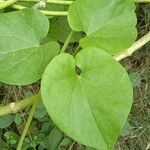
Tinospora crispa
Makabuhai
Description
Source: leafsnapTinospora crispa, also known as the "heart-leaved moonseed," is a perennial climbing vine belonging to the Menispermaceae family. Native to Southeast Asia, it is commonly found in countries such as Malaysia, Indonesia, and Thailand. The plant features heart-shaped leaves that are green on top and pale underneath, and it produces small, yellow-green flowers that bloom in clusters during the summer months. Tinospora crispa has been utilized for centuries in traditional medicine for its numerous health benefits. The plant contains several bioactive compounds, including alkaloids, flavonoids, and terpenoids, which have been found to possess anti-inflammatory, antioxidant, and antidiabetic properties, among others. The stem of Tinospora crispa is often used in traditional medicinal preparations, such as teas or decoctions, for treating various ailments including fever and digestive disorders like diarrhea and constipation. It has also been used topically on wounds or skin infections due to its antimicrobial properties. Overall, Tinospora crispa is a valuable medicinal plant with potential therapeutic benefits that continue to be studied by researchers today.
Care Guide
💧 Water Every 7 days
Makabuhai thrives in drier conditions and requires minimal watering, about once every three weeks. Its drought-resistant nature makes it an excellent low-maintenance plant. While commonly grown outdoors, makabuhai also does well in containers, which allows for easy monitoring and adjustment of its water intake based on the climate.
☀️ Light Partial sun
Makabuhai occurs naturally in habitats like forest understories or rocky locations, where it grows in natural shade. It favors partial sun but can tolerate both full sun and full shade, showing its hardy and adaptable nature.
What are the sunlight requirements for Makabuhai?
Makabuhai (Tinospora crispa) thrives in environments that replicate its native forest understories or rocky areas, which means it prefers partial sun, benefiting from about 3-6 hours of sunlight a day. However, it can also grow in full sun, where it receives more than 6 hours of sunlight, and is tolerant of full shade conditions. It's important to observe the movement of sunlight in your garden to choose spots that offer an optimal balance for the plant's health.
How can I provide adequate lighting for indoor Makabuhai plants?
For indoor Makabuhai plants, when natural sunlight is not sufficient, artificial lighting becomes crucial for maintaining optimal growth. LEDs are a preferred option as they can be tailored to the plant's specific needs, with full sun plants requiring 30-50 W/sq ft, partial sun plants needing 20-30 W/sq ft, and full shade plants 10-20 W/sq ft of artificial light. The light source should be positioned 12-36 inches above the plant, mimicking natural sunlight for 8-12 hours per day to ensure healthy growth.
What are symptoms of insufficient light in Makabuhai?
Makabuhai may display several symptoms when light conditions are insufficient, including new leaves growing smaller in size, leggy or sparse growth, faster leaf drop, slowed or halted growth, paler new leaves, and chlorosis, which is the yellowing of leaves due to a lack of chlorophyll. Additionally, excessive sunlight can cause sunscald, leaf curling, wilting, and leaf scorching, indicating a need to adjust the plant's light exposure.
What solutions can help improve light conditions for Makabuhai?
To optimize growth for Makabuhai, gradually increase sunlight exposure by moving the plant to sunnier spots each week until it receives 3-6 hours of direct sunlight daily. If the plant is large or not easily movable, consider using artificial light, like a desk or ceiling lamp for at least 8 hours daily, or invest in professional plant grow lights. For outdoor plants, avoid sudden changes in light intensity to prevent sunburn. Minimize obstructions by pruning or relocating the plant to a sunnier location, especially during its dormant period in late winter or early spring, to ensure healthy new growth after adjusting light exposure.
🌡️ Temperature 20–37.8°C
Makabuhai comes from tropical areas, where the climate is generally warm and humid. As a result, it is adapted to high temperatures and moisture. It is sensitive to sudden temperature changes and prefers a stable temperature environment, so indoor temperature fluctuations should be avoided. It typically does not tolerate cold and needs warmer conditions to grow; if temperatures fall too low, the plant may stop growing or even die.
What is Makabuhai?
Makabuhai, also known by its botanical name Tinospora crispa, is a plant recognized for its various uses and benefits. Unfortunately, the provided information does not include details about the essentials or symptoms related to Makabuhai, nor any additional information.
💨 Humidity
🪴 Soil 5-6
🌱 Fertilizer
Fertilizing is essential for Makabuhai's care. Regular feeding during the growing season replenishes energy for its showy leaves and supports overall development. Failing to fertilize can lead to unhealthy leaves, reduced ornamental value, and stunted or weak growth that is prone to breaking.
🪴 Pot & Repot
✂️ Pruning
Makabuhai is known for its heart-shaped leaves and medicinal properties. Pruning in early spring is crucial, as it helps remove dead or weak growth and allows for shaping and thinning the plant to improve air circulation. Using clean, sharp tools is important to prevent disease, which in turn promotes healthier growth and ensures better access to light and nutrients.
🌿 Propagating
🐛 Diseases & pets
☠️ Toxicity
Characteristics
- Plant Type
- Vine
- Life Cycle
- Perennial
- Genus
- Tinospora
- Family
- Menispermaceae
- Hardiness Zone
- 10-12
- Mature Height
- 10.06 m
- Mature Spread
- 30 cm
- Leaf Color
- Green
- Leaf Type
- Deciduous
- Flower Color
- Yellow, Green
- Flower Size
- 5.08 cm to 10.16 cm
- Bloom Time
- All year round
- Planting Time
- Spring, Summer, Autumn
- Harvest Time
- All year round
- Native Area
- Sri Lanka, India, Malaysia, Indonesia, Cambodia, Vietnam, Myanmar, Philippines, Bangladesh, Laos, Thailand, China